
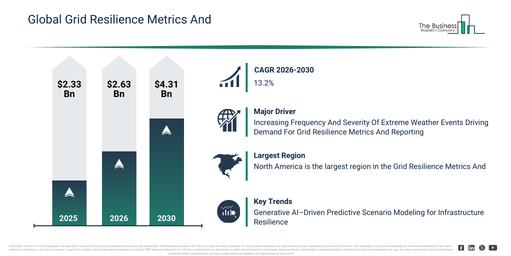
Grid Resilience Metrics And Reporting Market Size Forecast: How The Industry Is Expected To Grow From 2026 To 2030
Backed by market attractiveness analysis, total addressable market sizing, company benchmarking matrices, interactive Excel dashboards, wider supply chain intelligence, emerging startup coverage, and detailed product-level insights, The Business Research Company’s 2026 market reports are designed to offer research that is more actionable and strategically valuable than ever.
Grid Resilience Metrics And Reporting Market Expansion Outlook: What Revenue Opportunities Are Ahead?
The grid resilience metrics and reporting market has seen swift expansion in recent years. Its value is expected to increase from $2.33 billion in 2025 to $2.63 billion in 2026, reflecting a compound annual growth rate (CAGR) of 12.9%. Historically, this market’s expansion was fueled by intensified regulatory examination of grid reliability, the proliferation of outage reporting mandates, the integration of reliability indicators, the development of performance benchmarking techniques, and the initial implementation of reporting software.
The market size for grid resilience metrics and reporting is projected to experience substantial growth in the upcoming years. It is forecast to grow to $4.31 billion in 2030, exhibiting a compound annual growth rate (CAGR) of 13.2%. This expansion during the forecast period can be attributed to a heightened focus on climate resilience accountability, increased investments in grid modernization reporting, the broadening of equity-focused resilience metrics, a rising adoption of data-driven regulatory frameworks, and an increasing demand for clear utility performance disclosure. Dominant trends during the forecast period include the wider adoption of standardized resilience performance metrics, a surging demand for regulatory compliance reporting tools, an expanding use of real-time reliability dashboards, the development of more extensive risk and stress testing frameworks, and an enhanced emphasis on transparent grid performance reporting.
Get A Free Sample Report With In-Depth Market Insights:
Grid Resilience Metrics And Reporting Market Demand Drivers Opening New Revenue Streams
The market for grid resilience metrics and reporting is projected to expand due to the escalating occurrence and intensity of extreme weather events. Events like hurricanes, floods, heatwaves, wildfires, and severe storms exert considerable pressure on power grid infrastructure, resulting in power outages, equipment damage, and interruptions in service. This surge in the frequency and intensity of extreme weather is attributed to climate change, which stems from increased greenhouse gas emissions originating from human activities. Solutions for grid resilience metrics and reporting enable utilities to assess, track, and determine how well power systems can endure, react to, and bounce back from such incidents. An example is provided by Climate.gov, a US climate and weather data platform managed by the national oceanic and atmospheric administration, which reported in January 2024 that billion-dollar weather and climate disasters in the United States saw a year-over-year rise, increasing from 18 disasters in 2022 to 28 disasters in 2023, thereby highlighting the accelerating rate of significant climate occurrences. Consequently, the amplified frequency and severity of extreme weather events are fueling the expansion of the grid resilience metrics and reporting market.
Grid Resilience Metrics And Reporting Market Segments: Where Is Growth Concentrated?
The grid resilience metrics and reporting market covered in this report is segmented –
1) By Component: Software; Hardware; Services
2) By Deployment Mode: On-Premises; Cloud
3) By Metric Type: Reliability Metrics; Recovery Metrics; Adaptation Metrics; Performance Metrics; Other Metric Types
4) By Application: Utilities; Government Agencies; Industrial; Commercial; Residential; Other Applications
5) By End User: Energy And Utilities; Transportation; Manufacturing; Information Technology And Telecommunications; Other End Users
Subsegments:
1) By Software: Resilience Analytics Platforms; Reporting And Dashboard Tools; Data Integration And Management Software; Risk Modeling And Simulation Software
2) By Hardware: Grid Monitoring Sensors; Intelligent Meters; Communication Devices; Data Acquisition Equipment
3) By Services: Consulting And Advisory Services; System Integration Services; Maintenance And Support Services; Training And Implementation Services
Grid Resilience Metrics And Reporting Market Trends Powering Strategic Industry Growth
Companies operating within the grid resilience metrics and reporting market are concentrating on technological advancements in generative artificial intelligence for predictive resilience scenario modeling. This focus includes generative AI-enhanced platforms designed for predictive maintenance and scenario generation, which improve forecasting, anomaly detection, and operational planning. Such platforms represent advanced digital solutions that integrate machine learning, generative artificial intelligence, and data analytics to anticipate equipment failures and simulate operational scenarios before they manifest. As an example, in 2024, Siemens Aktiengesellschaft, an industrial technology company from Germany, introduced generative AI capabilities into its senseye predictive maintenance software. This innovation augments traditional machine learning with generative AI to offer conversational predictive insights, automated pattern recognition, and context-aware recommendations. This enables utilities and asset managers to proactively identify system weaknesses and plan resilience actions, fostering data-driven decisions that decrease downtime, optimize asset performance, and reinforce overall grid reliability and resilience.
Grid Resilience Metrics And Reporting Market Leading Players And Competitive Positioning
Major companies operating in the grid resilience metrics and reporting market are Microsoft Corporation, Siemens Aktiengesellschaft (Siemens AG), International Business Machines Corporation (IBM), Cisco Systems Inc., Oracle Corporation, Oracle Corporation, Schneider Electric SE, Mitsubishi Electric Corporation, Honeywell International Inc., ABB Ltd., Eaton Corporation plc, Hitachi Energy Ltd., Quanta Technology LLC, Emerson Electric Co., CGI Inc., Itron Inc., Landis+Gyr Group AG, Schweitzer Engineering Laboratories Inc., Bentley Systems Incorporated, Aspen Technology Inc.
View The Full Grid Resilience Metrics And Reporting Market Report:
Grid Resilience Metrics And Reporting Market Regional Split: Which Areas Are Fueling Growth?
North America was the largest region in the grid resilience metrics and reporting market in 2025. Asia-Pacific is expected to be the fastest-growing region in the forecast period. The regions covered in the grid resilience metrics and reporting market report are Asia-Pacific, South East Asia, Western Europe, Eastern Europe, North America, South America, Middle East, Africa.
Reach Out To Our Team:
The Business Research Company: https://www.thebusinessresearchcompany.com/
Americas: +1 310-496-7795
Asia: +44 7882 955267 & +91 8897263534
Europe: +44 7882 955267
Email us at: marketing@tbrc.info
Follow us on:
LinkedIn: https://in.linkedin.com/company/the-business-research-company
YouTube: https://www.youtube.com/channel/UC24_fI0rV8cR5DxlCpgmyFQ
Global Market Model: https://www.thebusinessresearchcompany.com/global-market-model
[KClientError] [REQ_ERR: OPERATION_TIMEDOUT] [KTrafficClient] Something is wrong.