Hernia Mesh Devices Market Analysis: Understanding The Drivers Behind 4.9% CAGR Through 2030 Growth
Featuring market attractiveness scoring, total addressable market sizing, company benchmarking matrices, interactive Excel dashboards, deeper supply chain intelligence, emerging startup tracking, and granular product-level insights, The Business Research Company’s 2026 market reports are built to deliver research that is both more actionable and more strategically valuable.
Hernia Mesh Devices Market Forecast: What Value Will The Market Reach By 2030?
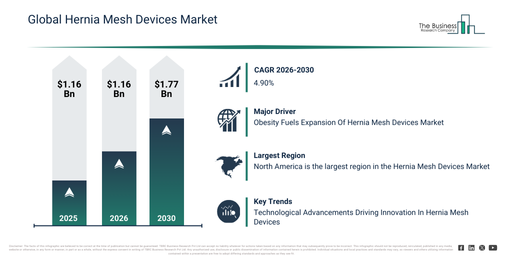
The market for hernia mesh devices has shown consistent expansion over recent years. This market is projected to expand from $4.51 billion in 2025 to reach $4.73 billion in 2026, exhibiting a compound annual growth rate (CAGR) of 4.9%. Historically, this growth has stemmed from factors such as the increasing occurrence of abdominal and inguinal hernias, an uptick in surgical procedures for hernia repair, greater acceptance of synthetic mesh products, advancements in surgical methods, and the development of hospital surgical facilities.
The hernia mesh devices market size is anticipated to experience consistent expansion over the upcoming years. This market is projected to reach $5.73 billion by 2030, exhibiting a compound annual growth rate (CAGR) of 4.9%. This projected growth during the forecast period stems from several factors, including an escalating demand for sophisticated biocompatible mesh options, the increasing uptake of robotic-assisted hernia operations, a heightened emphasis on customized mesh designs for patients, the expansion of surgical procedures performed on an outpatient basis, and greater investments in surgical advancements. Key trends expected within this period encompass the wider acceptance of lightweight and composite mesh materials, a growing inclination towards minimally invasive hernia repair techniques, the increased application of biologic mesh for intricate hernia instances, the proliferation of laparoscopic and robotic hernia interventions, and a stronger commitment to lowering recurrence and infection rates.
Get A Free Sample Report With In-Depth Market Insights:
Hernia Mesh Devices Market Growth Momentum: What Factors Are Shaping Demand?
The increasing obese population is projected to fuel the expansion of the hernia mesh devices market going forward. Obesity refers to an abnormal or excessive fat buildup that adversely affects individual health and elevates the likelihood of abdominal wall weakness. The prevalence of obesity is increasing as more individuals adopt sedentary lifestyles and unhealthy dietary habits, thereby contributing to higher hernia risks. Hernia mesh devices assist obese individuals by offering stronger, more durable reinforcement, which reduces recurrence rates and improves recovery compared to traditional suture repairs. For instance, in May 2025, according to the Office for Health Improvement & Disparities, a UK-based government department, an estimated 64.5% of adults aged 18 and over in England were overweight or living with obesity between 2023 and 2024, a slight rise from 64.0% observed from 2022 to 2023. Therefore, the expanding obese population is driving the growth of the hernia mesh devices market.
Hernia Mesh Devices Market Segments: Where Is Growth Concentrated?
The hernia mesh devices market covered in this report is segmented –
1) By Mesh Type: Biologic Mesh, Synthetic Mesh
2) By Procedure: Open Surgeries, Laparoscopic Surgeries, Robotic Surgeries
3) By Hernia Type: Incisional Hernia, Umbilical Hernia, Inguinal Hernia, Femoral Hernia, Other Hernia Types
4) By End User: Hospitals, Clinics, Ambulatory Surgical Centers, Other End Users
Subsegments:
1) By Biologic Mesh: Human-Derived Biologic Mesh, Animal-Derived Biologic Mesh
2) By Synthetic Mesh: Polyester Mesh, Polypropylene Mesh, ePTFE (Expanded Polytetrafluoroethylene) Mesh, Composites Mesh
Hernia Mesh Devices Market Trends Redefining Industry Growth
Key companies within the hernia mesh devices market are increasingly prioritizing technological advancements, particularly through innovations like tri-layer hybrid preperitoneal biomaterials. These materials are engineered to merge the enduring strength of synthetic components with a biointegrative design, thereby enhancing reinforcement, reducing the risk of recurrence, and improving handling efficiency during both minimally invasive and open hernia repair surgeries. The integrated multi-layer structure of tri-layer hybrid preperitoneal biomaterials delivers robust support, facilitates fluid absorption, and ensures conformability, allowing surgeons to achieve secure placement and effective bridging in complex hernia repairs. For example, in April 2025, W. L. Gore & Associates, a US-based medical materials and device company, launched its GORE SYNECOR Preperitoneal Biomaterial across Europe, the Middle East, and South Africa. This product is characterized by its flexible, conformable construction and material memory for easy unrolling, requires no pre-soaking, and is suitable for laparoscopic, robotic, and open surgical procedures, thus expanding the company’s offerings with a unique option designed to minimize hernia recurrence and streamline surgical handling.
Hernia Mesh Devices Market Leading Players And Competitive Positioning
Major companies operating in the hernia mesh devices market are Johnson & Johnson Services Inc., Medtronic plc, Betatech Medical, Ethicon Inc., B. Braun Melsungen AG, W.L. Gore & Associates Inc., Cook Medical Inc., Samyang Corporation, Integra Life Sciences Pvt. Ltd., LifeCell Corporation, Meril Life Sciences Pvt Ltd., Sinolinks Medical Innovation Inc, Aspide Medical S.A.S, C.R. Bard Inc., Bard Inc., Deep Blue Medical Inc., Changzhou Medical Equipment General Factory Co. Ltd., Katsan Katgut Sanayi ve Tic. A.S., BioCer Entwicklungs-GmbH, Dipromed S.r.l., Herniamesh S.r.l., Novus Scientific AB, Gem S.r.l., Primequal SA
View The Full Hernia Mesh Devices Market Report:
Hernia Mesh Devices Market Regional Split: Which Areas Are Fueling Growth?
North America was the largest region in the hernia mesh devices market in 2025. Asia-Pacific is expected to be the fastest-growing region in the forecast period. The regions covered in the hernia mesh devices market report are Asia-Pacific, South East Asia, Western Europe, Eastern Europe, North America, South America, Middle East, Africa.
Reach Out To Our Team:
The Business Research Company: https://www.thebusinessresearchcompany.com/
Americas: +1 310-496-7795
Asia: +44 7882 955267 & +91 8897263534
Europe: +44 7882 955267
Email us at: marketing@tbrc.info
Follow us on:
LinkedIn: https://in.linkedin.com/company/the-business-research-company
YouTube: https://www.youtube.com/channel/UC24_fI0rV8cR5DxlCpgmyFQ
Global Market Model: https://www.thebusinessresearchcompany.com/global-market-model