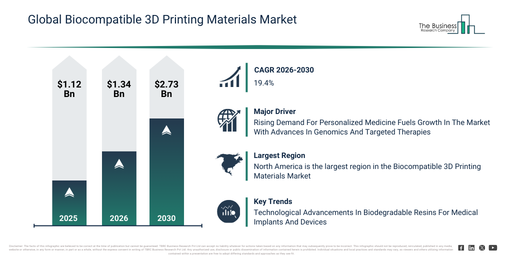
Biocompatible 3D Printing Materials Market Revenue Expected to Reach $2.72 Billion by 2030 with 19.4% CAGR
The Business Research Company’s 2026 market reports include new capabilities such as market attractiveness scoring and analysis, total addressable market analysis, company scoring matrix, interactive excel data dashboard, improved supply chain analysis, upcoming startups in the market, and overview of key products, aimed at improving the depth, usability, and strategic value of the insights delivered.
How Much Is The Biocompatible 3D Printing Materials Market Expected To Grow In Terms Of Market Value Between 2026 And 2030?
The biocompatible 3d printing materials market has experienced rapid expansion in recent years. It is forecast to increase from $1.12 billion in 2025 to $1.34 billion in 2026, exhibiting a compound annual growth rate (CAGR) of 19.7%. The historical growth of this market can be attributed to several factors, including advancements in additive manufacturing technologies, the growing utilization of 3d printed medical devices, the expansion of research within tissue engineering, the availability of medical-grade polymers, and the increasing adoption of customized implants.
The biocompatible 3d printing materials market size is anticipated to experience substantial growth over the next few years, with projections indicating it will reach $2.73 billion by 2030, propelled by a compound annual growth rate (CAGR) of 19.4%. This expansion during the forecast period is primarily driven by factors such as increased investments in regenerative medicine, a growing need for personalized healthcare solutions, the expansion of hospital-based 3d printing labs, broader adoption of bio-inks and hydrogels, and technological enhancements in multi-material printing. Significant trends expected in the forecast period include the increasing use of biodegradable printing materials, a rise in patient-specific implant printing, escalating demand for tissue engineering scaffolds, the widening scope of medical 3d printing applications, and an enhanced emphasis on material biocompatibility.
Download the Free Sample Report to Explore Key Market Insights:
https://www.thebusinessresearchcompany.com/sample.aspx?id=21324&type=smp
Which Growth Drivers Are Contributing To The Progress Of The Biocompatible 3D Printing Materials Market?
The rising demand for personalized medicine is projected to drive the growth of the biocompatible 3D printing materials market. Personalized medicine refers to a medical approach that customizes treatments and therapies based on an individual’s genetic, environmental, and lifestyle factors to achieve better healthcare outcomes. This increased demand for personalized medicine is attributed to advancements in genomics, molecular diagnostics, and AI-driven data analysis, which facilitate tailored treatments based on individual genetic profiles, thereby improving efficacy and reducing adverse effects. Biocompatible 3D printing materials enable personalized medicine by allowing the fabrication of patient-specific implants, prosthetics, and tissue scaffolds, enhancing treatment precision, biocompatibility, and overall patient outcomes. For instance, in February 2024, the Personalized Medicine Coalition, a US-based non-profit organization, reported that in 2023, the FDA approved 16 new personalized treatments for rare disease patients, an increase from six in 2022. Among these approvals, seven were cancer drugs, while three targeted other diseases and conditions. Thus, the increasing demand for personalized medicine is a key driver for the growth of the biocompatible 3D printing materials market.
What Major Segment Divisions Exist Within The Biocompatible 3D Printing Materials Market?
The biocompatible 3d printing materials market covered in this report is segmented –
1) By Product Type: Polymer, Metal, Other Product Types
2) By Printing Technology: Fused Deposition Modeling (FDM), Selective Laser Sintering (SLS), Stereolithography (SLA), Multi-Jet Modeling (MJM)
3) By Property: Biocompatibility, Strength, Durability, Porosity, Flexibility
4) By Form: Powder, Liquid, Other Forms
Subsegments:
1) By Polymer: Biodegradable Polymers, Photopolymer Resins, Thermoplastic Polymers
2) By Metal: Titanium And Titanium Alloys, Stainless Steel, Cobalt-Chrome Alloys
3) By Other Product Types: Ceramic-Based Materials, Bio-Ink And Hydrogels, Composite Materials
What Key Trends Are Influencing The Development Of The Biocompatible 3D Printing Materials Market?
Leading companies operating within the biocompatible 3D printing materials market are concentrating on developing innovative products, such as biodegradable resin for light-based (bio)printing, to bolster sustainability and expand their uses in medical and tissue engineering. This biodegradable resin for light-based (bio)printing is a photocurable substance employed in 3D printing techniques like stereolithography (SLA), digital light processing (DLP), or two-photon polymerization (TPP). For instance, in June 2024, BIO INX BV, a Belgium-based bioprinting materials company, introduced DEGRES INX, the first biodegradable and biocompatible resin featuring shape memory properties for light-based (bio)printing. This advanced material allows for deformation into a temporary shape after 3D printing and subsequently returns to its original form when subjected to body temperature, thereby enabling innovative applications in biomedical engineering. This breakthrough supports the creation of smart medical implants and tissue scaffolds, establishing a path for next-generation bioprinting applications.
Which Companies Are Leading Innovation In The Biocompatible 3D Printing Materials Market?
Major companies operating in the biocompatible 3d printing materials market are 3D Systems, Stratasys, EOS GmbH, Formlabs, Carbon Inc., Materialise NV, Lithoz GmbH, SINTX Technologies Inc., UpNano GmbH, Liqcreate, Boston Micro Fabrication, Organovo Holdings Inc., Aspect Biosystems, Poietis SA, Advanced BioMatrix Inc., BioInk Solutions Inc., Markforged Inc., Detax GmbH Co KG, RegenHU, Nanoscribe GmbH, Regemat 3D, Xilloc Medical
Read the full biocompatible 3d printing materials market report here:
What Are The Leading Geographic Regions In The Biocompatible 3D Printing Materials Market?
North America was the largest region in the biocompatible 3D printing materials market in 2025. Asia-Pacific is expected to be the fastest-growing region in the forecast period. The regions covered in the biocompatible 3d printing materials market report are Asia-Pacific, South East Asia, Western Europe, Eastern Europe, North America, South America, Middle East, Africa.
Request A Tailored Biocompatible 3D Printing Materials Market Research Report For Competitive Advantage:
https://www.thebusinessresearchcompany.com/customise?id=21324&type=smp
Browse Through More Reports Similar to the Global Biocompatible 3D Printing Materials Market 2026, By The Business Research Company
3D Printing In Healthcare Global Market Report
https://www.thebusinessresearchcompany.com/report/3d-printing-in-healthcare-global-market-report
3D Printed Medical Devices Global Market Report
https://www.thebusinessresearchcompany.com/report/3d-printed-medical-devices-global-market-report
3D Bioprinting Global Market Report
https://www.thebusinessresearchcompany.com/report/3d-bioprinting-global-market-report
Get in touch with us:
The Business Research Company: https://www.thebusinessresearchcompany.com/
Americas +1 310-496-7795
Asia +44 7882 955267 & +91 8897263534
Europe +44 7882 955267
Email us at info@tbrc.info
Follow us on:
LinkedIn: https://in.linkedin.com/company/the-business-research-company
YouTube: https://www.youtube.com/channel/UC24_fI0rV8cR5DxlCpgmyFQ
Global Market Model: https://www.thebusinessresearchcompany.com/global-market-model