Backed by market attractiveness analysis, total addressable market sizing, company benchmarking matrices, interactive Excel dashboards, wider supply chain intelligence, emerging startup coverage, and detailed product-level insights, The Business Research Company’s 2026 market reports are designed to offer research that is more actionable and strategically valuable than ever.
Implantable Cardioverter Defibrillators (ICDs) Market Expansion Outlook: What Revenue Opportunities Are Ahead?
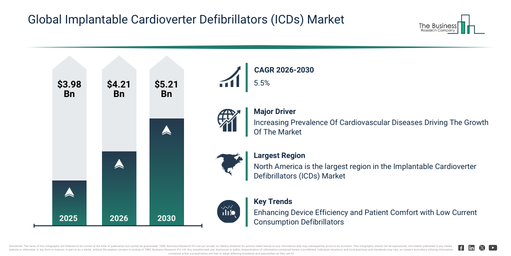
The market for implantable cardioverter defibrillators (ICDs) has demonstrated vigorous growth in recent years. Its valuation is set to climb from $3.98 billion in 2025 to $4.21 billion in 2026, achieving a compound annual growth rate (CAGR) of 5.7%. The expansion observed historically is attributable to factors such as an escalating incidence of sudden cardiac arrest, the increasing prevalence of ventricular arrhythmias, confirmed clinical efficacy of ICDs, their rising adoption among high-risk cardiac patients, and the broadening infrastructure for cardiac care.
The implantable cardioverter defibrillators (ICDs) market size is projected to experience robust expansion over the next few years. It is expected to grow to $5.21 billion by 2030, achieving a compound annual growth rate (CAGR) of 5.5%. This growth in the forecast period can be attributed to advancements in smart ICD technology, increasing demand for remote patient monitoring, a growing elderly population suffering from cardiac disorders, enhanced awareness of preventive cardiac therapies, and expanded reimbursement coverage for implantable devices. Prominent trends anticipated in the forecast period include the increasing adoption of remote monitoring-enabled ICDs, a rising preference for minimally invasive and wireless ICD systems, expanding use of MRI-compatible implantable devices, broadening indications of ICDs in heart failure management, and increased integration of predictive analytics in arrhythmia management.
Get A Free Sample Report With In-Depth Market Insights:
Implantable Cardioverter Defibrillators (ICDs) Market Growth Backed By Core Demand Fundamentals
The rising occurrence of cardiovascular diseases (CVDs) is anticipated to drive the expansion of the implantable cardioverter defibrillators (ICDs) market in the future. These diseases encompass various conditions impacting the heart and blood vessels, such as heart attacks, strokes, and hypertension, frequently resulting from elements like unhealthy eating habits, insufficient physical activity, smoking, and genetic predispositions. The growing incidence of cardiovascular diseases is predominantly fueled by an aging demographic, detrimental lifestyle decisions, and an escalation in risk factors including obesity, diabetes, and hypertension. Implantable cardioverter defibrillators (ICDs) aid in managing cardiovascular diseases (CVDs) by delivering critical electrical impulses to normalize heart rhythms for individuals susceptible to sudden cardiac arrest. As an illustration, data from October 2024, released by the Centers for Disease Control and Prevention (CDC), a US-based public health agency, indicated that 919,032 people succumbed to cardiovascular disease in 2023, representing roughly 1 in every 3 deaths across the United States. Consequently, the expanding occurrence of cardiovascular diseases (CVDs) is stimulating the development of the implantable cardioverter defibrillators (ICDs) market.
Implantable Cardioverter Defibrillators (ICDs) Market Segment Landscape And Growth Outlook
The implantable cardioverter defibrillators (icds) market covered in this report is segmented –
1) By Type: Single Chamber Implantable Cardioverter Defibrillators (ICDs), Dual Chamber Implantable Cardioverter Defibrillators (ICDs), Biventricular Devices
2) By Application: Bradycardia, Tachycardia, Heart Failure, Other Applications
3) By End User: Hospitals, Specialty Clinics, Ambulatory Surgical Centers, Other End Users
Subsegments:
1) By Single Chamber Implantable Cardioverter Defibrillators (ICDs): Standard Single Chamber ICDs, MRI-Compatible Single Chamber ICDs, Wireless Single Chamber ICDs
2) By Dual Chamber Implantable Cardioverter Defibrillators (ICDs): Standard Dual Chamber ICDs, MRI-Compatible Dual Chamber ICDs, Wireless Dual Chamber ICDs
3) By Biventricular Devices: CRT-D (Cardiac Resynchronization Therapy Defibrillator), Biventricular ICDs With Advanced Features (Remote Monitoring, Wireless Capabilities)
Implantable Cardioverter Defibrillators (ICDs) Market Growth Trends Reshaping The Competitive Landscape
Leading firms within the implantable cardioverter defibrillators (ICDs) market are prioritizing technological innovations, specifically low current consumption defibrillators, with the aim of boosting device efficiency, prolonging battery life, and elevating patient comfort. These low current consumption defibrillators are engineered to administer electrical impulses to the heart with reduced energy requirements, thereby contributing to extended battery longevity while still effectively managing arrhythmias. As an illustration, in October 2023, MicroPort CRM, a medical devices company based in France, introduced the ULYS implantable cardioverter defibrillator (ICD) and the INVICTA defibrillation lead in Japan, representing a significant stride forward in cardiac care technology. Such devices incorporate cutting-edge features, including minimal current draw for extended battery duration and MRI compatibility, making them appropriate for individuals who require imaging procedures. The ULYS ICD specifically integrates the PARAD+ arrhythmia discrimination algorithm and AutoMRI functionality, which collectively improve patient safety during magnetic resonance imaging scans. Furthermore, the INVICTA lead demonstrated a 100% implantation success rate and a 97.4% complication-free rate during clinical trials, underscoring its dependable performance and efficacy.
Implantable Cardioverter Defibrillators (ICDs) Market Competitive Landscape: Who Leads The Industry?
Major companies operating in the implantable cardioverter defibrillators (icds) market are Abbott Laboratories, Medtronic Inc., Boston Scientific Corporation, St. Jude Medical Inc., BIOTRONIK SE & Co. KG, LivaNova PLC, MicroPort Scientific Corporation, Intermedics Inc., Sorin Group S.p.A.
View The Full Implantable Cardioverter Defibrillators (ICDs) Market Report:
Implantable Cardioverter Defibrillators (ICDs) Market Regional Analysis And Top Geography
North America was the largest region in the implantable cardioverter defibrillators market in 2025. Asia-Pacific is expected to be the fastest-growing region in the forecast period. The regions covered in the implantable cardioverter defibrillators (icds) market report are Asia-Pacific, South East Asia, Western Europe, Eastern Europe, North America, South America, Middle East, Africa.
Reach Out To Our Team:
The Business Research Company: https://www.thebusinessresearchcompany.com/
Americas: +1 310-496-7795
Asia: +44 7882 955267 & +91 8897263534
Europe: +44 7882 955267
Email us at: marketing@tbrc.info
Follow us on:
LinkedIn: https://in.linkedin.com/company/the-business-research-company
YouTube: https://www.youtube.com/channel/UC24_fI0rV8cR5DxlCpgmyFQ
Global Market Model: https://www.thebusinessresearchcompany.com/global-market-model