
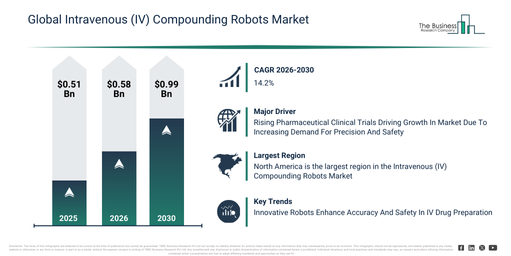
Intravenous (IV) Compounding Robots Market Forecast Highlights Expansion From $0.58 Billion To $0.99 Billion Through 2030
Enhanced with market attractiveness analysis, total addressable market evaluation, company benchmarking matrices, interactive Excel dashboards, expanded supply chain intelligence, emerging startup coverage, and detailed product insights, The Business Research Company’s 2026 market reports deliver more actionable and strategically valuable research.
Intravenous (IV) Compounding Robots Market Value Analysis: What Growth Is Expected Over The Forecast Period?
The intravenous (IV) compounding robots market size has seen substantial growth in recent years. It is expected to increase from $0.51 billion in 2025 to $0.58 billion in 2026, at a compound annual growth rate (CAGR) of 14.5%. The expansion witnessed in the past can be ascribed to an intensified focus on medication safety in hospitals, the rising frequency of chemotherapy drug preparation, the increasing integration of pharmacy automation systems, the proliferation of centralized hospital pharmacies, and the growing necessity to minimize human compounding errors.
The intravenous (IV) compounding robots market is anticipated to experience substantial expansion over the coming years, reaching $0.99 billion by 2030, demonstrating a compound annual growth rate (CAGR) of 14.2%. This projected growth stems from several factors, including the increasing need for secure handling of hazardous drugs, the rising implementation of automated sterile compounding practices, greater investments in hospital automation systems, the expansion of oncology treatment facilities, and an increased demand for improved operational efficiency within pharmacy processes. Key developments expected during this period involve technological breakthroughs in robotic drug compounding, progress in artificial intelligence (AI)-powered dose verification, advancements in closed system transfer integration, intensified research and development efforts in precision pharmacy robotics, and novel real-time monitoring and quality assurance solutions.
Download A Free Sample Report For Comprehensive Market Insights:
Intravenous (IV) Compounding Robots Market Expansion Supported By Key Demand Factors
The rise in pharmaceutical clinical trials is projected to fuel the expansion of the intravenous (IV) compounding robots market. These trials, which are structured investigations into new drug safety, effectiveness, and dosing in humans, are increasing due to a growing need for innovative therapies for intricate and emerging health issues. IV compounding robots support these trials by ensuring accurate and consistent preparation of investigational drugs, thereby boosting the safety and dependability of study outcomes. For example, in December 2024, data from the Association of the British Pharmaceutical Industry (ABPI) indicated that the number of pharmaceutical industry trials launched in the UK climbed for the second year in a row, increasing from 411 in 2022 to 426 in 2023. Consequently, the increasing volume of pharmaceutical clinical trials is a key driver for the intravenous (IV) compounding robots market’s growth. The increasing adoption of personalized medicine along with intricate infusion protocols is anticipated to stimulate the expansion of the intravenous (IV) compounding robots market. Personalized medicine involves tailoring medical treatments, including drug selection and dosage, to a patient’s unique attributes such as genetics and disease profiles. This growth in personalized medicine stems from the rising approval and clinical use of targeted therapies that necessitate highly customized intravenous dosing and preparation. IV compounding robots facilitate personalized medicine by automating the exact preparation and customized dosing of potent therapies, thereby ensuring precision, safety, and consistency for patient-specific treatments. For instance, in November 2025, the US Food and Drug Administration, as per the Personalized Medicine Coalition, approved 18 new personalized medicines in 2024, representing over 25% of all new drug approvals, building on 20 personalized medicine approvals in 2023, many of which require tailored IV preparation. Consequently, the expanding application of personalized medicine and complex infusion methods is propelling the growth of the intravenous (IV) compounding robots market.
Intravenous (IV) Compounding Robots Market Segment Analysis Highlighting Growth Areas
The intravenous (iv) compounding robots market covered in this report is segmented –
1) By Component: Hardware, Software, Consumables
2) By Product Type: Centralized Robots, Decentralized Robots
3) By Technology: Gravimetric Dosing Systems, Volumetric Dosing Systems, Hybrid Dosing Systems
4) By Application: Chemotherapy, Parenteral Nutrition, Monoclonal Antibodies, Other Applications
5) By End User: Hospitals, Oncology Centers, Compounding Pharmacies, Other End Users
Subsegments:
1) By Hardware: Robotic Arms, Control Panels, Safety Enclosures, Sensors
2) By Software: Workflow Management Software, Dose Verification Software, Inventory Management Software, Reporting And Analytics Software
3) By Consumables: Syringes, Vials, Needles
Intravenous (IV) Compounding Robots Market Growth Trends Influencing Competitive Dynamics
Leading companies in the intravenous (IV) compounding robots market are developing innovative central pharmacy dispensing robots to enhance accuracy, safety, and efficiency in intravenous drug preparation, support personalized medicine, and reduce occupational exposure to high-potency and hazardous drugs. Central pharmacy dispensing robots are automated systems designed to store, retrieve, and dispense medications efficiently and accurately within a hospital or pharmacy setting, reducing errors and improving workflow. For instance, in October 2025, Ballad Health, a US-based healthcare company, launched three compounding robots for its central fill pharmacy at Bristol (Tenn.) Regional Medical Center. The implementation of these robots enables Ballad Health to streamline workflow, reduce turnaround time for IV medication preparation, and support personalized treatment protocols. This adoption also reinforces the hospital’s commitment to patient safety and regulatory compliance in handling hazardous drugs.
Intravenous (IV) Compounding Robots Market Leading Companies: Who Holds Significant Market Presence?
Major companies operating in the intravenous (iv) compounding robots market are Becton Dickinson and Company, Baxa Corporation, Grifols Engineering S.A., IMA Life S.p.A., ICU Medical Inc., Syntegon Technology GmbH, Omnicell Inc., OPTIMA Pharma GmbH, Marchesini Group S.p.A., Romaco Group, Trasis S.A., APOTECA S.p.A., ARxIUM Inc., Health Robotics S.r.l., Steriline Robotics, PharmaSmart Robotics, iPharma Automation, Robotic Automation Systems, Pharma Automation Solutions, Aesynt Inc., Aseptio Technologies LLC
Access The Complete Intravenous (IV) Compounding Robots Market Report:
Intravenous (IV) Compounding Robots Market Largest Region By Revenue And Market Share
North America was the largest region in the intravenous (IV) compounding robots market in 2025. Asia-Pacific is expected to be the fastest-growing region in the forecast period. The regions covered in the intravenous (iv) compounding robots market report are Asia-Pacific, South East Asia, Western Europe, Eastern Europe, North America, South America, Middle East, Africa.
Get in touch with us:
The Business Research Company: https://www.thebusinessresearchcompany.com/
Americas: +1 310-496-7795
Asia: +44 7882 955267 & +91 8897263534
Europe: +44 7882 955267
Email us at: marketing@tbrc.info
Follow us on:
LinkedIn: https://in.linkedin.com/company/the-business-research-company
YouTube: https://www.youtube.com/channel/UC24_fI0rV8cR5DxlCpgmyFQ
Global Market Model: https://www.thebusinessresearchcompany.com/global-market-model

