Backed by market attractiveness analysis, total addressable market sizing, company benchmarking matrices, interactive Excel dashboards, wider supply chain intelligence, emerging startup coverage, and detailed product-level insights, The Business Research Company’s 2026 market reports are designed to offer research that is more actionable and strategically valuable than ever.
Juvenile Macular Degeneration Treatment Market Growth Analysis: How Will Revenue Trend Over The Forecast Period?
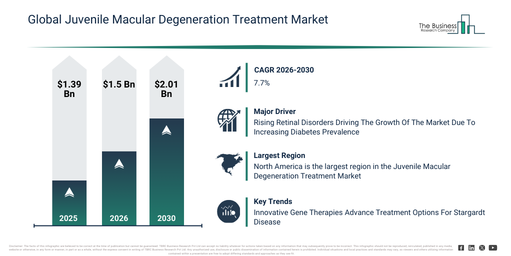
The juvenile macular degeneration treatment market has experienced robust growth recently. Its expansion is projected from $1.39 billion in 2025 to $1.5 billion in 2026, exhibiting a compound annual growth rate (CAGR) of 7.9%. This historical growth stems from factors such as restricted treatment options for juvenile macular degeneration, heightened awareness of inherited retinal disorders, progress in retinal imaging technologies, an increase in ophthalmology specialty care, and elevated diagnosis rates for Stargardt disease.
The juvenile macular degeneration treatment market is anticipated to experience significant growth in the coming years. It is projected to expand to $2.01 billion by 2030, achieving a compound annual growth rate (CAGR) of 7.7%. This growth during the forecast period is fueled by advancements in gene and stem cell research, increasing investments in therapeutics for rare diseases, a rising emphasis on early intervention in pediatric eye disorders, the expansion of clinical research pipelines, and improved access to specialized ophthalmic care. Prominent trends for the forecast period include a growing focus on the management of genetic eye disorders, the increasing adoption of gene and stem cell therapies, wider use of vision preservation and assistive devices, an increase in clinical trials for rare retinal diseases, and enhanced patient support and low-vision rehabilitation programs.
Get A Free Sample Report With In-Depth Market Insights:
Juvenile Macular Degeneration Treatment Market Growth Drivers: What’s Behind The Acceleration?
The juvenile macular degeneration treatment market is projected to grow as the prevalence of retinal disorders continues to rise. Retinal disorders are conditions that affect the retina, the light-sensitive tissue at the back of the eye, often leading to vision impairment or loss. The increase in these disorders is attributed to the growing incidence of diabetes, which causes conditions such as diabetic retinopathy that gradually damage the retina. Juvenile macular degeneration treatments are crucial for young patients because they enhance retinal disorder management by preserving vision through early intervention. For instance, in November 2024, a report by Retina Australia, an Australia-based non-profit organization, indicated that approximately 19,000 individuals in Australia, or about 1 in 1,380 people, are estimated to be living with an inherited retinal disease (IRD). Furthermore, the National Eye Institute, a US-based institute of health, expects the number of Americans with advanced age-related macular degeneration (AMD) to increase from the current 2.1 million to 3.7 million by 2030. Therefore, the increasing prevalence of retinal disorders is driving the growth of the juvenile macular degeneration treatment market.
Juvenile Macular Degeneration Treatment Market Segment Analysis And Revenue Potential
The juvenile macular degeneration treatment market covered in this report is segmented –
1) By Type: Stargardt Disease (ABCA4-Associated), X-Linked Juvenile Retinoschisis, Best Vitelliform Macular Dystrophy, Cone or Cone-Rod Dystrophy, Other Types
2) By Treatment: Devices, Drugs, Surgery
3) By Application: Vision Preservation, Disease Management, Symptom Relief, Preventive Care, Clinical Trials
4) By Sales Channel: Hospitals, Ambulatory Surgical Centres, Other Sales Channels
Subsegments:
1) By Stargardt Disease (ABCA4-Associated): Juvenile Macular Degeneration, ABCA4 Gene Mutations, Visual Cycle Modulators, Stem Cell–Based Therapies
2) By X-Linked Juvenile Retinoschisis: RS1 Gene Mutations, Pediatric-Onset Cases, Central Vision Impairment, Gene Therapy Programs
3) By Best Vitelliform Macular Dystrophy: BEST1 Gene Mutations, Early-Onset BVMD, Late-Onset BVMD, Gene Therapy Approaches
4) By Cone Or Cone-Rod Dystrophy: Cone-Dominant Disorders, Cone-Rod Progressive Disorders, Syndromic Forms, Non-Syndromic Forms
5) By Other Types: Pattern Dystrophies, North Carolina Macular Dystrophy, Unclassified Juvenile Macular Dystrophies
Juvenile Macular Degeneration Treatment Market Trends: What’s Defining The Industry’s Next Phase?
Leading companies in the juvenile macular degeneration treatment market are dedicating efforts to creating innovative solutions, such as dual adeno-associated viral (AAV) vectors, to enhance gene therapy delivery and improve treatment effectiveness for patients with juvenile macular degeneration. A dual adeno-associated viral (AAV) vector constitutes a gene therapy method that utilizes two AAV vectors for delivering large therapeutic genes that surpass the packaging capacity of a single AAV. For instance, in March 2025, SpliceBio, a Spain-based biotechnology company, declared the initial patient dosing for its Phase 1/2 ASTRA study involving SB-007, a dual AAV vector gene therapy specifically engineered to restore full-length ABCA4 protein expression. The therapy seeks to offer a prospective treatment for juvenile macular degeneration (stargardt disease), an inherited retinal disorder currently lacking approved treatments, by accommodating all patients irrespective of their mutations. This accomplishment represents a notable progression toward developing efficacious gene therapies for rare retinal diseases.
Juvenile Macular Degeneration Treatment Market Key Players Shaping Industry Direction
Major companies operating in the juvenile macular degeneration treatment market are Alkeus Pharmaceuticals Inc., MeiraGTx Holdings plc, Ocugen Inc., ProQR Therapeutics N.V., Applied Genetic Technologies Corporation, Lineage Cell Therapeutics Inc., jCyte Inc., Nanoscope Therapeutics Inc., Editas Medicine Inc., Beam Therapeutics Inc., ReNeuron Group plc, Astellas Institute for Regenerative Medicine, Kubota Vision Inc., Ionis Pharmaceuticals Inc., Atsena Therapeutics Inc., Vedere Bio Inc., GenSight Biologics S.A., ViGeneron GmbH, Sanofi Gene Therapy, Neurotech Pharmaceuticals Inc.
View The Full Juvenile Macular Degeneration Treatment Market Report:
Juvenile Macular Degeneration Treatment Market Regional Split: Which Areas Are Fueling Growth?
North America was the largest region in the juvenile macular degeneration treatment market in 2025. The regions covered in the juvenile macular degeneration treatment market report are Asia-Pacific, South East Asia, Western Europe, Eastern Europe, North America, South America, Middle East, Africa.
Reach Out To Our Team:
The Business Research Company: https://www.thebusinessresearchcompany.com/
Americas: +1 310-496-7795
Asia: +44 7882 955267 & +91 8897263534
Europe: +44 7882 955267
Email us at: marketing@tbrc.info
Follow us on:
LinkedIn: https://in.linkedin.com/company/the-business-research-company
YouTube: https://www.youtube.com/channel/UC24_fI0rV8cR5DxlCpgmyFQ
Global Market Model: https://www.thebusinessresearchcompany.com/global-market-model