The Business Research Company’s 2026 market reports feature enhanced tools like market attractiveness analysis, TAM assessment, and company scoring matrices, along with interactive dashboards, deeper supply chain insights, and startup coverage strengthening the depth, usability, and strategic value of insights.
From Its 2026 Market Size, What Value Is The Leadless Pacemakers Market Projected To Reach By 2030?
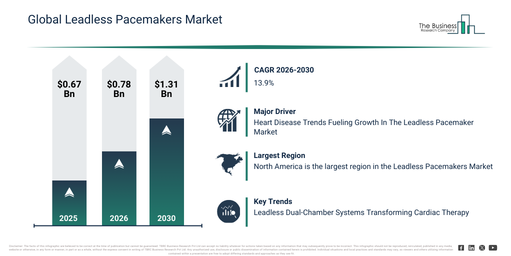
The market for leadless pacemakers has experienced significant expansion recently. This market is projected to expand from $0.67 billion in 2025 to $0.78 billion in 2026, demonstrating a compound annual growth rate (CAGR) of 15.6%. Factors contributing to its historical growth include the drawbacks of conventional lead-based pacemakers, an uptick in cardiac arrhythmia cases, an expanding elderly demographic, heightened recognition of complications linked to leads, and progress in the miniaturization of cardiac devices.
The leadless pacemakers market is anticipated to undergo significant expansion in the coming years. By 2030, its size is expected to reach $1.31 billion, exhibiting a compound annual growth rate (CAGR) of 13.9%. This growth in the forecast period stems from factors such as increasing demand for minimally invasive cardiac therapies, advancements in battery and device longevity, wider adoption of remote patient monitoring, the expansion of electrophysiology centers, and rising investment in next-generation cardiac devices. Key trends for the forecast period include the growing acceptance of leadless cardiac pacing systems, a move towards minimally invasive cardiac implant procedures, a heightened preference for devices with reduced infection risk, the broadening development of dual-chamber leadless pacemakers, and greater integration of remote cardiac monitoring.
Access Your Free Sample Report For In-Depth Market Analysis:
https://www.thebusinessresearchcompany.com/sample.aspx?id=15846&type=smp
What Significant Factors Are Influencing The Leadless Pacemakers Market Expansion?
The increasing incidence of heart disease is anticipated to propel the expansion of the leadless pacemaker market moving forward. Heart diseases encompass a spectrum of conditions that impact the heart’s structure or function, resulting in impaired blood flow, irregular heart rhythms, or other cardiovascular complications. The escalating prevalence of heart diseases is attributed to factors such as population growth and aging, various lifestyle choices, elevated stress levels, physical inactivity, challenges within healthcare systems, and a combination of genetic and environmental influences. Leadless pacemakers offer considerable advantages in managing certain heart conditions by providing effective pacing while simultaneously mitigating the risk of complications related to leads and offering a less invasive implantation process. For instance, in February 2024, according to the World Health Organization (WHO), a Switzerland-based intergovernmental organization, it is projected that there will be over 35 million new cases of cancer by 2050, representing a 77% increase over the estimated 20 million cases in 2022. Consequently, the rise in heart disease is serving as a driving force for the growth of the leadless pacemaker market.
Leadless Pacemakers Market Driver: Surge In Minimally Invasive Procedures Fueling Growth Due To Reduced Recovery Time And Lower Postoperative Discomfort
The growing preference for minimally invasive procedures is expected to drive the growth in the leadless pacemaker market in the coming years. Minimally invasive procedures refer to medical interventions carried out through small incisions or natural body openings, employing specialized instruments and imaging guidance to lessen tissue damage, pain, and recovery time, all while ensuring effective diagnostic or therapeutic outcomes. The increasing inclination towards minimally invasive procedures is primarily due to their capacity to reduce recovery time and postoperative discomfort, encouraging more patients and healthcare providers to select these techniques over traditional open surgeries. Leadless pacemakers support minimally invasive procedures by removing the necessity for surgical pockets and transvenous leads, enabling implantation through a small catheter-based method that reduces tissue disruption and accelerates recovery. For instance, in March 2024, according to a report published by the American Society of Plastic Surgeons (ASPS), a US-based professional medical organization, total cosmetic minimally invasive procedures saw an increase from 23,672,269 in 2022 to 25,442,640 in 2023, reflecting a 7% year-over-year growth. Therefore, the growing preference for minimally invasive procedures is a key driver for the leadless pacemaker market.
What Are The Main Segments Within The Leadless Pacemakers Market Segment Structure?
The leadless pacemakers market covered in this report is segmented –
1) By Product Type: Ventricular Leadless Pacemakers, Atrioventricular (AV) Synchronous Leadless Pacemakers, Dual-Chamber Leadless Pacemaker Systems
2) By Fixation Mechanism: Passive Fixation, Active Fixation
3) By Indication: Bradycardia, Atrioventricular Block, Atrial Fibrillation with Slow Ventricular Response, Other Indications
4) By End User: Hospitals, Cardiac Specialty Clinics, Ambulatory Surgical Centers
Subsegments:
1) By Ventricular Leadless Pacemakers: VVI-Mode Leadless Pacemakers, Rate-Responsive Ventricular Leadless Pacemakers (VVIR), Single-Module Ventricular Leadless Pacemakers
2) By Atrioventricular (AV) Synchronous Leadless Pacemakers: Accelerometer-Based AV Synchronous Leadless Pacemakers, Algorithm-Driven AV Synchrony Leadless Pacemakers, Single-Module AV Synchronous Leadless Pacemakers
3) By Dual-Chamber Leadless Pacemaker Systems: Modular Dual-Chamber Leadless Pacemaker Systems, Communicating Leadless Atrial and Ventricular Pacemaker Systems, Wireless Synchronized Dual-Chamber Leadless Pacemakers
What Trends Are Affecting The Direction Of The Leadless Pacemakers Market?
Leading companies in the leadless pacemakers market are concentrating on developing advanced products, such as dual-chamber systems, to enhance cardiac pacing efficiency and patient outcomes. A dual chamber system is a type of pacemaker that simultaneously monitors and stimulates both the heart’s atrium and ventricle, helping to maintain proper timing between the upper and lower chambers, improve blood flow, prevent irregular heart rhythms, and boost overall cardiac efficiency and patient quality of life. For instance, in July 2023, Abbott Laboratories, a US-based medical-device company, received US Food and Drug Administration (FDA) approval for its AVEIR DR dual-chamber leadless pacemaker system. This system enables two tiny devices, one in the atrium and one in the ventricle, to communicate beat-to-beat via its implant-to-implant (i2i) technology. By eliminating the necessity for transvenous leads, this system substantially decreases the risk of infection and mechanical complications while delivering more physiologic pacing. As the adoption of dual-chamber leadless pacemakers expands, these innovations are projected to broaden the patient population eligible for minimally invasive cardiac pacing and improve long-term clinical outcomes.
Who Are The Companies Participating In The Leadless Pacemakers Market?
Major companies operating in the leadless pacemakers market are Medtronic Plc, Abbott Laboratories, Boston Scientific Corporation, BIOTRONIK SE & Co. KG, MicroPort Scientific Corporation, LivaNova PLC, EBR Systems Inc., Cairdac, Imricor Medical Systems Inc., Osypka Medical GmbH, Shree Pacetronix Ltd., Lepu Medical Technology Co. Ltd., Terumo Corporation, MEDICO S.p.A., Vitatron Holding B.V., Oscor Inc., CathRx Ltd., Japan Lifeline Co. Ltd., Cardiac Pacemakers Inc., NVT AG
Get The Full Leadless Pacemakers Market Report:
https://www.thebusinessresearchcompany.com/report/leadless-pacemakers-global-market-report
Which Region Leads The Leadless Pacemakers Market In Overall Market Size?
North America was the largest region in the leadless pacemakers market in 2025. Asia-Pacific is expected to be the fastest-growing region in the forecast period. The regions covered in the leadless pacemakers market report are Asia-Pacific, South East Asia, Western Europe, Eastern Europe, North America, South America, Middle East, Africa.
Request A Customized Leadless Pacemakers Market Report For Competitive Insights:
https://www.thebusinessresearchcompany.com/report/leadless-pacemakers-global-market-report
Browse Through More Reports Similar to the Global Leadless Pacemakers Market 2026, By The Business Research Company
Pacemakers Market Report 2026
https://www.thebusinessresearchcompany.com/report/pacemakers-global-market-report
Cardiac Pacemakers Market Report
https://www.thebusinessresearchcompany.com/report/cardiac-pacemakers-global-market-report
External Pacemakers Market Report
https://www.thebusinessresearchcompany.com/report/external-pacemakers-global-market-report
Get in touch with us:
The Business Research Company: https://www.thebusinessresearchcompany.com/
Americas +1 310-496-7795
Asia +44 7882 955267 & +91 8897263534
Europe +44 7882 955267
Email us at info@tbrc.info
Follow us on:
LinkedIn: https://in.linkedin.com/company/the-business-research-company
YouTube: https://www.youtube.com/channel/UC24_fI0rV8cR5DxlCpgmyFQ
Global Market Model: https://www.thebusinessresearchcompany.com/global-market-model