Life Science Instrumentation Market Developments and Growth Opportunities Across 2026–2030
The Business Research Company’s 2026 market reports include new capabilities such as market attractiveness scoring and analysis, total addressable market analysis, company scoring matrix, interactive excel data dashboard, improved supply chain analysis, upcoming startups in the market, and overview of key products, aimed at improving the depth, usability, and strategic value of the insights delivered.
How Will The Market Size Of The Life Science Instrumentation Market Evolve From 2026 To 2030?
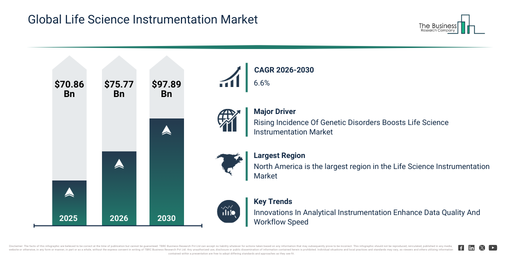
The life science instrumentation market has experienced robust growth in recent years. Projections indicate it will expand from $70.86 billion in 2025 to $75.77 billion in 2026, demonstrating a compound annual growth rate (CAGR) of 6.9%. This historical growth is largely due to factors such as the increasing scope of pharmaceutical and biotechnology research endeavors, greater investments in laboratory infrastructure, advancements in genomics and proteomics research, the integration of sophisticated diagnostic instruments, and a heightened need for precise analytical outcomes.
The life science instrumentation market is projected to experience substantial expansion over the coming years. Its valuation is anticipated to reach $97.89 billion by 2030, exhibiting a compound annual growth rate (CAGR) of 6.6%. This projected growth is primarily driven by factors such as the increasing deployment of automated and connected instruments, a rising need for tools in personalized medicine research, the broadening scope of clinical diagnostics testing, the growing acceptance of AI-powered instrumentation, and greater investments in advanced laboratory technologies. Key developments expected during this period involve the increasing uptake of high-throughput analytical devices, a greater integration of automation into lab processes, an escalating demand for highly accurate measurement technologies, the widening application of multi-omics research instruments, and a stronger emphasis on laboratory systems that integrate data.
Download the Free Sample Report to Explore Key Market Insights:
https://www.thebusinessresearchcompany.com/sample.aspx?id=19545&type=smp
What Key Drivers Are Influencing The Growth Of The Life Science Instrumentation Market?
The expanding occurrence of genetic conditions is anticipated to drive the future expansion of the life science instrumentation market. These disorders are defined as illnesses or states resulting from irregularities in an individual’s DNA or chromosomes. The rise in genetic disorder cases is attributable to advancements in diagnostic methods, heightened public understanding, and shifts in reproductive behaviors. Patients suffering from genetic disorders use life science instruments for diagnosis, ongoing monitoring, and the creation of specific treatments through the examination of genetic material and biological markers. A notable example is from May 2023, where the Alzheimer Society, a UK-based dementia care and research charity, reported that approximately 982,000 individuals are currently living with dementia in the UK, a figure projected to rise to 1.4 million by 2040. Consequently, the growing prevalence of genetic ailments is fueling the expansion of the life science instrumentation market.
Which Segment Areas Are Covered In The Life Science Instrumentation Market Analysis?
The life science instrumentation market covered in this report is segmented –
1) By Technology: Spectroscopy, Chromatography, Polymerase Chain Reaction, Liquid Handling
2) By Application: Research Applications, Clinical And Diagnostic Applications, Other Applications
3) By End User: Hospitals And Diagnostic Laboratories, Pharmaceutical And Biotechnology Companies, Academic And Research Institutes, Agriculture And Food Industries, Environmental Testing Labs, Clinical Research Organizations, Other End-Users
Subsegments:
1) By Spectroscopy: UV-Vis Spectroscopy, Infrared Spectroscopy (IR), Mass Spectrometry, Nuclear Magnetic Resonance (NMR) Spectroscopy, Raman Spectroscopy
2) By Chromatography: Gas Chromatography (GC), High-Performance Liquid Chromatography (HPLC), Thin Layer Chromatography (TLC), Ion Chromatography (IC), Supercritical Fluid Chromatography (SFC)
3) By Polymerase Chain Reaction (PCR): Quantitative PCR (qPCR), Reverse Transcription PCR (RT-PCR), Digital PCR, Multiplex PCR
4) By Liquid Handling: Automated Liquid Handling Systems, Manual Pipetting Systems, Liquid Handling Robotics
What Key Trends Are Influencing The Development Of The Life Science Instrumentation Market?
Leading companies in the life science instrumentation market are concentrating on developing innovative solutions, such as high-performance mass spectrometers with ultrahigh sensitivity, to enhance workflows in proteomics, metabolomics, translational research, and precision medicine. These high-performance mass spectrometers are analytical instruments designed to detect and quantify molecules like proteins, metabolites, and lipids by ionizing them and measuring their mass-to-charge ratio. In comparison to traditional instruments, these modern systems offer superior sensitivity, quicker analysis, and increased throughput, thereby enabling intricate biological and clinical studies with greater accuracy. For instance, in June 2023, Thermo Fisher Scientific Inc., a US-based life-science instrumentation company, launched the Thermo Scientific Orbitrap Astral mass spectrometer, an advanced system providing extensive proteome coverage, high resolution, and accelerated throughput for biomarker discovery and proteomics research. The Astral mass spectrometer facilitates the detection of low-abundance proteins, allows for faster processing of large sample batches, and offers improved support for translational and basic research, delivering a significant performance improvement over conventional MS platforms in terms of sensitivity, efficiency, and data quality.
Which Global Companies Are Actively Competing In The Life Science Instrumentation Market?
Major companies operating in the life science instrumentation market are Thermo Fisher Scientific Inc, Agilent Technologies Inc, Danaher Corporation, Bruker Corporation, Shimadzu Corporation, Waters Corporation, PerkinElmer Inc, Bio-Rad Laboratories Inc, JEOL Ltd, Horiba Ltd, Eppendorf AG, Tecan Group AG, Leica Microsystems AG, Sartorius AG, Illumina Inc, Oxford Instruments plc, Becton Dickinson and Company, Beckman Coulter Inc, Carl Zeiss AG, Nikon Corporation, Hitachi High Technologies Corporation
Read the full life science instrumentation market report here:
https://www.thebusinessresearchcompany.com/report/life-science-instrumentation-global-market-report
Which Region Is Expected To Register The Fastest Growth In The Life Science Instrumentation Market?
North America was the largest region in the life science instrumentation market in 2025. The regions covered in the life science instrumentation market report are Asia-Pacific, South East Asia, Western Europe, Eastern Europe, North America, South America, Middle East, Africa.
Request A Tailored Life Science Instrumentation Market Research Report For Competitive Advantage:
https://www.thebusinessresearchcompany.com/customise?id=19545&type=smp
Browse Through More Reports Similar to the Global Life Science Instrumentation Market 2026, By The Business Research Company
Liquid Chromatography Instruments Global Market Report
Minimally Invasive Surgical Instruments Global Market Report
Handheld Surgical Instruments Global Market Report
https://www.thebusinessresearchcompany.com/report/handheld-surgical-instruments-global-market-report
Get in touch with us:
The Business Research Company: https://www.thebusinessresearchcompany.com/
Americas +1 310-496-7795
Asia +44 7882 955267 & +91 8897263534
Europe +44 7882 955267
Email us at info@tbrc.info
Follow us on:
LinkedIn: https://in.linkedin.com/company/the-business-research-company
YouTube: https://www.youtube.com/channel/UC24_fI0rV8cR5DxlCpgmyFQ
Global Market Model: https://www.thebusinessresearchcompany.com/global-market-model