Outlook for Low Vision Assistive Devices Market: Key Developments and Future Strategies to 2029
Claim your 30% discount on Global Market Reports with code ONLINE30. Limited time only.
Claim your 30% discount on Global Market Reports with code ONLINE30. Limited time only.
What Is the Estimated Industry Valuation for the Low Vision Assistive Devices Sector?
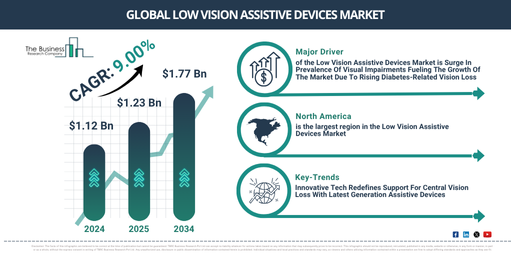
The market size of assistive devices for low vision has seen considerable growth over recent years. The market is projected to expand from $1.12 billion in 2024 to $1.23 billion in 2025, indicating a compound annual growth rate (CAGR) of 9.3%. Several factors contributed to this growth historically, including an increase in vision impairment, a surge in the aging population, heightened demand for aids that promote independent living, growing awareness of assistive technologies, and a rise in governmental support for disabilities.
The market for low vision assistive devices is predicted to experience significant expansion in the upcoming years, reaching $1.73 billion by 2029 at a consistent annual growth rate of 9.0%. Factors contributing to this predicted expansion throughout the forecast period include the increasing utilisation of AI-enabled smart assistive devices, a surge in healthcare spending on vision care, broader availability of assistive technology in emerging markets, an upswing in chronic eye disorders, and growing emphasis on home-based and personalised vision solutions. Key trends for the forecasted period encompass advancements in wearable low-vision technology, innovative portable electronic magnifiers, the incorporation of artificial intelligence in vision aids, development in smartphone-assisted apps, and the merging of IoT with low-vision devices.
Download The Free Sample Report Here:
https://www.thebusinessresearchcompany.com/sample.aspx?id=25813&type=smp
What Forces Are Driving The Growth Of The Low Vision Assistive Devices Market?
The rise in visual impairments is predicted to trigger the expansion of the market for low vision assistive devices. Visual impairments cover a spectrum of conditions, from partial sight to total blindness, that cannot be fully rectified with traditional glasses or lenses. This increase in such impairments is linked to the surge in diabetes patients, since diabetes commonly results in retinal damage and gradual vision loss. Assistive devices for low-vision help counteract the incidence of visual impairments by augmenting residual sight, facilitating daily tasks, and enhancing self-sufficiency and life quality for those with poor vision. For example, in February 2025, Vision Australia reported, according to Developing Australia Communities, an organization centered on empowering disabled individuals, that 453,000 Australians are either blind or have low vision. It’s a figure that is expected to climb to 564,000 by 2030. Consequently, the rising prevalence of visual impairments is catalyzing the expansion of the low-vision assistive devices market.
How Is The Low Vision Assistive Devices Industry Segmented Across Key Parameters?
The low vision assistive devices market covered in this report is segmented –
1) By Product Type: Magnifiers, Reading Devices, Wearable Devices, Screen Readers, Other Product Types
2) By Application: Education, Healthcare, Personal Use
3) By Distribution Channel: Online Stores, Specialty Stores, Optical Stores, Other Distribution Channels
4) By End-User: Children, Adults, Elderly
Subsegments:
1) By Magnifiers: Handheld Magnifiers, Stand Magnifiers, Electronic Magnifiers, Pocket Magnifiers
2) By Reading Devices: Optical Character Recognition (OCR) Devices, Text-To-Speech Devices, Desktop Video Magnifiers, Portable Reading Machines
3) By Wearable Devices: Smart Glasses, Head-Mounted Displays (HMDs), Augmented Reality (AR)-Based Devices, Camera-Based Wearable Systems
4) By Screen Readers: Software-Based Screen Readers, Web-Based Screen Readers, Mobile Screen Readers, Braille Display Integrated Readers
5) By Other Product Types: Braille Embossers, Tactile Graphics Devices, Speech-To-Text Converters, Audio Books And E-Readers
What Notable Trends Are Shaping The Direction Of The Low Vision Assistive Devices Market?
Prominent businesses in the low vision assistive devices market are prioritizing the development of cutting-edge technologies, such as the newest generation of aides for the visually impaired. Their aim is to boost visual precision, self-reliance, and movement for individuals suffering from central vision impairment. This newest generation of aids integrates high-definition imaging, real-time image processing, and wearable organic light-emitting diode (OLED) display systems. Together, they create improved imagery that flawlessly interacts with the user’s residual vision, while maintaining peripheral awareness. As an example, eSight, a Canadian assistive technology firm, introduced the eSight Go wearable technology in July 2025. The product sports a 12-megapixel camera with 4K resolution, dual high-definition OLED screens, and a broad 45-degree field of view, giving users an authentic and immersive viewing experience. The device also has added benefits such as superior image stabilization, a user-friendly interface, and a neck-mounted battery pack for comfortable everyday use. The goal of these futuristic assistive technologies is to allow users to maintain complete mobility and actively engage in everyday activities, be it at school, work, home, or in social settings, thus catering to over 20 distinct vision impairments globally.
Which Companies Currently Dominate The Competitive Landscape In The Low Vision Assistive Devices Industry?
Major companies operating in the low vision assistive devices market are HIMS Inc., OrCam Technologies Ltd., AudioEye Inc., HumanWare Group, Freedom Scientific Inc., eSight Corporation, IrisVision Global Inc., Zoomax Technology Co. Limited, Optelec U.S. Inc., Cobolt Systems Ltd., NuEyes Technologies Inc., Vision Buddy Inc., Acesight, Eyedaptic Inc., LVI Low Vision International AB, Reinecker Vision GmbH, Ash Technologies Ltd., RevoSight Inc., Joint Optical Reflective Display, Clarity.
Get The Full Report Here:
https://www.thebusinessresearchcompany.com/report/low-vision-assistive-devices-global-market-report
Which Geographic Regions Are Driving Demand In The Low Vision Assistive Devices Market?
North America was the largest region in the low vision assistive devices market in 2024. The regions covered in the low vision assistive devices market report are Asia-Pacific, Western Europe, Eastern Europe, North America, South America, Middle East, Africa.
Request For A Customized Report:
https://www.thebusinessresearchcompany.com/customise?id=25813&type=smp
About The Business Research Company:
With over 15000+ reports from 27 industries covering 60+ geographies, The Business Research Company has built a reputation for offering comprehensive, data-rich research and insights. Armed with 1,500,000 datasets, the optimistic contribution of in-depth secondary research, and unique insights from industry leaders, you can get the information you need to stay ahead in the game.
Get in touch with us:
The Business Research Company: https://www.thebusinessresearchcompany.com/
Americas +1 310-496-7795
Asia +44 7882 955267 & +91 8897263534
Europe +44 7882 955267
Email us at info@tbrc.info
Follow us on:
LinkedIn: https://in.linkedin.com/company/the-business-research-company
YouTube: https://www.youtube.com/channel/UC24_fI0rV8cR5DxlCpgmyFQ
Global Market Model: https://www.thebusinessresearchcompany.com/global-market-model