Unlock Global Insights – Save 20% on Market Reports with Code ONLINE20
What Is The Anticipated Size Of The Low Vision Electronic Visual Aids Market Over The Five-Year Period 2025–2029?
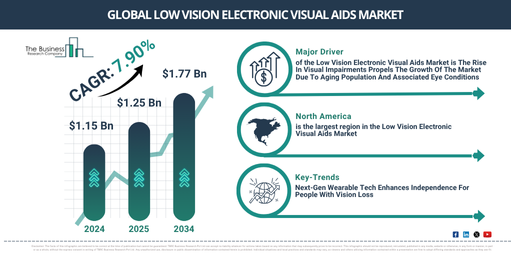
The low vision electronic visual aids market has experienced robust expansion in recent years. It is projected to increase from $1.15 billion in 2024 to $1.25 billion by 2025, achieving a compound annual growth rate (CAGR) of 8.2%. This historical growth can be attributed to several factors, including increasing awareness regarding vision impairment, a growing elderly population, a rising prevalence of chronic eye disorders, improved access to eye care in urban areas, the growing adoption of electronic magnifiers, and increased funding for low vision research.
The low vision electronic visual aids market is projected for significant expansion over the coming years. It is anticipated to reach $1.69 billion by 2029, exhibiting a compound annual growth rate (CAGR) of 7.9%. This growth during the forecast period is propelled by factors such as the expanding application of smart technology in assistive devices, a rising need for wearable vision enhancement solutions, the increasing prevalence of diabetes and hypertension, a greater inclination towards home-based healthcare services, and the uptick in online sales of assistive devices. Key trends anticipated for this period encompass the development of customizable user interfaces, the integration of smart device ecosystems, advancements in augmented reality applications, innovations in multi-sensory feedback systems, and the creation of personalized training algorithms.
Unlock Your Free Sample Report for Exclusive Market Data:
https://www.thebusinessresearchcompany.com/sample.aspx?id=25815&type=smp
Which Drivers Are Impacting The Low Vision Electronic Visual Aids Market?
An increasing number of individuals experiencing visual impairments is anticipated to fuel the expansion of the low vision electronic visual aids market in the future. Visual impairments are defined as various forms of vision loss not entirely correctable with conventional eyeglasses, contact lenses, medical treatments, or surgical procedures, thus impacting an individual’s clear vision. This rise in visual impairment cases is largely attributed to the demographic shift towards an older population, given that age-associated eye conditions like macular degeneration, cataracts, and glaucoma occur more frequently as people age. Low-vision electronic visual aids assist those with visual impairments by improving their residual sight via magnification, contrast modification, and digital image processing, thereby fostering increased autonomy in everyday tasks. As an illustration, the World Health Organization, a specialized agency of the United Nations based in Switzerland, reported in August 2023 that at least 2.2 billion individuals worldwide suffer from near or distance vision impairment. Nevertheless, estimates show that only 36% of individuals with distance vision impairment stemming from refractive errors and merely 17% of those with vision impairment caused by cataracts have accessed suitable treatment. Consequently, the increasing incidence of visual impairments is a key factor propelling the expansion of the low vision electronic visual aids market.
Which Key Segments Fueling The Low Vision Electronic Visual Aids Market?
The low vision electronic visual aids market covered in this report is segmented –
1) By Type: Portable Electronic Magnifiers, Closed Circuit Television, Voice Readers, Other Types
2) By Technology: Optical Devices, Electronic Magnifiers, Text-to-Speech Devices, Speech Recognition Systems
3) By Application: Reading Assistance, Navigation Assistance, Social Interaction And Communication, Entertainment
4) By Distribution Channel: Online Retail, Specialty Stores, Optical Stores, Other Distribution Channels
5) By End-User: Individuals, Hospitals And Clinics, Rehabilitation Centers, Educational Institutions
Subsegments:
1) By Portable Electronic Magnifiers: Handheld Magnifiers, Stand Magnifiers, Wearable Magnifiers, Digital Magnifier Tablets
2) By Closed Circuit Television: Desktop Closed Circuit Television Systems, Transportable Closed Circuit Television Systems, Wearable Closed Circuit Television Devices, Closed Circuit Television With Text-To-Speech Integration
3) By Voice Readers: Screen Readers, Book Readers, Optical Character Recognition-Based Readers, Smart Audio Assistants For Reading
4) By Other Types: Braille Notetakers, Smart Glasses, Screen Magnification Software, Navigation Aids
What Long-Term Trends Will Shape The Future Growth Of The Low Vision Electronic Visual Aids Industry?
Key companies in the low vision electronic visual aids market are prioritizing the development of innovative solutions, such as artificial intelligence-powered wearable smart glasses, to improve real-time visual interpretation and user independence. Artificial intelligence-powered wearable smart glasses are advanced electronic visual aids that utilize AI-driven image processing, object recognition, and voice output to enable individuals with low vision to perceive and interact with their environment more effectively. For instance, in August 2024, Eyedaptic Inc., a US-based medical technology company, introduced EYE6 with Ivy, a next-generation wearable visual assistant specifically designed for individuals with age-related macular degeneration and other retinal disorders. These lightweight smart glasses integrate advanced vision enhancement with an AI-powered assistant named Ivy. It offers capabilities such as reading text, identifying objects, describing surroundings, and supporting users in 99 languages to foster greater independence. Boasting full HD 1080p displays, hands-free voice control, and remote upgrade features, the EYE6 delivers a fluid, customizable user experience for people with low vision conditions.
Which Leading Companies Dominate The Low Vision Electronic Visual Aids Market Share?
Major companies operating in the low vision electronic visual aids market are Rehan Electronics Co. Ltd., Eschenbach Optik GmbH, Vispero, HumanWare Group, Freedom Scientific Inc., IrisVision Global Inc., VisionAid International Ltd., Zoomax Technology Co. Ltd., HIMS Inc., LS And S Products Inc., SHG Technologies LLC, Clarity Vision Limited, CTECH Low Vision And Blindness Solutions, Low Vision International AB, NuEyes Technologies Inc., Optelec U.S. Inc., Reinecker Vision GmbH, Quantum Reading Learning Vision, Optima Low Vision Services LTD, OrCam Technologies Ltd.
Download The Full Report For Exclusive Market Findings:
Which Region Shows The Highest Potential For Future Expansion In The Low Vision Electronic Visual Aids Market?
North America was the largest region in the low vision electronic visual aids market in 2024. Asia-Pacific is expected to be the fastest-growing region in the forecast period. The regions covered in the low vision electronic visual aids market report are Asia-Pacific, Western Europe, Eastern Europe, North America, South America, Middle East, Africa.
Request A Customized Version Of The Low Vision Electronic Visual Aids Market Report:
https://www.thebusinessresearchcompany.com/customise?id=25815&type=smp
Browse Through More Reports Similar to the Global Low Vision Electronic Visual Aids Market 2025, By The Business Research Company
Vision Care Devices And Equipment Global Market Report 2025
Night Vision Devices Global Market Report 2025
https://www.thebusinessresearchcompany.com/report/night-vision-devices-global-market-report
Assistive Technologies For Visually Impaired Global Market Report 2025
Get in touch with us:
The Business Research Company: https://www.thebusinessresearchcompany.com/
Americas +1 310-496-7795
Asia +44 7882 955267 & +91 8897263534
Europe +44 7882 955267
Email us at info@tbrc.info
Follow us on:
LinkedIn: https://in.linkedin.com/company/the-business-research-company
YouTube: https://www.youtube.com/channel/UC24_fI0rV8cR5DxlCpgmyFQ
Global Market Model: https://www.thebusinessresearchcompany.com/global-market-model