
Global Medical Image Management Market 2026–2030: Forecast Insights for Business Planning
Uncover key drivers, emerging technologies, and competitive movements shaping the medical image management market from 2026–2035 with trusted insights from The Business Research Company
What growth pattern is forecast for the Medical Image Management Market size between 2026 and 2035?
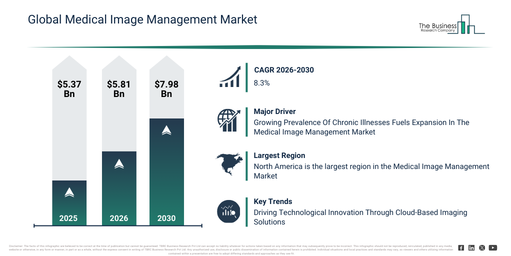
The medical image management market size has experienced robust growth in recent years. It is projected to expand from $5.37 billion in 2025 to $5.81 billion in 2026, achieving a compound annual growth rate (CAGR) of 8.2%. The historical growth can be linked to the early digitization of radiology departments, widespread adoption of PACS, growth in diagnostic imaging volumes, increasing use of electronic health records, and the need for efficient medical data storage.
The medical image management market size is projected to undergo substantial expansion in the coming years, reaching $7.98 billion by 2030, at a compound annual growth rate (CAGR) of 8.3%. This growth during the forecast period is primarily fueled by increasing imaging data volumes, the expansion of multi-site healthcare networks, a growing requirement for interoperability, an intensified regulatory emphasis on data retention, and the need for quicker clinical access to images. Significant trends expected during this period include the wider adoption of vendor neutral archives across healthcare networks, a rising need for centralized image storage and retrieval, greater integration of imaging systems across diverse modalities, the broadening of image sharing to facilitate collaborative clinical decision-making, and an elevated focus on long-term medical image archiving and compliance.
Access Your Free Sample Report for In-Depth Market Insights:
https://www.thebusinessresearchcompany.com/sample.aspx?id=14138&type=smp
Which Drivers Are Impacting Market Performance In The Medical Image Management Market?
The increasing prevalence of chronic illnesses is projected to boost the expansion of the medical image management market moving forward. A chronic illness is a persistent medical condition or ailment that typically lasts for an extended period, generally three months or more. Routine medical imaging allows healthcare professionals to monitor the progression of chronic illnesses through comparison of images over time, which helps in evaluating treatments, making necessary adjustments, and identifying any complications or shifts in a patient’s health. For instance, in February 2024, the Centers for Disease Control and Prevention (CDC), a US-based federal public health agency, reported that an estimated 129 million people in the United States have at least one major chronic disease, encompassing conditions like heart disease, cancer, diabetes, obesity, and hypertension. Thus, the escalating prevalence of chronic illnesses is fueling the growth of the medical image management market.
What Segment Types Are Examined In The Medical Image Management Market?
The medical image management market covered in this report is segmented –
1) By Product: Vendor Neutral Archives (VNA), Picture Archiving And Communication Systems (PACS), Application-Independent Clinical Archives (AICA)
2) By Delivery: On Premise, Hybrid, Cloud
3) By Application: Standard Radiography, Advanced Body Imaging, Cardiovascular Imaging, Neuroradiology, Musculoskeletal Imaging And Pain Management, Oncology Imaging, Other Applications
4) By End User: Hospitals, Clinics, Diagnostic Centers, Ambulatory Surgery Centers
Subsegments:
1) By Vendor Neutral Archives (VNA): Data Integration Solutions, Storage And Retrieval Systems, Image Lifecycle Management
2) By Picture Archiving And Communication Systems (PACS): Diagnostic Imaging Solutions, Workflow Management Tools, Image Sharing And Collaboration Features
3) By Application-Independent Clinical Archives (AICA): Multi-Modal Image Storage, Long-Term Data Preservation, Clinical Data Management Tools
What Long-Term Trends Are Expected To Shape The Future Of The Medical Image Management Market?
Leading entities within the medical image management market are prioritizing the integration of cutting-edge technologies, particularly cloud-based PACS, to boost imaging accessibility, optimize operational procedures, and elevate diagnostic accuracy. Cloud-based PACS represents a picture archiving and communication system that leverages cloud infrastructure for the storage and management of medical images, thereby enabling medical professionals to securely retrieve, examine, and interpret imaging information irrespective of their physical location. A notable example occurred in November 2023, when Koninklijke Philips N.V., a global health technology firm based in the Netherlands, unveiled HealthSuite Imaging, its advanced cloud-based PACS platform, which incorporates AI-driven clinical and operational workflows. This particular solution integrates cloud storage, sophisticated AI functionalities, and secure access for multiple users to consolidate imaging data, automate analytical processes, and facilitate joint decision-making across various clinical departments. Its primary functionalities encompass predictive analytics, AI-powered triage, and improved compatibility with wider health IT environments. This platform supports diverse applications spanning radiology, cardiology, oncology, and comprehensive enterprise imaging operations, offering advantages such as enhanced workflow effectiveness, quicker diagnostic completion, elevated patient care, and decreased complexity associated with on-premise IT infrastructure.
Who Are The Primary Competitors In The Global Medical Image Management Market?
Major companies operating in the medical image management market are McKesson Corporation, International Business Machines Corporation, NTT DATA Corporation, Fujifilm Holdings Corporation, Siemens Healthineers, Koninklijke Philips N.V., GE Healthcare, Hologic Inc., Agfa-Gevaert Group, Carestream Health Inc., Change Healthcare, Hyland Software Inc., Intelerad Medical Systems Incorporated, Sectra AB, Merge Healthcare Inc., Infinitt Healthcare Co. Ltd., TeraRecon Inc., Novarad Corporation, Subtle Medical Inc., Mach7 Technologies Ltd., BridgeHead Software Ltd., Zebra Medical Vision Inc., Ambra Health, Vital Images Inc.
Access The Complete Report For Deeper Market Insights:
https://www.thebusinessresearchcompany.com/report/medical-image-management-global-market-report
Which Region Is Expected To Experience The Fastest Growth In The Medical Image Management Market?
North America was the largest region in the medical image management market in 2025. Asia-Pacific is expected to be the fastest-growing region in the forecast period. The regions covered in the medical image management market report are Asia-Pacific, South East Asia, Western Europe, Eastern Europe, North America, South America, Middle East, Africa.
Request Your Customized Medical Image Management Market Research Report for Competitive Advantage:
https://www.thebusinessresearchcompany.com/customise?id=14138&type=smp
Browse Through More Reports Similar to the Global Medical Image Management Market 2026, By The Business Research Company
Medical Imaging Equipment Market Report 2026
https://www.thebusinessresearchcompany.com/report/medical-imaging-equipment-global-market-report
Medical Imaging Market Report 2026
https://www.thebusinessresearchcompany.com/report/medical-imaging-global-market-report
Medical Image Analysis Software Market Report 2026
Get in touch with us:
The Business Research Company: https://www.thebusinessresearchcompany.com/
Americas +1 310-496-7795
Asia +44 7882 955267 & +91 8897263534
Europe +44 7882 955267
Email us at info@tbrc.info
Follow us on:
LinkedIn: https://in.linkedin.com/company/the-business-research-company
YouTube: https://www.youtube.com/channel/UC24_fI0rV8cR5DxlCpgmyFQ
Global Market Model: https://www.thebusinessresearchcompany.com/global-market-model

