Featuring market attractiveness scoring, total addressable market sizing, company benchmarking matrices, interactive Excel dashboards, deeper supply chain intelligence, emerging startup tracking, and granular product-level insights, The Business Research Company’s 2026 market reports are built to deliver research that is both more actionable and more strategically valuable.
Metastatic Bone Disease Market Size And Revenue Outlook Through 2030
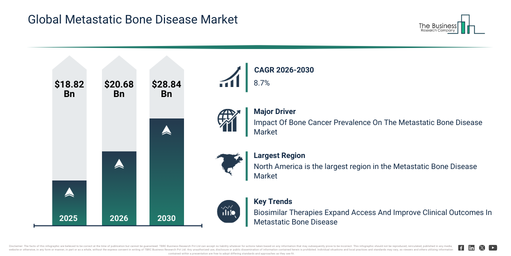
The metastatic bone disease market size has seen strong expansion in recent years. It is forecast to increase from $18.82 billion in 2025 to $20.68 billion in 2026, reflecting a compound annual growth rate (CAGR) of 9.8%. The historical growth in this market can be attributed to increasing cancer incidence, growing cases of bone metastasis, expanding chemotherapy usage, development of radiation therapy techniques, and rising use of bisphosphonates.
The market size for metastatic bone disease is expected to witness substantial growth over the next few years. It is projected to expand to $28.84 billion by 2030, achieving a compound annual growth rate (CAGR) of 8.7%. This anticipated growth during the forecast period can be attributed to the rise in targeted bone agents, increasing adoption of immunotherapy combinations, a growing demand for non-invasive tumor ablation, the expansion of personalized treatment approaches, and stronger oncologic diagnostic capabilities. Key trends expected in the forecast period involve advancements in targeted bone metastasis therapies, AI-assisted enhancements in diagnostic imaging, digital platforms for remote symptom monitoring, automation within oncology radiology workflows, and virtual reality-based surgical and treatment training.
Get A Free Sample Report With In-Depth Market Insights:
Metastatic Bone Disease Market Growth Factors: What’s Supporting Expansion?
The escalating incidence of bone cancer is anticipated to drive the future growth of the metastatic bone disease market. Bone cancer is defined as a malignant tumor originating within bone cells. Its prevalence is influenced by genetic factors, radiation exposure, and environmental factors, including exposure to certain chemicals. This condition can lead to metastatic bone disease when cancer cells from the primary tumor disseminate through the bloodstream or lymphatic system, forming new tumors in other bones. For instance, in 2023, the American Cancer Society, a US-based non-profit organization, reported 3,970 new cases of bone and joint cancer, an increase from the 3,910 cases reported in 2022. Thus, the rising occurrence of bone cancer is a significant factor propelling the expansion of the metastatic bone disease market.
Metastatic Bone Disease Market Segmentation And Category Overview
The metastatic bone disease market covered in this report is segmented –
1) By Treatment: Medication, Radiation Therapy, Surgical Intervention, Tumor Ablation Therapy
2) By Origin: Breast, Lung, Thyroid, Kidney, Prostate, Other Origins
3) By End-User: Hospitals, Specialty Clinics, Ambulatory Surgical Centers
Subsegments:
1) By Medication: Bisphosphonates, Denosumab, Chemotherapy Drugs, Hormonal Therapies, Targeted Therapies, Radiation Therapy
2) By Radiation Therapy: External Beam Radiation Therapy, Internal Radiation Therapy
3) By Surgical Intervention: Bone Stabilization Surgery, Bone Resection Surgery, Spinal Decompression Surgery
4) By Tumor Ablation Therapy: Radiofrequency Ablation, Cryoablation, Microwave Ablation
Metastatic Bone Disease Market Industry Trends: What’s Reshaping Demand?
Leading companies operating in the metastatic bone disease market are concentrating on developing biosimilar therapies to enhance patient access and reduce treatment expenses while sustaining clinical efficacy. Biosimilars are biological medical products closely resembling already approved reference medicines, displaying no clinically significant differences in safety or effectiveness. For example, in March 2024, Sandoz, a Switzerland-based biopharmaceutical company, obtained FDA approval for Wyost (denosumab-bbdz) and Jubbonti (denosumab-bbdz), which are the initial and sole FDA-approved biosimilars of denosumab covering all indications of the reference medicines. These indications include preventing skeletal-related events in patients with bone metastases originating from solid tumors. Such progress is expected to improve treatment accessibility and better clinical outcomes for individuals with metastatic bone disease.
Metastatic Bone Disease Market Competitive Analysis Of Leading Industry Participants
Major companies operating in the metastatic bone disease market are Pfizer Inc., Johnson & Johnson, Roche Holding AG, Merck & Co. Inc., Bayer AG, Sanofi SA, Bristol-Myers Squibb Company, AstraZeneca plc, Novartis AG, GSK plc, Takeda Pharmaceutical Company Limited, Medtronic plc, Eli Lilly and Company, Amgen Inc., Boston Scientific Corporation, Regeneron Pharmaceuticals Inc., Astellas Pharma Inc., Daiichi Sankyo Company Limited, Jazz Pharmaceuticals Inc., Exelixis Inc., BeiGene Ltd., Mylan N.V., Novocure GmbH, Galapagos NV, Telix Pharmaceuticals Limited
View The Full Metastatic Bone Disease Market Report:
Metastatic Bone Disease Market Largest Region: Which Geography Holds The Biggest Share?
North America was the largest region in the metastatic bone disease market in 2025. The regions covered in the metastatic bone disease market report are Asia-Pacific, South East Asia, Western Europe, Eastern Europe, North America, South America, Middle East, Africa.
Reach Out To Our Team:
The Business Research Company: https://www.thebusinessresearchcompany.com/
Americas: +1 310-496-7795
Asia: +44 7882 955267 & +91 8897263534
Europe: +44 7882 955267
Email us at: marketing@tbrc.info
Follow us on:
LinkedIn: https://in.linkedin.com/company/the-business-research-company
YouTube: https://www.youtube.com/channel/UC24_fI0rV8cR5DxlCpgmyFQ
Global Market Model: https://www.thebusinessresearchcompany.com/global-market-model