Methicillin-Resistant Staphylococcus Aureus (MRSA) Drugs Market to Grow at a CAGR of 5.6% from 2025 to 2029
Unlock Global Insights – Save 20% on Market Reports with Code ONLINE20
What Are The Growth Projections For The Methicillin-Resistant Staphylococcus Aureus (MRSA) Drugs Market Size During 2025–2029?
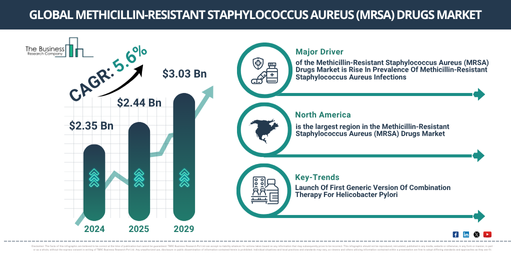
The methicillin-resistant staphylococcus aureus (MRSA) drugs market has seen a consistent expansion in its size over recent years. It is anticipated to increase from $2.35 billion in 2024 to $2.44 billion in 2025, achieving a compound annual growth rate (CAGR) of 3.9%. The market’s past growth drivers encompass worries regarding antibiotic resistance, the occurrence of hospital-acquired infections, various surgical procedures, a worldwide surge in MRSA incidents, and elevated mortality rates.
The methicillin-resistant staphylococcus aureus (MRSA) drugs market size is projected to experience robust expansion over the next few years. It is predicted to reach $3.03 billion by 2029, achieving a compound annual growth rate (CAGR) of 5.6%. The expansion during the forecast period is attributable to ongoing antibiotic resistance challenges, advancements in MRSA diagnostic methods, the global prevalence of healthcare-associated infections, implementation of preventive measures in surgery, and an increase in community-acquired MRSA cases. Significant trends expected in this period include the exploration of immunomodulators, establishment of strategic partnerships for drug development, creation of customized therapies based on strain characteristics, a focus on formulations specific to pediatric patients, and global health initiatives aimed at combating antibiotic resistance.
Unlock Your Free Sample Report for Exclusive Market Data:
https://www.thebusinessresearchcompany.com/sample.aspx?id=10859&type=smp
Which Factors And Drivers Are Influencing The Methicillin-Resistant Staphylococcus Aureus (MRSA) Drugs Market In 2025?
The anticipated rise in Hospital Acquired Infections (HAIs) is projected to boost the growth of the methicillin-resistant Staphylococcus aureus drugs market. Hospital-acquired infections (HAIs) are defined as infections patients develop during their treatment in a healthcare facility, appearing 48 hours or more post-admission. These infections are often attributed to elements like contaminated medical equipment, inadequate hand hygiene among healthcare personnel, excessive antibiotic use, prolonged hospital stays, and patients’ compromised immune systems. Methicillin-resistant Staphylococcus aureus (MRSA) drugs are instrumental in treating hospital-acquired infections by specifically targeting and eradicating MRSA strains resistant to standard antibiotics, thereby reducing the transmission and impact of these infections in healthcare settings. For example, in 2023, the World Health Organization, a Switzerland-based Intergovernmental organization, reported an estimated 136 million global cases of healthcare-associated antibiotic-resistant infections annually. Consequently, the increasing prevalence of methicillin-resistant Staphylococcus aureus infections is a key factor driving the expansion of the methicillin-resistant Staphylococcus aureus drug market.
What Are The Segment Types Shaping The Methicillin-Resistant Staphylococcus Aureus (MRSA) Drugs Market?
The methicillin-resistant staphylococcus aureus (mrsa) drugs market covered in this report is segmented –
1) By Drug Class: Lipopeptides, Oxazolidinones, Cephalosporin, Tetracycline, Folate Antagonist, Lipoglycopeptide, Other Drug Classes
2) By Indication: Skin Infections, Bone and Joint Infections, Bacteremia, Animal Infections
3) By MRSA Type: Hospital-Acquired (HA-MRSA), Community-Acquired (CA-MRSA)
4) By Route of Administration: Oral Administration, Parenteral Administration
5) By End User: Hospitals and Clinics, Research and Academic Institutes, Other End-Users
Subsegments:
1) By Lipopeptides: Daptomycin
2) By Oxazolidinones: Linezolid, Tedizolid
3) By Cephalosporin: Ceftaroline
4) By Tetracycline: Minocycline, Doxycycline
5) By Folate Antagonist: Trimethoprim Or Sulfamethoxazole
6) By Lipoglycopeptide: Telavancin, Dalbavancin, Oritavancin
7) By Other Drug Classes: Vancomycin, Clindamycin, Quinupristin Or Dalfopristin
How Are Trends Influencing The Methicillin-Resistant Staphylococcus Aureus (MRSA) Drugs Market?
A significant trend gaining traction in the Methicillin-Resistant Staphylococcus aureus (MRSA) drug market is product innovation. Key companies operating in the Methicillin-Resistant Staphylococcus Aureus (MRSA) drug market are directing their efforts towards developing new products to bolster their analytical capabilities and secure their market position. For example, in March 2023, Endo, a US-based biopharmaceutical firm, introduced the first generic version of Pylera (bismuth subcitrate potassium, metronidazole, tetracycline hydrochloride) capsules, presenting a more economical treatment alternative for patients dealing with Helicobacter pylori infections. This initiative seeks to improve availability of effective therapy for gastric ulcers, simultaneously contributing to cost reductions in healthcare, ensuring that a larger patient population can access the requisite treatment to manage their health conditions efficiently.
Who Are The Core Companies Influencing The Methicillin-Resistant Staphylococcus Aureus (MRSA) Drugs Market Landscape?
Major companies operating in the methicillin-resistant staphylococcus aureus (MRSA) drugs market include Basilea Pharmaceutica Ltd., Merck & Co Inc., Pfizer Inc., Theravance Biopharma Inc., Allergan plc, Cumberland Pharmaceuticals Inc., Debiopharm International S.A., AbbVie Inc., Innovation Pharmaceuticals Inc., Melinta Therapeutics Inc., Nabriva Therapeutics plc, Paratek Pharmaceuticals Inc., Teva Pharmaceutical Industries Ltd., AmpliPhi Biosciences Corporation, AstraZeneca plc, Meiji Seika Kaisha Ltd., GlaxoSmithKline plc, Johnson & Johnson, Sanofi S.A., Novartis, Wockhardt, Sun Pharmaceutical Industries Ltd., Lupin Limited, Glenmark Pharmaceuticals, Dr. Reddy’s Laboratories Ltd., Eli Lilly and Company, Astellas Pharma Inc.
Download The Full Report For Exclusive Market Findings:
Which Geographies Are Emerging As Strong Markets For The Methicillin-Resistant Staphylococcus Aureus (MRSA) Drugs Industry?
North America was the largest region in the global methicillin-resistant staphylococcus aureus drugs market in 2024.Asia-Pacific is expected to be the fastest-growing region in the forecast period. The regions covered in the methicillin-resistant staphylococcus aureus (MRSA) drugs market report are Asia-Pacific, Western Europe, Eastern Europe, North America, South America, Middle East, Africa
Request A Customized Version Of The Methicillin-Resistant Staphylococcus Aureus (MRSA) Drugs Market Report:
https://www.thebusinessresearchcompany.com/customise?id=10859&type=smp
Browse Through More Reports Similar to the Global Methicillin-Resistant Staphylococcus Aureus (MRSA) Drugs Market 2025, By The Business Research Company
Drugs For Immunotherapy Global Market Report 2025
https://www.thebusinessresearchcompany.com/report/drugs-for-immunotherapy-global-market-report
Multiple Sclerosis Drugs Global Market Report 2025
https://www.thebusinessresearchcompany.com/report/multiple-sclerosis-drugs-global-market-report
Anti Parkinson Drugs Global Market Report 2025
https://www.thebusinessresearchcompany.com/report/anti-parkinson-drugs-global-market-report
Get in touch with us:
The Business Research Company: https://www.thebusinessresearchcompany.com/
Americas +1 310-496-7795
Asia +44 7882 955267 & +91 8897263534
Europe +44 7882 955267
Email us at info@tbrc.info
Follow us on:
LinkedIn: https://in.linkedin.com/company/the-business-research-company
YouTube: https://www.youtube.com/channel/UC24_fI0rV8cR5DxlCpgmyFQ
Global Market Model: https://www.thebusinessresearchcompany.com/global-market-model