Microcarrier Beads Market Revenue Forecast to Reach $4.95 Billion by 2030 at 8.9% CAGR
The Business Research Company’s 2026 market reports include new capabilities such as market attractiveness scoring and analysis, total addressable market analysis, company scoring matrix, interactive excel data dashboard, improved supply chain analysis, upcoming startups in the market, and overview of key products, aimed at improving the depth, usability, and strategic value of the insights delivered.
How Will The Market Size Of The Microcarrier Beads Market Evolve From 2026 To 2030?
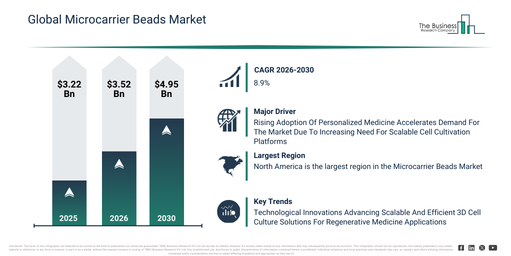
The microcarrier beads market has shown significant expansion in recent years. This market is anticipated to increase from $3.22 billion in 2025 to $3.52 billion in 2026, exhibiting a compound annual growth rate (CAGR) of 9.2%. Key factors contributing to its historical growth include the restricted supply of standardized microcarriers, a reliance on small-scale cell culture methods, the rising need for vaccine production, expanding biopharmaceutical research and development, and the adoption of fundamental tissue engineering techniques.
The microcarrier beads market is projected to experience substantial growth over the next few years. It is anticipated to expand to $4.95 billion by 2030, demonstrating a compound annual growth rate (CAGR) of 8.9%. This expected growth during the forecast period is primarily attributed to the advancement and modification of microcarriers, the increasing scope of gene therapy and regenerative medicine, the growing embrace of scalable bioreactor systems, rising investments in biotechnology, and the progress in personalized medicine and protein therapeutics. Furthermore, significant trends foreseen in this period include an escalating demand for large-scale cell culture expansion, a rise in vaccine and gene therapy production, the broader application of microcarriers in tissue engineering and protein production, the adoption of custom and modified microcarrier beads, and the expansion of academic and research applications for cell-based studies.
Download the Free Sample Report to Explore Key Market Insights:
https://www.thebusinessresearchcompany.com/sample.aspx?id=27345&type=smp
What Drivers Are Influencing The Microcarrier Beads Market?
The microcarrier beads market is anticipated to expand, driven by the increasing trend of personalized medicine. Personalized medicine involves customizing healthcare decisions and treatments based on the individual characteristics of each patient, such as their genetic profile and biological markers. This approach is gaining momentum due to advancements in genomic technologies, which facilitate rapid and cost-efficient analysis of individual genetic data to inform targeted therapies. Microcarrier beads support personalized medicine by offering a scalable system for cultivating patient-specific cells required for individualized treatments. For instance, in February 2024, according to the Personalized Medicine Coalition, a US-based non-profit organization, the FDA approved 16 new personalized treatments for rare disease patients in 2023, an increase compared to 6 in 2022. The 2023 approvals also encompassed seven cancer therapies and three for other medical conditions. Therefore, the growing trend of personalized medicine is a significant driver for the growth of the microcarrier beads market.
Which Segment Areas Are Covered In The Microcarrier Beads Market Analysis?
The microcarrier beads market covered in this report is segmented –
1) By Type: Cytodex Microcarriers, Cultispher Microcarriers, Microcarriers MC10, Microcarriers MC3T3, Microcarriers MC3T3-E1
2) By Size: Small Microcarriers, Medium Microcarriers, Large Microcarriers
3) By Distribution Channel: Direct Sales, Distributors Or Resellers, Online Platforms, Catalogs And Magazines
4) By Application: Cell Culture Expansion, Vaccine Production, Gene Therapy, Tissue Engineering, Protein Production
5) By End-User: Biotechnology Companies, Pharmaceutical Companies, Academic And Research Institutions, Contract Research Organizations (CROs), Other End Users
Subsegments:
1) By Cytodex Microcarriers: Cytodex 1, Cytodex 3, Cytodex 4
2) By CultiSpher Microcarriers: CultiSpher-S, CultiSpher-G, CultiSpher-GM
3) By Microcarriers MC10: MC10 Standard, MC10 Modified
4) By Microcarriers MC3T3: MC3T3 Alpha, MC3T3 Beta
5) By Microcarriers MC3T3-E1: MC3T3-E1 Standard, MC3T3-E1 Enhanced
What Key Developments And Trends Are Impacting The Microcarrier Beads Market?
Major companies engaged in the microcarrier beads market are dedicating efforts to developing advanced solutions, such as hydrophilic polymer-based beads, to improve cell attachment, growth, and scalability within bioreactor-based cell culture systems. Hydrophilic polymer-based beads are characterized as microcarrier beads comprising polymers that readily absorb water, thereby establishing a hydrated environment that emulates natural cellular conditions, which in turn enhances cell viability, proliferation, and functionality during large-scale cell culture processes. For instance, in April 2024, Kuraray Co. Ltd., a chemical manufacturing company from Japan, introduced PVA (polyvinyl alcohol) hydrogel microcarriers for cell culture applications, specifically targeting regenerative medicine. These serve as highly elastic, damage-resistant bead-like scaffolds, enabling efficient, large-scale 3D cell culture, along with straightforward cell recovery, improved proliferation, and safety for regenerative medicine. Their swelling characteristic expands the surface area, consequently reducing the microcarrier usage and allowing for clear microscopic observation of cells during the culture period.
Which Global Companies Are Actively Competing In The Microcarrier Beads Market?
Major companies operating in the microcarrier beads market are Thermo Fisher Scientific Inc., Merck KGaA, Asahi Kasei Corporation, Corning Incorporated, Lonza Corporation, Cytiva Life Sciences, KURARAY CO. LTD., Sartorius AG, Bio-Techne Corporation, Pall Corporation, Ilex Life Sciences Ltd., ReproCELL Inc., HiMedia Laboratories Pvt. Ltd., Synthecon Inc., Beaver Biomedical Engineering Co. Ltd., Percell Biolytica.
Read the full microcarrier beads market report here:
https://www.thebusinessresearchcompany.com/report/microcarrier-beads-global-market-report
Which Regions Are Expected To Experience Rapid Expansion In The Microcarrier Beads Market?
North America was the largest region in the microcarrier beads market in 2025. Asia-Pacific is expected to be the fastest-growing region in the forecast period. The regions covered in the microcarrier beads market report are Asia-Pacific, South East Asia, Western Europe, Eastern Europe, North America, South America, Middle East, Africa.
Request A Tailored Microcarrier Beads Market Research Report For Competitive Advantage:
https://www.thebusinessresearchcompany.com/customise?id=27345&type=smp
Browse Through More Reports Similar to the Global Microcarrier Beads Market 2026, By The Business Research Company
Payment Processor Market Report 2026
https://www.thebusinessresearchcompany.com/report/payment-processor-global-market-report
Payment As A Service Market Report 2026
https://www.thebusinessresearchcompany.com/report/payment-as-a-service-global-market-report
Payment Processing Solutions Market Report 2026
https://www.thebusinessresearchcompany.com/report/payment-processing-solutions-global-market-report
Get in touch with us:
The Business Research Company: https://www.thebusinessresearchcompany.com/
Americas +1 310-496-7795
Asia +44 7882 955267 & +91 8897263534
Europe +44 7882 955267
Email us at info@tbrc.info
Follow us on:
LinkedIn: https://in.linkedin.com/company/the-business-research-company
YouTube: https://www.youtube.com/channel/UC24_fI0rV8cR5DxlCpgmyFQ
Global Market Model: https://www.thebusinessresearchcompany.com/global-market-model