The Business Research Company’s 2026 market reports feature advanced enhancements such as market attractiveness analysis, total addressable market evaluation, company benchmarking matrices, interactive Excel dashboards, expanded supply chain intelligence, emerging startup coverage, and detailed product insights, delivering more actionable and strategically valuable research.
What Is The Expected Market Size Of The Microfluidic Devices Market In 2026 And How Much Will It Reach By 2030?
The microfluidic devices market has experienced rapid expansion in recent years. This market is projected to grow from $10.14 billion in 2025 to $11.72 billion in 2026, reflecting a compound annual growth rate (CAGR) of 15.5%. In the historical period, this growth can be ascribed to several factors, including limited microfabrication techniques, the high cost associated with early microfluidic devices, a reliance on traditional fluid handling methods, expanding pharmaceutical and biotech research, and the adoption of basic lab-on-a-chip applications.
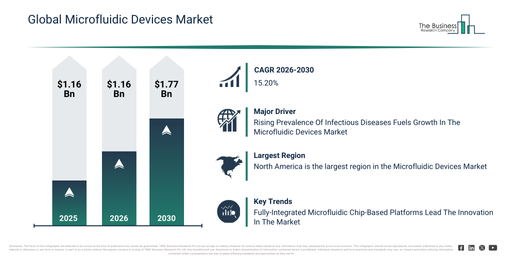
The market for microfluidic devices is projected to experience swift expansion over the coming years, anticipated to reach $20.65 billion by 2030, exhibiting a compound annual growth rate (CAGR) of 15.2%. This projected growth is driven by several factors, including developments in microfabrication and 3D printing technologies, an increasing need for point-of-care diagnostic solutions, the incorporation of sensors and actuators into microfluidic platforms, greater investment in precision medicine research, and the broader use of high-throughput screening applications. Key trends identified for this period encompass the increasing uptake of lab-on-a-chip and digital microfluidic devices, the integration of sophisticated microfluidic sensors for diagnostic purposes, expanded application of microfluidic platforms within pharmaceutical research, the proliferation of polymer and silicon-based microfluidic materials, and a heightened emphasis on miniaturization alongside efficient high-throughput fluid management.
Download A Free Sample Report For Comprehensive Market Insights:
https://www.thebusinessresearchcompany.com/sample.aspx?id=19589&type=smp
What Primary Factors Are Fueling The Expansion Of The Microfluidic Devices Market?
The increasing occurrence of infectious diseases is anticipated to fuel the expansion of the microfluidic devices market in the future. These diseases are health conditions resulting from disease-causing microorganisms, including bacteria, viruses, fungi, or parasites. Their widespread presence stems from the traits of pathogens, environmental influences, human actions, and the accessibility of healthcare services. Microfluidic devices represent an effective instrument in combating infectious diseases, given their capability to manage and examine minute biological samples with great accuracy and effectiveness. This technology improves the capacity to efficiently and precisely detect, diagnose, and manage infectious diseases, thereby fostering improved health results and disease containment. As an illustration, in November 2025, data from the European Centre for Disease Prevention and Control (ECDC), a government agency located in Sweden, indicated that in 2025, there were 266,165 reported CHIKVD cases and 118 deaths, showing a 35.2% decline compared to 2024, with Brazil in South America experiencing the highest impact. Consequently, the growing occurrence of infectious diseases is a key factor propelling the expansion of the microfluidic devices market.
Which Segment Divisions Form The Structure Of The Microfluidic Devices Market?
The microfluidic devices market covered in this report is segmented –
1) By Device Type: Chips, Sensors, Other Device Types
2) By Material: Glass, Silicon, Polymer, Other Materials
3) By End-User: Pharmaceutical And Biotechnology Companies, Research Institutes, Diagnostic Centers, Healthcare Facilities, Other End-Users
Subsegments:
1) By Chips: Lab-On-A-Chip (LoC) Devices, Digital Microfluidic Chips, Microfluidic Flow Control Chips, Integrated Microfluidic Platforms, Diagnostic Microfluidic Chips
2) By Sensors: Pressure Sensors, Flow Sensors, Temperature Sensors, Chemical Sensors, Optical Sensors
3) By Other Device Types: Microfluidic Pumps, Valves And Actuators, Microarray Devices, Microfluidic Analytical Devices, Microfluidic Bioreactors
What Trends Are Affecting The Growth Of The Microfluidic Devices Market?
Leading companies in the microfluidic devices market are concentrating on developing innovative platforms, particularly microfluidic chip-based platforms, to streamline and automate complex laboratory processes, boost the precision and efficiency of experiments, and enable a wide array of applications. A microfluidic chip-based platform refers to a miniaturized device that consolidates multiple laboratory functions onto a single chip, facilitating the precise control and analysis of small fluid volumes. For example, in January 2023, SCIEX, a US-based manufacturer of mass spectrometry instrumentation, introduced the Intabio ZT system, marking it as the first fully integrated microfluidic chip-based platform. This pioneering platform uniquely combines imaged capillary isoelectric focusing (icIEF) separation with UV detection. The system incorporates the Biologics Explorer software, which enhances its data processing capabilities, thereby allowing for a more profound understanding of the biopharmaceuticals under analysis.
Who Are The Leading Firms Participating In The Microfluidic Devices Market?
Major companies operating in the microfluidic devices market are Thermo Fisher Scientific Inc., Danaher Corporation, Agilent Technologies Inc., Teledyne Technologies Incorporated, Illumina Inc., PerkinElmer Inc., Bio-Rad Laboratories Inc., Zeon Corporation, Standard BioTools Inc., Biosurfit SA, Blacktrace Holdings Ltd., LioniX International B.V., CMC Microsystems Inc., Micronit Microfluidics B.V., Sphere Fluidics Limited, Microfluidic ChipShop GmbH, BlackHole Lab Inc., Bartels-Mikrotechnik GmbH, Hesperos Inc., Fluigent SA
Access The Complete Microfluidic Devices Market Report:
https://www.thebusinessresearchcompany.com/report/microfluidic-devices-global-market-report
Which Regional Market Leads The Microfluidic Devices Market?
North America was the largest region in the microfluidic devicess market in 2025. Asia-Pacific is expected to be the fastest-growing region in the market going forward. The regions covered in the microfluidic devices market report are Asia-Pacific, South East Asia, Western Europe, Eastern Europe, North America, South America, Middle East, Africa.
Access a Microfluidic Devices Market Report for Deeper Competitive Insights
https://www.thebusinessresearchcompany.com/report/microfluidic-devices-global-market-report
Browse Through More Reports Similar to the Global Microfluidic Devices Market 2026, By The Business Research Company
Bio Implants Market Report 2026
https://www.thebusinessresearchcompany.com/report/bio-implants-global-market-report
Smart Implants Market Report 2026
https://www.thebusinessresearchcompany.com/report/smart-implants-global-market-report
Metal Implants And Medical Alloys Market Report 2026
Get in touch with us:
The Business Research Company: https://www.thebusinessresearchcompany.com/
Americas: +1 310-496-7795
Asia: +44 7882 955267 & +91 8897263534
Europe: +44 7882 955267
Email us at: marketing@tbrc.info
Follow us on:
LinkedIn: https://in.linkedin.com/company/the-business-research-company
YouTube: https://www.youtube.com/channel/UC24_fI0rV8cR5DxlCpgmyFQ
Global Market Model: https://www.thebusinessresearchcompany.com/global-market-model