Delivering more actionable and strategically valuable research, The Business Research Company’s 2026 market reports feature market attractiveness analysis, total addressable market evaluation, company benchmarking matrices, interactive Excel dashboards, expanded supply chain intelligence, emerging startup coverage, and detailed product insights.
The molecular diagnostics sector for sexually transmitted diseases (STDs) has seen significant momentum recently, driven by advances in technology and rising infection rates. As diagnostic tools become more sophisticated and accessible, the market is poised for substantial growth in the coming years. Let’s explore the current market size, key growth drivers, segmentation, innovations, and regional insights shaping this vital healthcare field.
Current Market Size and Growth Outlook for Molecular Diagnostics in STDs
The molecular diagnostics market for sexually transmitted diseases has expanded quickly in recent years. It is projected to grow from $3.67 billion in 2025 to $4.07 billion in 2026, reflecting a compound annual growth rate (CAGR) of 10.7%. Past growth was largely driven by dependence on traditional serological tests, limited access to automated PCR systems, lack of awareness about molecular diagnostics in emerging economies, rising incidence of STDs, and labor-intensive manual testing workflows.
Download A Free Sample Report For Comprehensive Market Insights:
https://www.thebusinessresearchcompany.com/sample.aspx?id=27351&type=smp
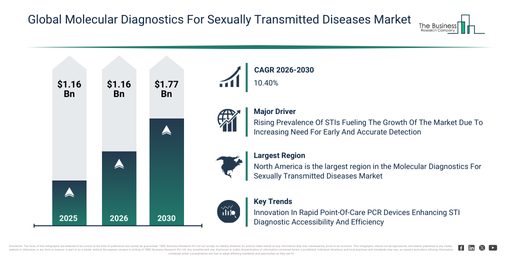
Looking ahead, the market is expected to surge to $6.05 billion by 2030, maintaining a CAGR of 10.4%. This anticipated expansion is attributed to advancements in automated PCR and nucleic acid extraction technologies, growth of point-of-care molecular diagnostic solutions, improved healthcare infrastructure in developing countries, broader adoption of laboratory information management systems (LIMS), and increased research and development investment in rapid and multiplex diagnostic assays. Leading trends forecasted include rising use of nucleic acid-based testing techniques, expansion of point-of-care diagnostics, demand for fast and accurate STD detection, integration with laboratory information systems, and the growth of automated high-throughput PCR platforms.
Increasing Prevalence of STDs Boosting Market Demand
The growing number of sexually transmitted infections worldwide is a significant factor driving the molecular diagnostics market. STDs, caused by bacteria, viruses, and parasites transmitted primarily through sexual contact, affect the reproductive and urinary systems. The rise in infections is mainly due to inconsistent use of protection methods during sexual activity, which facilitates easier disease transmission.
Access The Complete Molecular Diagnostics For Sexually Transmitted Diseases Market Report:
Molecular diagnostics play a crucial role in controlling these infections by enabling early, precise detection of pathogens—even in individuals without symptoms. This leads to timely treatment, reduced spread of infections, and improved patient outcomes. For example, in June 2024, the UK Health Security Agency (UKHSA) reported 401,800 new STI cases in England for 2023, a 4.7% increase from 383,789 cases in 2022. This upward trend in STD prevalence is a key driver for expanding molecular diagnostic solutions.
Market Segmentation and Revenue Sources in Molecular Diagnostics for STDs
The molecular diagnostics market for sexually transmitted diseases is segmented into several categories for detailed analysis:
1) By Product: Instruments and Services, Consumables, and Software
2) By Technology: Laboratory Testing and Point-of-Care Testing
3) By Application: Testing for Chlamydia Trachomatis (CT) or Neisseria Gonorrhoeae (NG), Syphilis, Gonorrhea, Herpes Simplex Virus (HSV), Human Papillomavirus (HPV), Human Immunodeficiency Virus (HIV), Trichomonas, Ureaplasma and Mycoplasma, and other infections.
Further breakdown includes:
– Instruments and Services such as molecular diagnostic analyzers, automated PCR systems, nucleic acid extraction instruments, diagnostic service providers, maintenance and calibration, and installation/training services.
– Consumables comprising DNA and RNA extraction kits, PCR reagents, nucleic acid probes, control and reference standards, detection enzymes, and buffers.
– Software offerings include data interpretation and reporting software, PCR workflow management, laboratory information management systems, diagnostic decision support, and quality control monitoring software.
Innovative Technologies Driving Transformation in Molecular Diagnostics
Leading companies in this sector are focusing on innovative solutions like rapid point-of-care PCR devices that enhance diagnostic speed, accuracy, and accessibility. These portable tools combine sample preparation, amplification, and detection in a single unit, allowing for fast, sensitive pathogen identification outside traditional labs.
For instance, in March 2025, Visby Medical from the US introduced the Visby Medical Women’s Sexual Health Test, a single-use handheld PCR device capable of detecting chlamydia, gonorrhea, and trichomoniasis from vaginal samples within 30 minutes. This device operates without external instruments or cold-chain storage, includes integrated amplification, and delivers lab-quality results on-site to support immediate clinical decisions. It is authorized for prescription home use, making it the first FDA-cleared molecular diagnostic test for multiple STIs usable outside clinical environments. This highlights a shift toward decentralized diagnostics that improve access, especially in underserved or remote populations.
Key Players Shaping the Molecular Diagnostics for STDs Market
Several prominent companies are leading the molecular diagnostics market for sexually transmitted diseases, including:
F. Hoffmann-La Roche Ltd, Thermo Fisher Scientific Inc., Abbott Laboratories, Siemens Healthineers AG, Illumina Inc., Hologic Inc., bioMérieux S.A., QuidelOrtho Corporation, QIAGEN N.V., Cepheid, Sansure Biotech Inc., OraSure Technologies Inc., Meridian Bioscience, Seegene Inc., Visby Medical Inc., Zeesan Biotech, Binx Health Inc., GCC Biotech, GeneProof, and Solone Life Sciences India (P) Ltd.
Regional Market Leadership and Growth Forecast
In 2025, North America accounted for the largest share of the molecular diagnostics market for sexually transmitted diseases. Meanwhile, Asia-Pacific is projected to be the fastest-growing region during the forecast period. The analysis covers key regions including Asia-Pacific, South East Asia, Western Europe, Eastern Europe, North America, South America, the Middle East, and Africa, providing a broad perspective on global market dynamics.
Get in touch with us:
The Business Research Company: https://www.thebusinessresearchcompany.com/
Americas: +1 310-496-7795
Asia: +44 7882 955267 & +91 8897263534
Europe: +44 7882 955267
Email us at: marketing@tbrc.info
Follow us on:
LinkedIn: https://in.linkedin.com/company/the-business-research-company
YouTube: https://www.youtube.com/channel/UC24_fI0rV8cR5DxlCpgmyFQ
Global Market Model: https://www.thebusinessresearchcompany.com/global-market-model