Featuring market attractiveness scoring, total addressable market sizing, company benchmarking matrices, interactive Excel dashboards, deeper supply chain intelligence, emerging startup tracking, and granular product-level insights, The Business Research Company’s 2026 market reports are built to deliver research that is both more actionable and more strategically valuable.
Oncology Biosimilars Market Size And Revenue Outlook Through 2030
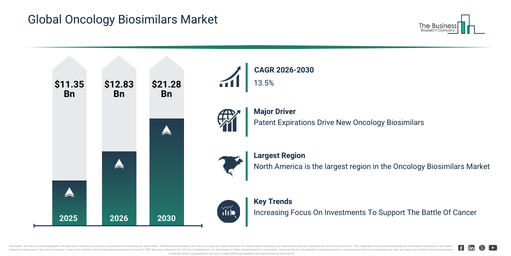
The oncology biosimilars market size has experienced rapid growth in recent years. It is anticipated to expand from $11.35 billion in 2025 to $12.83 billion in 2026, achieving a compound annual growth rate (CAGR) of 13.0%. This historical development can be ascribed to factors such as the high expense of reference biologics, the limited access to oncology biosimilars, the increasing global incidence of cancer, the expansion of hospital and pharmacy infrastructure, and swift regulatory approvals for monoclonal antibody biosimilars.
The oncology biosimilars market is projected to experience substantial expansion in the coming years, reaching a valuation of $21.28 billion by 2030, exhibiting a compound annual growth rate (CAGR) of 13.5%. This anticipated growth is driven by factors such as the introduction of novel biosimilar drugs like pembrolizumab and pegfilgrastim, the broadening of online pharmacy distribution networks, increased acceptance of immunomodulators and hematopoietic agents, governmental efforts to enhance cancer care accessibility, and a greater emphasis on individualized oncology treatments. Key developments expected during this period include the increased uptake of rituximab, trastuzumab, and bevacizumab biosimilars, expanded utilization of immunomodulators and hematopoietic agents in cancer therapy, an increase in G-CSF biosimilars for managing neutropenia, the development of hospital and retail pharmacy channels for oncology biosimilars, and a focus on delivering affordable and easily available cancer treatment options.
Get A Free Sample Report With In-Depth Market Insights:
Oncology Biosimilars Market Growth Catalysts And Demand Drivers
The market for oncology biosimilars is experiencing growth primarily driven by the expiration of patents for biologics utilized in cancer treatment. Biologics, which are patented for a finite duration, pave the way for the creation of new biosimilars once their protective period concludes. These biologics are targeted medications synthesized from living organisms that are designed to stimulate the immune system to attack cancer cells. Biosimilars, although not identical to biologics, offer comparable effectiveness at a reduced cost. An illustration of this trend is seen in February 2024, where DrugTimes, a Chinese-based company focused on the pharmaceutical and biotech industry, reported that by 2037, more than 25 products are expected to lose patent protection. This could potentially result in a combined revenue decline exceeding $236.4 billion, based on 2024 sales figures. Such an increase in patent expiries is projected to significantly boost the demand for the production of new oncology biosimilars, consequently driving the overall market growth for the oncology biosimilars sector.
Oncology Biosimilars Market Segment Landscape And Growth Outlook
The oncology biosimilars market covered in this report is segmented –
1) By Drug Type: Monoclonal Antibody, Immunomodulators, Hematopoietic Agents, Granulocyte Colony-Stimulating Factor (G-CSF)
2) By Cancer Type: Breast Cancer, Colorectal Cancer, Blood Cancer, Neutropenia Cancer, Non-Small Cell Lung Cancer, Other Cancer Types
3) By Distribution Type: Hospital Pharmacy, Retail Pharmacy, Online Pharmacy
Subsegments:
1) By Monoclonal Antibody: Rituximab Biosimilars, Trastuzumab Biosimilars, Bevacizumab Biosimilars, Pembrolizumab Biosimilars
2) By Immunomodulators: Thalidomide Biosimilars, Lenalidomide Biosimilars, Pomalidomide Biosimilars
3) By Hematopoietic Agents: Epoetin Biosimilars, Darbepoetin Biosimilars
4) By Granulocyte Colony-Stimulating Factor (G-CSF): Filgrastim Biosimilars, Pegfilgrastim Biosimilars
Oncology Biosimilars Market Trends Shaping Long-Term Demand
Major companies in the oncology biosimilars market are prioritizing the development of innovative cancer therapies, such as targeted biologics and monoclonal antibodies, to improve treatment effectiveness, patient outcomes, and overall accessibility in oncology care. Monoclonal antibodies (mAbs) are laboratory-engineered proteins created to identify and attach to specific antigens on cancer cells, facilitating precise targeting and immune-mediated destruction. For instance, in March 2023, Pfizer, a US-based pharmaceutical company, completed a merger with Seagen, investing $43 billion to enhance its oncology portfolio. This strategic action boosts Pfizer’s standing in cancer therapeutics and accelerates the creation of advanced treatments for cancer, which is a leading cause of death globally. The investment further emphasizes the increasing trend of significant capital investment into innovative oncology biosimilars to address unmet medical requirements and broaden global access to cancer care.
Oncology Biosimilars Market Competitive Landscape: Who Leads The Industry?
Major companies operating in the oncology biosimilars market are Biocon Biologics Limited, Celltrion Inc., Dr. Reddy’s Laboratories Ltd., Intas Pharmaceuticals Ltd., STADA Arzneimittel AG, Pfizer Inc., Apotex Inc., Teva Pharmaceutical Industries Ltd., Sandoz International GmbH, BIOCAD, Amgen Inc., F. Hoffmann-La Roche, Sanofi SA, Mylan, Samsung Bioepis, Biogen International GmbH, Merck & Co. Inc., Coherus Biosciences, Eli Lilly and Company, Novartis AG, Viatris Inc., Accord Healthcare Ltd., Zydus Cadila Health Care Limited, Hetero Drugs Limited, Mundipharma International Limited, Mabion SA, Polpharma Biologics, Alvotech, Innovent Biologics, Gan & Lee Pharmaceuticals, Henlius Biotech
View The Full Oncology Biosimilars Market Report:
Oncology Biosimilars Market Regional Split: Which Areas Are Fueling Growth?
North America was the largest region in the global oncology biosimilars market in 2025. Middle East is expected to be the fastest-growing region in the oncology biosimilars market report forecast period. The regions covered in the oncology biosimilars market report are Asia-Pacific, South East Asia, Western Europe, Eastern Europe, North America, South America, Middle East, Africa.
Reach Out To Our Team:
The Business Research Company: https://www.thebusinessresearchcompany.com/
Americas: +1 310-496-7795
Asia: +44 7882 955267 & +91 8897263534
Europe: +44 7882 955267
Email us at: marketing@tbrc.info
Follow us on:
LinkedIn: https://in.linkedin.com/company/the-business-research-company
YouTube: https://www.youtube.com/channel/UC24_fI0rV8cR5DxlCpgmyFQ
Global Market Model: https://www.thebusinessresearchcompany.com/global-market-model