Oncology Biosimilars Market 2026 gaining momentum as cost-effective biologics reshape treatment access
The Business Research Company’s 2026 market reports include new capabilities such as market attractiveness scoring and analysis, total addressable market analysis, company scoring matrix, interactive excel data dashboard, improved supply chain analysis, upcoming startups in the market, and overview of key products, aimed at improving the depth, usability, and strategic value of the insights delivered.
What Market Size Expansion Is Predicted For The Oncology Biosimilars Market Between 2026 And 2030?
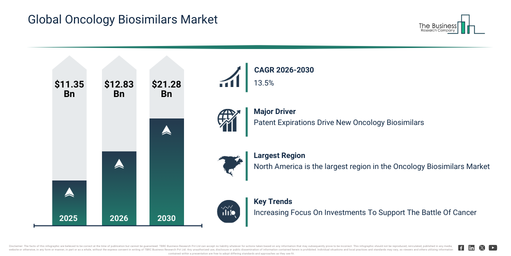
The oncology biosimilars market has seen considerable expansion in recent years. It is anticipated to expand from $11.35 billion in 2025 to $12.83 billion in 2026, exhibiting a compound annual growth rate (CAGR) of 13.0%. This historical growth can be linked to factors such as the high cost of reference biologics, limited availability of oncology biosimilars, increasing cancer prevalence globally, growing hospital and pharmacy infrastructure, and early regulatory approvals for monoclonal antibody biosimilars.
The oncology biosimilars market is projected to experience substantial expansion over the upcoming years, reaching a valuation of $21.28 billion by 2030, driven by a compound annual growth rate (CAGR) of 13.5%. This anticipated growth during the forecast period is fueled by several factors, including the introduction of novel biosimilar drugs such as pembrolizumab and pegfilgrastim, the broadening of online pharmacy distribution networks, a growing uptake of immunomodulators and hematopoietic agents, increased governmental efforts aimed at enhancing access to cancer care, and a heightened emphasis on individualized oncology treatments. Key trends identified for the forecast period encompass the increasing integration of rituximab, trastuzumab, and bevacizumab biosimilars; a greater utilization of immunomodulators and hematopoietic agents in cancer therapy; the expansion of g-csf biosimilars for managing neutropenia; the widening of hospital and retail pharmacy avenues for oncology biosimilars; and a concentrated effort towards offering affordable and readily available cancer treatment choices.
Download the Free Sample Report to Explore Key Market Insights:
https://www.thebusinessresearchcompany.com/sample.aspx?id=2821&type=smp
What Key Drivers Are Influencing The Growth Of The Oncology Biosimilars Market?
The lapse of patents for biologics employed in cancer therapy is a key factor propelling the development of new oncology biosimilars. Biologics are granted patent exclusivity for a finite duration, and the termination of these patents permits the creation of new biosimilars. These are precision drugs, derived from living organisms, designed to stimulate the immune system to attack cancer cells. Biosimilars, while not identical to biologics, provide comparable efficacy at a reduced price point. For instance, in February 2024, according to the DrugTimes is a Chinese-based company focused on the pharmaceutical and biotech industry, it was projected that by 2037, over 25 products would lose patent protection. This could potentially result in a cumulative revenue decrease surpassing $236.4 billion, calculated using 2024 sales figures. This anticipated increase in patent expirations is expected to stimulate the demand for producing new oncology biosimilars, thereby fostering market expansion for the oncology biosimilars sector.
Which Market Segments Are Examined In The Oncology Biosimilars Market Study?
The oncology biosimilars market covered in this report is segmented –
1) By Drug Type: Monoclonal Antibody, Immunomodulators, Hematopoietic Agents, Granulocyte Colony-Stimulating Factor (G-CSF)
2) By Cancer Type: Breast Cancer, Colorectal Cancer, Blood Cancer, Neutropenia Cancer, Non-Small Cell Lung Cancer, Other Cancer Types
3) By Distribution Type: Hospital Pharmacy, Retail Pharmacy, Online Pharmacy
Subsegments:
1) By Monoclonal Antibody: Rituximab Biosimilars, Trastuzumab Biosimilars, Bevacizumab Biosimilars, Pembrolizumab Biosimilars
2) By Immunomodulators: Thalidomide Biosimilars, Lenalidomide Biosimilars, Pomalidomide Biosimilars
3) By Hematopoietic Agents: Epoetin Biosimilars, Darbepoetin Biosimilars
4) By Granulocyte Colony-Stimulating Factor (G-CSF): Filgrastim Biosimilars, Pegfilgrastim Biosimilars
Which Trends Are Influencing The Oncology Biosimilars Market?
Leading firms within the oncology biosimilars market are concentrating their efforts on creating advanced cancer treatments, including targeted biologics and monoclonal antibodies, with the aim of improving therapeutic effectiveness, patient results, and accessibility in cancer care generally. Monoclonal antibodies (mAbs) are laboratory-designed proteins that identify and attach to particular antigens on cancer cells, allowing for accurate targeting and their destruction by the immune system. A notable example occurred in March 2023 when Pfizer, a pharmaceutical firm based in the US, acquired Seagen and committed $43 billion to bolster its offerings in oncology. This strategic acquisition significantly strengthens Pfizer’s position in cancer therapies and expedites the creation of cutting-edge treatments for cancer, which remains a primary global cause of mortality. Furthermore, this investment highlights an increasing pattern of substantial financial commitments towards pioneering oncology biosimilars, intended to fulfill underserved medical requirements and broaden worldwide access to cancer treatment.
Who Are The Primary Competitors In The Oncology Biosimilars Market?
Major companies operating in the oncology biosimilars market are Biocon Biologics Limited, Celltrion Inc., Dr. Reddy’s Laboratories Ltd., Intas Pharmaceuticals Ltd., STADA Arzneimittel AG, Pfizer Inc., Apotex Inc., Teva Pharmaceutical Industries Ltd., Sandoz International GmbH, BIOCAD, Amgen Inc., F. Hoffmann-La Roche, Sanofi SA, Mylan, Samsung Bioepis, Biogen International GmbH, Merck & Co. Inc., Coherus Biosciences, Eli Lilly and Company, Novartis AG, Viatris Inc., Accord Healthcare Ltd., Zydus Cadila Health Care Limited, Hetero Drugs Limited, Mundipharma International Limited, Mabion SA, Polpharma Biologics, Alvotech, Innovent Biologics, Gan & Lee Pharmaceuticals, Henlius Biotech
Read the full oncology biosimilars market report here:
https://www.thebusinessresearchcompany.com/report/oncology-biosimilar-global-market-report
Which Region Is Expected To Register The Fastest Growth In The Oncology Biosimilars Market?
North America was the largest region in the global oncology biosimilars market in 2025. Middle East is expected to be the fastest-growing region in the oncology biosimilars market report forecast period. The regions covered in the oncology biosimilars market report are Asia-Pacific, South East Asia, Western Europe, Eastern Europe, North America, South America, Middle East, Africa.
Request A Tailored Oncology Biosimilars Market Research Report For Competitive Advantage:
https://www.thebusinessresearchcompany.com/customise?id=2821&type=smp
Browse Through More Reports Similar to the Global Oncology Biosimilars Market 2026, By The Business Research Company
Biosimilar Growth Hormone Market Report 2026
https://www.thebusinessresearchcompany.com/report/biosimilar-growth-hormone-global-market-report
Biosimilar Monoclonal Antibodie Market Report 2026
Biosimilar Therapeutic Peptide Market Report 2026
Get in touch with us:
The Business Research Company: https://www.thebusinessresearchcompany.com/
Americas +1 310-496-7795
Asia +44 7882 955267 & +91 8897263534
Europe +44 7882 955267
Email us at info@tbrc.info
Follow us on:
LinkedIn: https://in.linkedin.com/company/the-business-research-company
YouTube: https://www.youtube.com/channel/UC24_fI0rV8cR5DxlCpgmyFQ
Global Market Model: https://www.thebusinessresearchcompany.com/global-market-model