Ophthalmic Lasers Market Outlook Highlights The Next Major Growth Opportunities
Delivering more actionable and strategically valuable research, The Business Research Company’s 2026 market reports feature market attractiveness analysis, total addressable market evaluation, company benchmarking matrices, interactive Excel dashboards, expanded supply chain intelligence, emerging startup coverage, and detailed product insights.
The ophthalmic lasers market has been witnessing notable growth in recent years, driven by advances in technology and increasing demand for eye care treatments. As the population ages and awareness around vision health rises, this sector is expected to continue expanding steadily in the coming years. Below is an overview of the market size, growth drivers, segmentation, technological trends, leading players, and regional insights shaping the ophthalmic lasers industry.
Ophthalmic Lasers Market Size and Projected Growth Through 2030
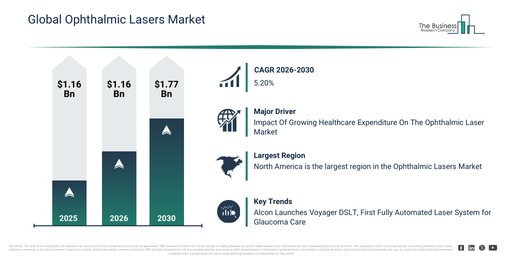
The ophthalmic lasers market has demonstrated strong growth historically, with its size projected to increase from $1.42 billion in 2025 to $1.49 billion in 2026, reflecting a compound annual growth rate (CAGR) of 5.3%. This growth is attributed to factors such as the rising incidence of cataracts and refractive errors, early adoption of laser procedures like LASIK and PRK, enhancement of hospital-based ophthalmic surgery infrastructure, increased healthcare spending in developed regions, and regulatory approvals for laser treatment systems. Looking ahead, the market is expected to reach $1.83 billion by 2030, with a CAGR of 5.2%. This anticipated growth is supported by an aging population in emerging economies, increasing numbers of surgeries in ambulatory centers, a growing burden of diabetes and diabetic retinopathy, advancements in femtosecond and Nd:YAG laser technology, and rising demand for elective vision correction procedures. Key trends shaping the market include a shift toward minimally invasive laser surgeries, wider adoption of outpatient laser procedures, increasing prevalence of diabetic retinopathy and age-related macular degeneration, growing use of laser-assisted cataract and refractive treatments, and the integration of multi-functional ophthalmic laser platforms.
Download A Free Sample Report For Comprehensive Market Insights:
https://www.thebusinessresearchcompany.com/sample.aspx?id=13498&type=smp
Healthcare Spending as a Catalyst for Ophthalmic Lasers Market Growth
Rising healthcare expenditure plays a crucial role in driving the ophthalmic lasers market forward. Healthcare spending encompasses the resources allocated to medical goods and services, public health programs, and administrative costs. This growing expenditure is influenced by factors such as an aging population, medical technology breakthroughs, climbing pharmaceutical costs, and the increasing prevalence of chronic diseases. Increased healthcare investment allows for greater adoption of advanced laser technologies and expands access to precision eye care treatments for more patients. For example, in June 2024, Health Affairs reported that U.S. national healthcare spending is projected to rise from $4,799.3 billion in 2023 to $5,048.8 billion in 2024, an increase of approximately $249.5 billion. This surge in healthcare funding is an important driver of the ophthalmic laser market’s development.
Segmentation of the Ophthalmic Lasers Market and Its Revenue Drivers
The ophthalmic lasers market is segmented based on product types, applications, and end-users to provide a comprehensive understanding of the industry dynamics. Product categories include femtosecond lasers, excimer lasers, neodymium-doped yttrium aluminum garnet (Nd:YAG) lasers, diode lasers, and other laser types. The application segments cover treatments for refractive errors, cataracts, glaucoma, diabetic retinopathy, age-related macular degeneration (AMD), and other conditions. End-users comprise hospitals, ambulatory service centers, and ophthalmic clinics. Further subcategorization recognizes specific types of femtosecond lasers used for cataract surgery, refractive surgery, and corneal flap creation; excimer lasers for LASIK, PRK, and corneal reshaping; Nd:YAG lasers for capsulotomy, retinal disorders, and glaucoma treatment; diode lasers for retinal photocoagulation, glaucoma, and pterygium surgery; and other products such as argon, KTP, and holmium lasers. This detailed segmentation highlights the diverse applications and technologies fueling market growth.
Access The Complete Ophthalmic Lasers Market Report:
https://www.thebusinessresearchcompany.com/report/ophthalmic-lasers-global-market-report
Innovations Transforming the Ophthalmic Lasers Market
Technological advancements are rapidly transforming the ophthalmic lasers market, with companies focusing on innovations that improve treatment efficacy and patient experience. One such innovation is the development of fully automated Direct Selective Laser Trabeculoplasty (DSLT) systems, which offer efficient first-line treatment for glaucoma and ocular hypertension. These systems combine precise laser delivery, eye-tracking features, and user-friendly interfaces to remove the need for manual gonio lens positioning, reduce training demands, and enable ophthalmologists to treat patients more safely and effectively. For instance, in February 2025, Alcon launched the Voyager DSLT device in the U.S., which administers 120 automated laser pulses per treatment using SureTrac eye-tracking technology. This innovation improves targeting accuracy of the trabecular meshwork, increases procedural efficiency, expands patient access to glaucoma therapy, and streamlines clinical workflows for eye care providers.
Key Players Leading Competition in the Ophthalmic Lasers Market
Several prominent companies dominate the ophthalmic lasers market, driving competition and innovation. These include Abbott Laboratories, Alcon Laboratories Inc., Bausch & Lomb Incorporated, Coherent Inc., Carl Zeiss Meditec AG, Topcon Corporation, Lumenis Ltd., Johnson & Johnson Surgical Vision Inc., LUMIBIRD, Lutronic Corporation, Quantel Medical SAS, NIDEK CO. LTD, IRIDEX Corporation, Ellex Inc., Technolas Perfect Vision GmbH, LENSAR LLC, Lightmed GmbH, Ziemer Ophthalmic Systems AG, SCHWIND eye-tech-solutions GmbH & Co. KG, NoIR Laser Company LLC, DEKA Laser, A.R.C. Laser GmbH, ATL Lasertechnik GmbH, Norlase, Alna-Medicalsystem GmbH, and Luxium Solutions LLC. These organizations continue to invest in cutting-edge research and product development to maintain leadership in this fast-evolving sector.
Geographical Insights Highlighting Market Leadership and Growth Regions
In 2025, North America held the largest share of the ophthalmic lasers market, driven by advanced healthcare infrastructure, high adoption rates, and favorable reimbursement policies. Meanwhile, the Asia-Pacific region is anticipated to be the fastest-growing market during the forecast period, fueled by improving healthcare access, increasing surgical volumes, and a growing elderly population. The market analysis includes regions such as Asia-Pacific, South East Asia, Western Europe, Eastern Europe, North America, South America, the Middle East, and Africa, providing a global perspective on market trends and opportunities.
Get in touch with us:
The Business Research Company: https://www.thebusinessresearchcompany.com/
Americas: +1 310-496-7795
Asia: +44 7882 955267 & +91 8897263534
Europe: +44 7882 955267
Email us at: marketing@tbrc.info
Follow us on:
LinkedIn: https://in.linkedin.com/company/the-business-research-company
YouTube: https://www.youtube.com/channel/UC24_fI0rV8cR5DxlCpgmyFQ
Global Market Model: https://www.thebusinessresearchcompany.com/global-market-model