
Global Opioid-Induced Constipation Treatment Market Report 2026–2030: Data-Driven Growth Insights
Uncover key drivers, emerging technologies, and competitive movements shaping the opioid-induced constipation treatment market from 2026–2035 with trusted insights from The Business Research Company
How much larger will the Opioid-Induced Constipation Treatment Market be in 2030 compared with 2026?
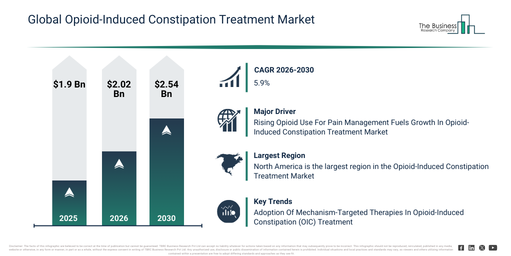
The opioid-induced constipation treatment market size has seen strong expansion in recent years. It is forecast to increase from $1.9 billion in 2025 to $2.02 billion in 2026, achieving a compound annual growth rate (CAGR) of 6.7%. The market’s historical growth can be linked to factors such as the extensive use of opioids for managing chronic pain, the insufficient efficacy of conventional laxatives, the increasing prevalence of pain associated with cancer, the lack of early OIC-specific treatments, and a rise in hospitalizations stemming from opioid adverse effects.
The opioid-induced constipation treatment market size is anticipated to expand substantially in the coming years. It is projected to reach $2.54 billion by 2030, demonstrating a compound annual growth rate (CAGR) of 5.9%. This expansion during the forecast period is fueled by several factors, including the increasing demand for PAMORA-based therapies, a rise in long-term opioid prescriptions among older demographics, a greater clinical emphasis on patient-centric pain management, the widening availability of online and retail pharmacies, and increased investment in the development of drugs for gastrointestinal disorders. Noteworthy trends for the forecast period encompass a greater adoption of peripherally acting μ-opioid receptor antagonists, a growing inclination towards targeted OIC therapies that do not compromise analgesia, an expanded application of combined pharmacological and non-pharmacological treatments, a heightened focus on enhancing the quality of life for individuals with chronic pain, and an improved awareness and diagnosis of opioid-induced constipation.
Access Your Free Sample Report for In-Depth Market Insights:
https://www.thebusinessresearchcompany.com/sample.aspx?id=15881&type=smp
What Drivers Are Guiding Growth Patterns In The Opioid-Induced Constipation Treatment Market?
The increasing administration of opioids for both cancer and non-cancer pain is projected to advance the opioid-induced constipation treatment market. Cancer pain relates to discomfort associated with cancer and its remedies, while non-cancer pain originates from conditions unrelated to cancer. The use of opioids for cancer and non-cancer pain is essential for effectively managing moderate to severe pain, taking into account elements such as pain intensity and duration, patient response to alternative treatments, and the overarching aim of enhancing quality of life while minimizing potential addiction risks and adverse effects. Opioid-induced constipation (OIC) treatment aids patients suffering from cancer and non-cancer pain by alleviating constipation caused by opioid consumption, thereby improving overall comfort, adherence to pain management plans, and quality of life without compromising pain relief. For example, in November 2024, information from the Centers for Disease Control and Prevention, a US-based public health agency, indicated that in 2023, the rate was 37.5 opioid prescriptions dispensed per 100 persons. Additionally, states with the highest opioid dispensing rates per 100 persons in 2023 included Arkansas (71.5), Alabama (71.4), Mississippi (63.1), and Louisiana (62.7). Thus, the increased administration of opioids for cancer and non-cancer pain is stimulating the expansion of the opioid-induced constipation treatment market.
How Is The Opioid-Induced Constipation Treatment Market Divided Into Segments?
The opioid-induced constipation treatment market covered in this report is segmented –
1) By Drug Class: Laxatives, Peripherally Acting μ-opioid Receptor Antagonists, Serotonin Receptor Agonists
2) By Type: Oral, Parenteral
3) By Distribution Channel: Hospital Pharmacies, Online Pharmacies, Retail Pharmacies
Subsegments:
1) By Laxatives: Osmotic Laxatives, Stimulant Laxatives, Bulk-Forming Laxatives
2) By Peripherally Acting μ-Opioid Receptor Antagonists: Naloxegol, Methylnaltrexone, Alvimopan
3) By Serotonin Receptor Agonists: Prucalopride, Tegaserod
What Industry Trends Are Transforming The Opioid-Induced Constipation Treatment Market?
Key companies operating in the opioid-induced constipation treatment market are prioritizing the development of innovations such as peripherally acting μ-opioid receptor antagonists (PAMORAs). These are engineered for targeted modulation of gut receptors, aiming to boost efficacy, improve patient adherence, and mitigate systemic adverse effects during opioid therapy. A PAMORA operates by selectively blocking μ-opioid receptors in the gastrointestinal tract without crossing the blood–brain barrier, thereby restoring bowel function while maintaining central analgesia, unlike traditional laxatives which do not address the underlying receptor-mediated cause of constipation. As an illustration, in May 2025, Luye Pharma, a China-based pharmaceutical company, introduced Mimeixin, an oral oxycodone/naloxone sustained-release tablet specifically formulated for OIC. This product delivers once-daily analgesia while simultaneously antagonizing gut opioid receptors, leading to improved bowel regularity and reduced gastrointestinal side effects compared to older therapies, thus providing a patient-friendly option that combines pain control and constipation management in a single tablet.
Which Key Players Are Driving Competition In The Opioid-Induced Constipation Treatment Market?
Major companies operating in the opioid-induced constipation treatment market are Pfizer Inc., AstraZeneca plc, Takeda Pharmaceutical Company Limited, Bausch Health Companies Inc., Ironwood Pharmaceuticals Inc., Collegium Pharmaceutical Inc., Cumberland Pharmaceuticals Inc., RedHill Biopharma Ltd., Theravance Biopharma Inc., Mundipharma International Limited, Daiichi Sankyo Co Ltd, Progenics Pharmaceuticals Inc, Shionogi & Co Ltd, Purdue Pharma, Nektar Therapeutics, S L A Pharma AG, Bristol‑Myers Squibb Company, Fresenius Kabi AG, Viatris Inc, Novartis AG, Teva Pharmaceutical Industries Ltd, F Hoffmann‑La Roche Ltd, Aurobindo Pharma, Abbott Laboratories, Daewoong Pharmaceutical Company
Access The Complete Report For Deeper Market Insights:
Which Region Currently Holds The Largest Share Of The Opioid-Induced Constipation Treatment Market?
North America was the largest region in the opioid-induced constipation treatment market in 2025. Asia-Pacific is expected to be the fastest-growing region in the forecast period. The regions covered in the opioid-induced constipation treatment market report are Asia-Pacific, South East Asia, Western Europe, Eastern Europe, North America, South America, Middle East, Africa.
Request Your Customized Opioid-Induced Constipation Treatment Market Research Report for Competitive Advantage:
https://www.thebusinessresearchcompany.com/customise?id=15881&type=smp
Browse Through More Reports Similar to the Global Opioid-Induced Constipation Treatment Market 2026, By The Business Research Company
Migraine Treatment Market Report 2026
https://www.thebusinessresearchcompany.com/report/migraine-treatment-global-market-report
Constipation Treatment Market Report 2026
https://www.thebusinessresearchcompany.com/report/constipation-treatment-global-market-report
Constipation Laxative Market Report 2026
https://www.thebusinessresearchcompany.com/report/constipation-laxative-global-market-report
Get in touch with us:
The Business Research Company: https://www.thebusinessresearchcompany.com/
Americas +1 310-496-7795
Asia +44 7882 955267 & +91 8897263534
Europe +44 7882 955267
Email us at info@tbrc.info
Follow us on:
LinkedIn: https://in.linkedin.com/company/the-business-research-company
YouTube: https://www.youtube.com/channel/UC24_fI0rV8cR5DxlCpgmyFQ
Global Market Model: https://www.thebusinessresearchcompany.com/global-market-model

