Claim your 30% discount on Global Market Reports with code ONLINE30. Limited time only.
How Has the Pediatric Growth Hormone Deficiency Market Grown from 2024 to 2025?
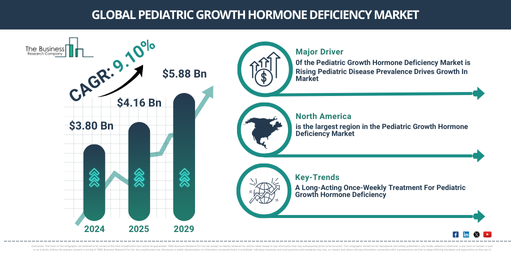
The market for pediatric growth hormone deficiency has seen significant expansion in the past few years. It is predicted to increase from a value of $3.80 billion in 2024 to $4.16 billion in 2025, showcasing a compound annual growth rate (CAGR) of 9.4%. This impressive growth in the historical period is due to factors such as heightened awareness about how to treat childhood growth disorders, improved diagnostic ability, increased funding for researching and developing next-generation products, and an enhanced public insurance program.
What Growth Rate Is Anticipated for the Pediatric Growth Hormone Deficiency Market in the Coming Years?
Predictions suggest that the market size for pediatric growth hormone deficiency will witness substantial expansion in the upcoming years, with projections indicating a rise to $5.88 billion by 2029 – a compound annual growth rate (CAGR) of 9.1%. This anticipated growth during the forecast period is linked to factors such as the augmentation of healthcare infrastructure and accessibility, advancements in growth hormone treatment practices, increased awareness and patient advocacy, favorable government policies, and healthcare schemes, coupled with a surge in the incidence of PGHD. The forecast period is also expected to see significant trends such as the unveiling of new therapy methods, customization in treatment options, product innovation, the use of telemedicine and remote monitoring, plus personalized medicine and genetic testing.
Download The Free Sample Report Here:
https://www.thebusinessresearchcompany.com/sample.aspx?id=21250&type=smp
Who Are the Leading Companies in the Pediatric Growth Hormone Deficiency Market?
Major companies operating in the pediatric growth hormone deficiency market are Pfizer Inc., Eli Lilly and Company, Novo Nordisk A/S, Genentech Inc., Merck KGaA Darmstadt Germany, Teva Pharmaceutical Industries Ltd., Mylan N.V., Sandoz International GmbH, Sun Pharmaceutical Industries Ltd., I-Mab Biopharma Co. Ltd., Ipsen Pharma, Gedeon Richter Plc, Ferring Pharmaceuticals, Celltrion Healthcare Co. Ltd., OPKO Health Inc., Zhejiang Hisun Pharmaceutical Co., Ltd., Dong-A ST Co. Ltd., Ascendis Pharma A/S, AnkeBio, Versartis Inc., Changchun Changsheng Life Sciences Ltd.
What Are the Key Drivers of the Pediatric Growth Hormone Deficiency Market?
The escalation of pediatric illnesses is forecasted to stimulate the expansion of the pediatric growth hormone deficiency market. Pediatric illnesses are medical ailments predominantly affecting children, from newborns to adolescents. The rise in pediatric illnesses can be attributed to environmental influences, improved diagnostic methods, changes in lifestyle, genetic susceptibility, and a surge in the chronic diseases and allergies among youngsters. These diseases can cause pediatric growth hormone deficiency (GHD) by impairing the function of the hypothalamus or pituitary gland, which play a crucial role in the production of growth hormone. For example, in March 2024, as per the data released by United Nations Children’s Fund (UNICEF), a US-based government agency, an estimated 4.9 million children below the age of five lost their lives in 2022, averaging to about 13,400 deaths every day. Global leading causes of mortality for children under five include infectious diseases like pneumonia, diarrhea, and malaria along with complications arising from premature birth and issues related to the intrapartum period. Hence, the increasing incidence of pediatric diseases is fostering the growth of the pediatric growth hormone deficiency market.
Request For A Customized Report:
https://www.thebusinessresearchcompany.com/customise?id=21250&type=smp
What Are the Key Market Segments in the Pediatric Growth Hormone Deficiency Industry?
The pediatric growth hormone deficiency market covered in this report is segmented –
1) By Type: Congenital GH Deficiency, Acquired GH Deficiency, Idiopathic GH deficiency
2) By Product: Recombinant Human Growth Hormone (rhGH), Human Growth Hormone (HGH) Analogs, Long-Acting Growth Hormones
3) By Route Of Administration: Subcutaneous, Intramuscular, Oral
4) By Distribution Channel: Hospital Pharmacies, Retail Pharmacies, Online Pharmacies
5) By Application: Growth Hormone Deficiency, Idiopathic Short Stature, Turner Syndrome, Small For Gestational Age, Prader Willi Syndrome, Other Applications
Subsegments:
1) By Congenital GH Deficiency: Isolated GH Deficiency, Combined Pituitary Hormone Deficiency
2) By Acquired GH Deficiency: GH Deficiency Due To Pituitary Tumors, GH Deficiency Due To Brain Injury, GH Deficiency Due To Radiation Therapy
3) By Idiopathic GH Deficiency: Primary Idiopathic GH Deficiency, Secondary Idiopathic GH Deficiency
What Are the Latest Trends in the Pediatric Growth Hormone Deficiency Market?
Major players in the market for pediatric growth hormone deficiency are concentrating their efforts on the creation of ground-breaking solutions like long-acting, once-weekly human growth hormone analogs, to enhance patient adaptability and convenience. The term ‘long-acting, once-weekly human growth hormone (HGH) analog’ designates a modified variant of the natural human growth hormone that is designed to stay active in the body for extended periods. For instance, in June 2023, a joint announcement was made by Pfizer Inc., and OPKO Health Inc., both US-based, introducing NGENLA (somatrogon-ghla), a once-weekly human growth hormone analog curated specifically for treating growth failure in pediatric patients aged three and above due to inadequate growth hormone secretion. This innovative treatment was approved by the US-based government body, the Food and Drug Administration. The goal of this novel therapy is to enhance patient adaptability by bringing down the number of injections, considering that the conventional treatments generally involve daily dosage. Clinical trials indicated that NGENLA offers comparable effectiveness as daily growth hormone therapies do, thereby providing a more feasible and manageable alternative for children and their families.
Access The Full Report Here:
What Are the Key Regional Markets in the Pediatric Growth Hormone Deficiency Industry?
North America was the largest region in the pediatric growth hormone deficiency market in 2024. Asia-Pacific is expected to be the fastest-growing region in the forecast period. The regions covered in the pediatric growth hormone deficiency market report are Asia-Pacific, Western Europe, Eastern Europe, North America, South America, Middle East, Africa.
Purchase The Full Report Today:
https://www.thebusinessresearchcompany.com/purchaseoptions.aspx?id=21250
This Report Delivers Insight On:
1. How big is the pediatric growth hormone deficiency market, and how is it changing globally?
2. Who are the major companies in the pediatric growth hormone deficiency market, and how are they performing?
3. What are the key opportunities and risks in the pediatric growth hormone deficiency market right now?
4. Which products or customer segments are growing the most in the pediatric growth hormone deficiency market?
5. What factors are helping or slowing down the growth of the pediatric growth hormone deficiency market?
About The Business Research Company:
With over 15000+ reports from 27 industries covering 60+ geographies, The Business Research Company has built a reputation for offering comprehensive, data-rich research and insights. Armed with 1,500,000 datasets, the optimistic contribution of in-depth secondary research, and unique insights from industry leaders, you can get the information you need to stay ahead in the game.
Get in touch with us:
The Business Research Company: https://www.thebusinessresearchcompany.com/
Americas +1 310-496-7795
Asia +44 2071930708
Europe +44 7882 955267
Email us at info@tbrc.info
Follow us on:
LinkedIn: https://in.linkedin.com/company/the-business-research-company
YouTube: https://www.youtube.com/channel/UC24_fI0rV8cR5DxlCpgmyFQ
Global Market Model: https://www.thebusinessresearchcompany.com/global-market-model