
Positron Emission Tomography (PET) Scanners Market Growth To $2.12 Billion Creates New Opportunities Across The Industry
Featuring market attractiveness scoring, total addressable market sizing, company benchmarking matrices, interactive Excel dashboards, deeper supply chain intelligence, emerging startup tracking, and granular product-level insights, The Business Research Company’s 2026 market reports are built to deliver research that is both more actionable and more strategically valuable.
Positron Emission Tomography (PET) Scanners Market Revenue Outlook: What CAGR Lies Ahead Through 2030?
The positron emission tomography (pet) scanners market has shown strong expansion in recent years. It is anticipated to grow from $1.58 billion in 2025 to $1.66 billion in 2026, reflecting a compound annual growth rate (CAGR) of 5.2%. The past growth can be attributed to various factors such as the increasing prevalence of cancer and chronic conditions that require functional imaging, the greater adoption of pet-ct systems by hospitals for oncology diagnostics, the early availability of gadolinium oxyorthosilicate and bismuth germanium oxide detector technologies, the expansion of diagnostic imaging infrastructure across hospitals and specialty centers, and the accumulating clinical evidence supporting pet imaging for treatment planning.
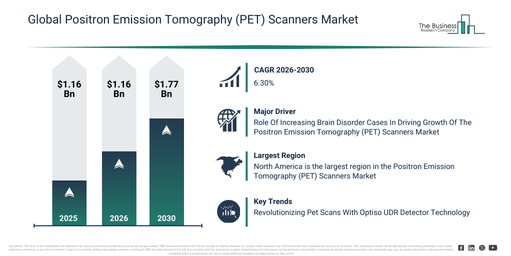
The market for positron emission tomography (PET) scanners is projected to experience substantial expansion over the forthcoming years. It is forecast to reach $2.12 billion by 2030, exhibiting a compound annual growth rate (CAGR) of 6.3%. Key factors contributing to this anticipated growth include an escalating demand for advanced hybrid PET-MRI and PET-CT platforms, enhanced deployment of lutetium fine silicate and lutetium oxyorthosilicate detectors, increasing application volumes within cardiology and neurology, wider availability of PET scanners in developing healthcare sectors, and a heightened emphasis on precision imaging for tailoring therapy assessments. Noteworthy trends during the forecast period encompass the increasing adoption of PET-CT and PET-MRI imaging for sophisticated disease diagnosis and monitoring, expanded use of PET scanners in oncology for detecting cancer and evaluating treatments, a growing inclination towards hybrid and high-resolution PET imaging systems, the broadened scope of PET imaging applications across cardiology, neurology, and gastroenterology, and the increased installation of PET scanners in both hospitals and diagnostic centers.
Get A Free Sample Report With In-Depth Market Insights:
Positron Emission Tomography (PET) Scanners Market Industry Drivers: What’s Behind The Revenue Growth?
The rising incidence of brain disorder cases is projected to fuel the expansion of the positron emission tomography (PET) scanners market in the future. A brain disorder refers to any condition impairing the brain’s typical function, resulting from disease, genetic factors, or physical trauma. PET scans utilize a radioactive tracer substance to visualize both normal and abnormal metabolic activity within the brain. positron emission tomography (PET) scanners track brain function, monitor disease progression, assess treatment efficacy, and identify conditions not visible through other imaging modalities. For example, as reported by the Alzheimer’s Association, a US-based non-profit organization, in March 2024, approximately 6.9 million Americans aged 65 and older were estimated to be living with Alzheimer’s dementia as of 2024. Furthermore, this figure is anticipated to rise to 13.8 million by 2060. Consequently, the growing prevalence of brain disorder cases is a key factor propelling the expansion of the positron emission tomography (PET) scanners market.
Positron Emission Tomography (PET) Scanners Market Segment Analysis: What Are The Core Market Categories?
The positron emission tomography (pet) scanners market covered in this report is segmented –
1) By Modality: PET-CT (Positron Emission Tomography-Computed Tomography), PET-MRI (Positron Emission Tomography-Magnetic Resonance Imaging)
2) By Detector Type: Gadolinium Oxyorthosilicate, Lutetium Fine Silicate, Bismuth Germanium Oxide, Lutetium Oxyorthosilicate
3) By Application: Cardiology, Neurology, Oncology, Orthopedics, Urology, Gastroenterology, Other Applications
4) By End User: Hospitals, Diagnostic Centers, Other End-Users
Subsegments:
1) By PET-CT (Positron Emission Tomography-Computed Tomography): Standalone PET-CT Systems, Hybrid PET-CT Systems
2) By PET-MRI (Positron Emission Tomography-Magnetic Resonance Imaging): Dedicated PET-MRI Systems
#Positron Emission Tomography (PET) Scanners Market Growth Trends: What’s Shaping The Future Outlook?
Leading companies in the positron emission tomography (PET) scanner market are developing innovative products by adopting new technologies such as Optiso Ultra Dynamic Range (UDR) detector technology to provide reliable services to their customers. The Optiso Ultra Dynamic Range (UDR) detector represents a new generation of PET detector, utilizing multiple technologies to deliver optimal performance across a wide spectrum of count rates. This significantly enhances the image quality and diagnostic accuracy of PET scans, especially benefiting patients with high-activity tracers. For instance, in June 2023, Siemens Healthineers AG, a Germany-based provider of healthcare solutions and services, launched Biograph Vision X, a next-generation positron emission tomography/computed tomography (PET/CT) scanner. This system was developed with Optiso Ultra Dynamic Range (UDR) detector technology, which employs silicon photomultipliers (SiPMs), facilitating the use of small 3.2 mm x 3.2 mm lutetium oxyorthosilicate (LSO) crystal elements. These smaller crystals provide higher spatial resolution than larger ones and achieve a time of flight (TOF) of 178 picoseconds (PS). By fully coating these incredibly tiny LSO crystals with SiPMs, the scanner attains an excellent 48-mm3 volumetric resolution and a 20% performance enhancement (TOF gain).
Positron Emission Tomography (PET) Scanners Market Industry Leaders And Competitive Landscape
Major companies operating in the positron emission tomography (pet) scanners market are Hitachi Ltd., Canon Medical Systems USA Inc., Toshiba Corporation, Siemens Healthineers, Fujifilm Holdings Corporation, Koninklijke Philips N.V., GE HealthCare, CMR Naviscan Corporation, Shimadzu Corporation, Neusoft Medical Systems Co. Ltd., Mediso Medical Imaging Systems, Cubresa Inc., Oncovision, Mediso Ltd., MR Solutions Group Ltd., MinFound Medical Systems Co. Ltd, PETsys Electronics SA, Positron Corporation, RefleXion Medical, EdgePoint Medical
View The Full Positron Emission Tomography (PET) Scanners Market Report:
Positron Emission Tomography (PET) Scanners Market Regional Analysis And Top Geography
North America was the largest region in the positron emission tomography (PET) scanners market in 2025. Asia-Pacific is expected to be the fastest-growing region in the forecast period. The regions covered in the positron emission tomography (pet) scanners market report are Asia-Pacific, South East Asia, Western Europe, Eastern Europe, North America, South America, Middle East, Africa.
Reach Out To Our Team:
The Business Research Company: https://www.thebusinessresearchcompany.com/
Americas: +1 310-496-7795
Asia: +44 7882 955267 & +91 8897263534
Europe: +44 7882 955267
Email us at: marketing@tbrc.info
Follow us on:
LinkedIn: https://in.linkedin.com/company/the-business-research-company
YouTube: https://www.youtube.com/channel/UC24_fI0rV8cR5DxlCpgmyFQ
Global Market Model: https://www.thebusinessresearchcompany.com/global-market-model

