Platelet Aggregation Devices Market Expected To Reach $2.93 Billion By 2030 As Growth Accelerates At 22.5% CAGR
Delivering more actionable and strategically valuable research, The Business Research Company’s 2026 market reports feature market attractiveness analysis, total addressable market evaluation, company benchmarking matrices, interactive Excel dashboards, expanded supply chain intelligence, emerging startup coverage, and detailed product insights.
The platelet aggregation devices market is experiencing remarkable growth driven by advancements in medical diagnostics and increasing prevalence of chronic diseases. As healthcare systems worldwide focus on better disease management and rapid diagnostic solutions, this sector is poised for significant expansion. Let’s explore the market’s current value, key growth drivers, segment classifications, emerging innovations, major players, and regional performance.
Steady Market Expansion Expected for Platelet Aggregation Devices
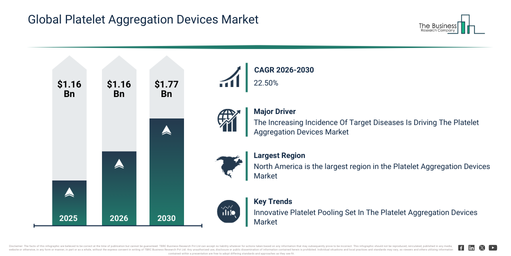
The platelet aggregation devices market has shown rapid growth in recent years and is forecasted to continue this trajectory. The market value is projected to rise from $1.04 billion in 2025 to $1.31 billion in 2026, achieving a compound annual growth rate (CAGR) of 25.4%. The market’s previous expansion has been primarily fueled by an increase in cardiovascular disease cases, the proliferation of clinical diagnostic labs, broader use of antiplatelet therapies, heightened demand for coagulation testing, and progress in hematology diagnostic technologies.
Download A Free Sample Report For Comprehensive Market Insights:
https://www.thebusinessresearchcompany.com/sample.aspx?id=15896&type=smp
Long-Term Growth Outlook for the Platelet Aggregation Devices Market
Looking further ahead, the market is expected to reach $2.94 billion by 2030, growing at a CAGR of 22.5%. This anticipated growth is driven by factors such as rising adoption of personalized medicine approaches, growing investments in advanced diagnostic tools, increasing demand for rapid platelet function tests, continuous research into blood disorders, and ongoing innovation in diagnostic technology. Key trends expected to influence the market include wider use of automated platelet function analyzers, demand for high-throughput testing platforms, integration of digital data management systems, expansion of multi-channel aggregation devices, and a sharper focus on enhancing diagnostic accuracy.
Rising Prevalence of Target Diseases Boosts Market Demand
One of the primary forces driving the platelet aggregation devices market is the increasing incidence of target diseases, which include critical conditions such as cancer, cardiovascular diseases, and diabetes. These devices play a vital role in early detection and management of thrombotic risks, helping to reduce complications like heart attacks and strokes in vulnerable populations. For example, in February 2024, the International Agency for Research on Cancer (IARC) reported that approximately 20 million new cancer cases and 9.7 million deaths occurred globally in 2022, with projections forecasting a 77% surge to over 35 million new cases by 2050. Lung cancer was the most common, with 2.5 million new diagnoses, followed by female breast, colorectal, prostate, and stomach cancers. Such alarming statistics highlight why the demand for platelet aggregation devices remains strong.
Access The Complete Platelet Aggregation Devices Market Report:
https://www.thebusinessresearchcompany.com/report/platelet-aggregation-devices-global-market-report
How Target Disease Trends Are Shaping Market Dynamics
The rising burden of these diseases underscores the need for advanced diagnostic tools that can facilitate timely intervention. Platelet aggregation devices contribute significantly by enabling healthcare providers to monitor platelet function effectively, which is crucial in managing thrombotic conditions. As efforts to combat these diseases intensify globally, the demand for reliable and efficient platelet aggregation testing solutions continues to expand, directly influencing market growth.
Breaking Down the Platelet Aggregation Devices Market Structure
The market is segmented into various categories to better understand consumer needs and technological preferences. These include:
1) Product Types: Reagents, Systems, Consumables and Accessories
2) Channel Configuration: Four Channel, Dual Channel, Eight Channel
3) Technology Used: Optical, Impedance, Other Technologies
4) Application Areas: Clinical Applications, Research Applications, Cardiovascular Applications, Other Applications
5) End-Users: Standalone Hospitals, Diagnostic Laboratories, Research and Academic Institutes, Other End Users
Within these segments, subcategories are detailed further, such as platelet aggregation assay reagents and coagulation/anticoagulation reagents under products, as well as testing systems that include platelet aggregation testing systems and automated systems. Consumables cover items like sample collection kits, testing plates, cuvettes, and calibration kits.
Innovation Trends Transforming the Platelet Aggregation Devices Market
Leading companies are focusing on developing state-of-the-art products to address supply challenges and improve diagnostic outcomes. A notable innovation is the introduction of the first platelet pooling set designed to stabilize the U.S. platelet supply and meet increasing clinical demands. Platelet pooling sets are specialized devices used in plateletpheresis to collect platelets from multiple donors into a single unit for transfusion. For instance, in February 2023, Terumo BCT Inc., a U.S.-based firm specializing in blood components and cellular technology, received FDA approval for its IMUGARD WB Platelet Pooling Set. This device offers extended platelet shelf life with seven-day storage clearance and enables platelet recovery from whole blood donations, enhancing supply flexibility. Such advancements are crucial for supporting critical medical procedures like chemotherapy and organ transplants, reflecting a significant leap forward in platelet aggregation technology.
Key Industry Players Leading the Market Competition
Several prominent companies dominate the platelet aggregation devices sector, including Roche Holding AG, Cytiva (Danaher Corp.), Siemens Healthineers, Sysmex Corporation, WerfenLife S.A., Haemonetics Corporation, Helena Laboratories Corporation, Sarstedt AG and Co. KG, Sekisui Diagnostics LLC, Diagnostica Stago, Accriva Diagnostics Holdings Inc., Sentinel CH. SpA, ADInstruments, Chrono-Log Corporation, Bio/Data Corporation, Haemochrom Diagnostica GmbH, AggreDyne Inc., Hart Biologicals Ltd., Stago, and Instrumentation Laboratory. These organizations are key drivers of innovation and competitive growth.
Regional Market Overview and Growth Potential
In 2025, North America held the largest share of the platelet aggregation devices market, reflecting its advanced healthcare infrastructure and high adoption of diagnostic technologies. However, the Asia-Pacific region is anticipated to exhibit the fastest growth in the coming years, fueled by expanding healthcare access, increasing prevalence of chronic diseases, and growing investments in medical diagnostics. The market report also covers regions including South East Asia, Western Europe, Eastern Europe, South America, the Middle East, and Africa, providing a comprehensive view of global trends and opportunities.
Get in touch with us:
The Business Research Company: https://www.thebusinessresearchcompany.com/
Americas: +1 310-496-7795
Asia: +44 7882 955267 & +91 8897263534
Europe: +44 7882 955267
Email us at: marketing@tbrc.info
Follow us on:
LinkedIn: https://in.linkedin.com/company/the-business-research-company
YouTube: https://www.youtube.com/channel/UC24_fI0rV8cR5DxlCpgmyFQ
Global Market Model: https://www.thebusinessresearchcompany.com/global-market-model