Built to provide research that’s more actionable and strategically valuable, The Business Research Company’s 2026 market reports include market attractiveness analysis, total addressable market sizing, company benchmarking matrices, interactive Excel dashboards, broader supply chain intelligence, emerging startup tracking, and in-depth product insights.
Preclinical Antibody Development Market Size And Revenue Outlook Through 2030
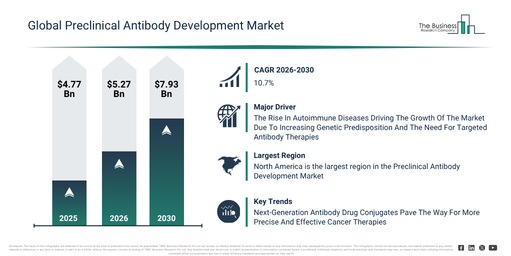
The preclinical antibody development market has experienced rapid expansion in its size over recent years. This market is projected to expand from $4.77 billion in 2025 to $5.27 billion in 2026, demonstrating a compound annual growth rate (CAGR) of 10.5%. Historically, this expansion has been driven by factors such as the increasing need for therapeutic antibodies, significant progress in monoclonal antibody technologies, the expansion of research in oncology and infectious diseases, enhancements in laboratory automation, and greater research and development investments by pharmaceutical firms.
The preclinical antibody development market is projected to experience swift expansion over the coming years. Its value is set to reach $7.93 billion by 2030, exhibiting a compound annual growth rate (CAGR) of 10.7%. This anticipated growth stems from several factors, including the increasing embrace of AI-based platforms for antibody design, the incorporation of predictive analytics into preclinical research, the expansion of infrastructure for biotechnology research, a rising emphasis on personalized medicine, and more partnerships between pharmaceutical and biotech firms. Key developments anticipated during this period encompass high-throughput screening of antibodies, AI-powered optimization of candidates, advanced in vitro testing methods, predictive models for toxicity, and early evaluations of developability.
Get A Free Sample Report With In-Depth Market Insights:
Preclinical Antibody Development Market Growth Factors Behind Sustained Expansion
The rising occurrence of autoimmune conditions is anticipated to drive expansion in the preclinical antibody development market throughout the projection period. These disorders involve the immune system erroneously targeting healthy cells and tissues, resulting in persistent inflammation and cellular harm. The growing incidence of these ailments stems from a mix of genetic predispositions, environmental and lifestyle influences, shifts in immune-modulating exposures, and enhanced understanding and diagnostic tools for the diseases. The increasing challenge posed by autoimmune diseases has created substantial unfulfilled medical requirements, leading pharmaceutical and biotechnology firms to intensify their research and development initiatives on targeted biologic treatments. In this context, preclinical antibody development is crucial, facilitating the identification, testing, and refinement of antibodies specifically designed to regulate or inhibit disordered immune reactions before clinical trials. For example, as reported by Arthritis Australia, an Australia-based non-profit organization, in February 2024, the count of males affected by rheumatoid arthritis (RA), an autoimmune disease, is 212,136 and females 362,137 for 2025, projected to increase by 2040 to around 280,040 males and 479,828 females. Consequently, the expanding occurrence of autoimmune diseases is fueling the expansion of the preclinical antibody development market.
Preclinical Antibody Development Market Segment Analysis And Revenue Potential
The preclinical antibody development market covered in this report is segmented –
1) By Type: Monoclonal Antibodies, Polyclonal Antibodies, Other Types
2) By Service Type: Antibody Discovery, Humanization And Engineering, Affinity Maturation, Developability Assessment, Expression And Purification, In Vitro Functional Characterization
3) By Application: Oncology, Infectious Diseases, Autoimmune Diseases, Other Applications
4) By End-User: Pharmaceutical Companies, Biotechnology Companies, Research Institutes, Other End-Users
Subsegments:
1) By Monoclonal Antibodies: Murine Monoclonal Antibodies, Chimeric Monoclonal Antibodies, Humanized Monoclonal Antibodies, Fully Human Monoclonal Antibodies, Recombinant Monoclonal Antibodies
2) By Polyclonal Antibodies: Primary Polyclonal Antibodies, Secondary Polyclonal Antibodies, Affinity Purified Polyclonal Antibodies, Antiserum Polyclonal Antibodies, Species Specific Polyclonal Antibodies
3) By Other Types: Bispecific Antibodies, Single Domain Antibodies, Antibody Fragments, Conjugated Antibodies, Catalytic Antibodies
Preclinical Antibody Development Market Industry Trends Fueling Future Revenue Growth
Major companies active in the preclinical antibody development market are increasingly concentrating on the creation of innovative modalities, such as antibody-drug conjugates (ADCs), to improve targeted cancer therapies and enhance treatment efficacy. ADCs are a class of focused therapeutics that integrate the specificity of monoclonal antibodies with the powerful cytotoxic activity of small-molecule drugs, enabling the precise delivery of toxic payloads to cancer cells while minimizing harm to healthy tissues. As an example, in November 2024, Celltrion Inc., a South Korea-based biopharmaceutical firm, announced the advancement of CT-P70 and CT-P71, two novel preclinical ADC candidates aimed at solid tumors, including non-small cell lung cancer and bladder cancer, respectively. Both of these ADCs comprise tumor-targeting antibodies conjugated to cytotoxic payloads, engineered to achieve accurate tumor targeting with reduced off-target toxicity, potentially improving therapeutic indices compared to traditional monoclonal antibodies or chemotherapies. These next-generation ADC programs signify a broader industry shift from biosimilar manufacturing towards the development of novel, differentiated biologic therapies.
Preclinical Antibody Development Market Leading Players And Competitive Positioning
Major companies operating in the preclinical antibody development market are Thermo Fisher Scientific Inc., WuXi AppTec Co Ltd., Charles River Laboratories International Inc., Sartorius Aktiengesellschaft, Samsung Biologics Co. Ltd., Evotec SE, KBI Biopharma Inc., GenScript Biotech Corporation, Abzena plc, Crown Bioscience Inc., AbCellera Biologics Inc., Adimab LLC, Creative Biolabs Inc., Boehringer Ingelheim BioXcellence GmbH, Integral Molecular Inc., ProMab Biotechnologies Inc., Eurofins Scientific SE, Ablexis Inc., Mabsilico Inc., Fujifilm Diosynth Biotechnologies Inc., Recipharm AB.
View The Full Preclinical Antibody Development Market Report:
Preclinical Antibody Development Market Regional Distribution: Which Areas Power Market Growth?
North America was the largest region in the preclinical antibody development market in 2025. Asia-Pacific is expected to be the fastest-growing region in the forecast period. The regions covered in the preclinical antibody development market report are Asia-Pacific, South East Asia, Western Europe, Eastern Europe, North America, South America, Middle East, Africa.
Reach Out To Our Team:
The Business Research Company: https://www.thebusinessresearchcompany.com/
Americas: +1 310-496-7795
Asia: +44 7882 955267 & +91 8897263534
Europe: +44 7882 955267
Email us at: marketing@tbrc.info
Follow us on:
LinkedIn: https://in.linkedin.com/company/the-business-research-company
YouTube: https://www.youtube.com/channel/UC24_fI0rV8cR5DxlCpgmyFQ
Global Market Model: https://www.thebusinessresearchcompany.com/global-market-model