Rabbit Monoclonal Antibody Market Future Outlook Showing Expansion Toward $1.45 Billion by 2030
The Business Research Company’s 2026 market reports include new capabilities such as market attractiveness scoring and analysis, total addressable market analysis, company scoring matrix, interactive excel data dashboard, improved supply chain analysis, upcoming startups in the market, and overview of key products, aimed at improving the depth, usability, and strategic value of the insights delivered.
How Will The Market Size Of The Rabbit Monoclonal Antibody Market Evolve From 2026 To 2030?
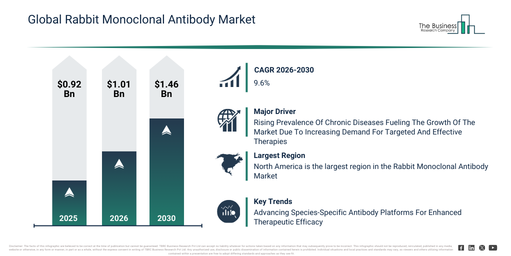
The rabbit monoclonal antibody market has experienced robust expansion over the past few years. Projections indicate its size will increase from $0.92 billion in 2025 to $1.01 billion in 2026, demonstrating a compound annual growth rate (CAGR) of 9.9%. Historically, this growth can be ascribed to several factors, including the widening scope of protein research applications, a heightened need for sensitive detection reagents, increased adoption of immunohistochemistry, a rise in biomedical research funding, and the accessibility of hybridoma technologies.
The rabbit monoclonal antibody market is anticipated to experience robust expansion over the next few years. It is projected to grow to $1.46 billion in 2030, demonstrating a compound annual growth rate (CAGR) of 9.6%. This expansion throughout the forecast period can be attributed to factors such as the increasing demand for precision diagnostics, the rising application of antibodies in drug discovery, the broadening of personalized medicine research, the growing adoption of recombinant antibody platforms, and an increasing emphasis on optimizing assay sensitivity. Major trends expected during this period include the increased use of rabbit antibodies for difficult epitopes, their rising utilization in advanced diagnostics, a growing preference for high-affinity antibodies, the expansion of recombinant rabbit antibody production, and an enhanced focus on analytical sensitivity.
Download the Free Sample Report to Explore Key Market Insights:
https://www.thebusinessresearchcompany.com/sample.aspx?id=30364&type=smp
What Drivers Are Influencing The Rabbit Monoclonal Antibody Market?
The increasing occurrence of chronic illnesses is anticipated to boost the expansion of the rabbit monoclonal antibody market in the future. Chronic diseases are long-lasting health problems that emerge gradually and persist for an extended duration, frequently necessitating ongoing medical attention. The rise in these conditions can be partly attributed to sedentary lifestyles, as extended periods of sitting and insufficient physical activity heighten the risk of ailments like heart issues and diabetes. Rabbit monoclonal antibodies contribute to chronic disease therapy by offering exceptionally specific and high-affinity targeting of proteins linked to the disease. They improve accuracy in treatment, minimize unintended side effects, and boost the effectiveness of therapy, leading to better results for patients and more efficient drug development. For example, in June 2024, the National Health Service, a UK-based government department, reported that 3,615,330 individuals registered with a general practitioner (GP) had been diagnosed with non-diabetic hyperglycemia or pre-diabetes (a condition with elevated blood sugar levels, not high enough to be classified as diabetes) in 2023, representing an 18% increase from 3,065,825 cases in 2022. Consequently, the growing prevalence of chronic diseases is fueling the growth of the rabbit monoclonal antibody market.
Which Segment Areas Are Covered In The Rabbit Monoclonal Antibody Market Analysis?
The rabbit monoclonal antibody market covered in this report is segmented –
1) By Type: Immunoglobulin G (IgG), Immunoglobulin M (IgM), Immunoglobulin A (IgA), Immunoglobulin E (IgE), Immunoglobulin D (IgD)
2) By Application: Diagnostics, Therapeutics, Research, Drug Discovery, Immunohistochemistry
3) By End User: Pharmaceutical Companies, Academic And Research Institutions, Diagnostic Laboratories, Contract Research Organizations, Biotechnology Companies
Subsegments:
1) By Immunoglobulin G (IgG): Subclass 1 Immunoglobulin G, Subclass 2 Immunoglobulin G, Subclass 3 Immunoglobulin G, Subclass 4 Immunoglobulin G
2) By Immunoglobulin M (IgM): Pentameric Immunoglobulin M, Monomeric Immunoglobulin M
3) By Immunoglobulin A (IgA): Serum Immunoglobulin A, Secretory Immunoglobulin A
4) By Immunoglobulin E (IgE): Allergen Specific Immunoglobulin E, Total Immunoglobulin E
5) By Immunoglobulin D (IgD): Membrane Bound Immunoglobulin D, Secreted Immunoglobulin D
What Trends Are Affecting The Expansion Of The Rabbit Monoclonal Antibody Market?
Major companies in the rabbit monoclonal antibody market are prioritizing the creation of advanced platforms, such as species-specific antibody development, to enhance therapeutic effectiveness, refine target specificity, and decrease immunogenicity. Species-specific antibody development involves the strategic utilization of distinct animal immune systems to generate antibodies with unique binding attributes and high affinity for challenging drug targets. In September 2024, ImmunoPrecise Antibodies Ltd., a Canadian AI-driven biotherapeutic research and technology company, announced significant progress in its rabbit antibody platforms. This species-specific antibody displayed considerable clinical advancement through its B Cell Select platform, which is integrated with LENSai artificial intelligence technology for automated antibody discovery and optimization. This system combines automation with AI-driven analytics to quickly identify high-affinity rabbit monoclonal antibodies while preserving their natural structures. This methodology improves clinical translation efficiency, accelerates target validation, shortens development timelines, and enhances reproducibility in therapeutic antibody initiatives.
Which Global Companies Are Actively Competing In The Rabbit Monoclonal Antibody Market?
Major companies operating in the rabbit monoclonal antibody market are F. Hoffmann-La Roche Ltd., Merck KGaA, Thermo Fisher Scientific Inc., Bio-Rad Laboratories Inc., Bio-Techne Corporation, Elabscience Biotechnology Inc., GenScript Biotech Corporation, Takara Bio Inc., Rockland Immunochemicals Inc., Creative Biolabs Inc., Bioss Antibodies Inc., Cell Signaling Technology Inc., MyBioSource Inc., Boster Biological Technology Co. Ltd., GeneTex Inc., Proteintech Group Inc., Santa Cruz Biotechnology Inc., AvantGen Inc., ImmunoWay Biotechnology Company, Abcam plc
Read the full rabbit monoclonal antibody market report here:
https://www.thebusinessresearchcompany.com/report/global-rabbit-monoclonal-antibody-market-report
Which Regions Are Expected To Experience Rapid Expansion In The Rabbit Monoclonal Antibody Market?
North America was the largest region in the rabbit monoclonal antibody market in 2025. Asia-Pacific is expected to be the fastest-growing region in the forecast period. The regions covered in the rabbit monoclonal antibody market report are Asia-Pacific, South East Asia, Western Europe, Eastern Europe, North America, South America, Middle East, Africa.
Request A Tailored Rabbit Monoclonal Antibody Market Research Report For Competitive Advantage:
https://www.thebusinessresearchcompany.com/customise?id=30364&type=smp
Browse Through More Reports Similar to the Global Rabbit Monoclonal Antibody Market 2026, By The Business Research Company
Quantum Computing In Healthcare Global Market Report
Enterprise Quantum Computing Global Market Report
https://www.thebusinessresearchcompany.com/report/enterprise-quantum-computing-global-market-report
Quantum Computing And Technologies Global Market Report
Get in touch with us:
The Business Research Company: https://www.thebusinessresearchcompany.com/
Americas +1 310-496-7795
Asia +44 7882 955267 & +91 8897263534
Europe +44 7882 955267
Email us at info@tbrc.info
Follow us on:
LinkedIn: https://in.linkedin.com/company/the-business-research-company
YouTube: https://www.youtube.com/channel/UC24_fI0rV8cR5DxlCpgmyFQ
Global Market Model: https://www.thebusinessresearchcompany.com/global-market-model