The Business Research Company’s 2026 market reports feature enhanced tools like market attractiveness analysis, TAM assessment, and company scoring matrices, along with interactive dashboards, deeper supply chain insights, and startup coverage strengthening the depth, usability, and strategic value of insights.
How Is The Market Size Of The Recurrent Pericarditis Market Expected To Scale Between 2026 And 2030?
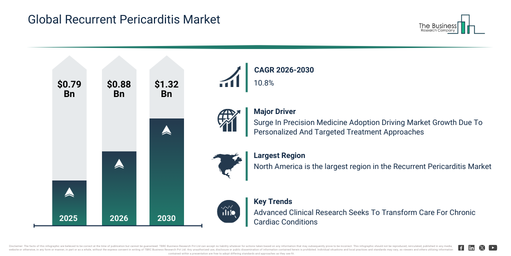
The market size for recurrent pericarditis has expanded significantly in recent years. It is projected to increase from $0.79 billion in 2025 to $0.88 billion in 2026, achieving a compound annual growth rate (CAGR) of 10.6%. The historical growth can be attributed to historical reliance on NSAIDs and colchicine, rising diagnosis of inflammatory heart conditions, established cardiology care pathways, increased availability of echocardiography, and guideline driven anti inflammatory therapy use.
The recurrent pericarditis market size is poised for substantial growth over the next few years. It is projected to expand to $1.32 billion in 2030, demonstrating a compound annual growth rate (CAGR) of 10.8%. This growth during the forecast period can be attributed to the rising adoption of biologic drugs, improved recurrence risk stratification, the expansion of specialty cardiology clinics, heightened awareness of immune-mediated pericarditis, and the increasing application of targeted cytokine inhibitors. Noteworthy trends anticipated in the forecast period encompass a greater reliance on targeted biologic therapies, the expansion of long-term disease monitoring, a rise in anti-inflammatory combination therapy, increased integration of IL-1 inhibitors, and the establishment of structured recurrence prevention protocols.
Access Your Free Sample Report For In-Depth Market Analysis:
https://www.thebusinessresearchcompany.com/sample.aspx?id=33288&type=smp
What Key Drivers Are Fueling The Growth Of The Recurrent Pericarditis Market?
The increasing focus on precision medicine approaches is anticipated to propel the growth of the recurrent pericarditis market going forward. Precision medicine is a medical strategy that customizes prevention and treatment plans for individual patients based on their genetic makeup, environment, and lifestyle. This rising emphasis on precision medicine is driven by enhanced treatment effectiveness, as therapies tailored to an individual’s genetic and biological profile lead to superior outcomes and a reduced risk of adverse effects. Recurrent pericarditis aids in advancing precision medicine by allowing targeted treatment approaches that concentrate on patient-specific inflammatory pathways, such as interleukin-1–mediated mechanisms, thereby enabling more personalized and effective disease management. For instance, in February 2025, according to the NHS England, a UK-based public healthcare body, in 2024 the NHS Genomic Medicine Service delivered over 810,000 genomic tests for patients across the life course in England. This has continued to increase year-on-year since the NHS Genomic Medicine Service was established, and increased by 8% compared to 2023. Therefore, the growing emphasis on precision medicine approaches is driving the growth of the recurrent pericarditis market.
Which Segment Categories Are Included In The Recurrent Pericarditis Market Segment Analysis?
The recurrent pericarditis market covered in this report is segmented –
1) By Product Type: Non-Steroidal Anti-Inflammatory Drugs (NSAIDs); Corticosteroids; Colchicine; Biologics; Other Product Types
2) By Diagnosis And Assessment: Electrocardiography (ECG); Echocardiography; Physical Examination
3) By Route of Administration: Oral; Injectable
4) By Application: Colchicine Therapy; Corticosteroids; Non-Steroidal Anti-Inflammatory Drugs (NSAIDs)
5) By End-User: Hospitals; Ambulatory Surgical Centers; Clinics; Home Care Settings; Emergency Medical Services (EMS)
Subsegments:
1) By Non Steroidal Anti Inflammatory Drugs: Ibuprofen; Aspirin; Indomethacin; Naproxen
2) By Corticosteroids: Prednisone; Methylprednisolone; Hydrocortisone; Dexamethasone
3) By Colchicine: Oral Colchicine; Low Dose Colchicine; Extended Duration Colchicine Therapy
4) By Biologics: Interleukin One Inhibitors; Monoclonal Antibody Therapies; Targeted Cytokine Inhibitors
5) By Other Product Types: Immunosuppressive Agents; Analgesic Therapies; Supportive Combination Therapies
What Trends Are Influencing The Recurrent Pericarditis Market?
Leading firms within the recurrent pericarditis market are prioritizing the creation of treatments offering anti-inflammatory and anti-fibrotic benefits. These developments aim to alleviate pericardial inflammation, avert lasting heart damage, elevate patients’ quality of life, and lower instances of recurrence. Anti-inflammatory actions work by decreasing tissue inflammation, whereas anti-fibrotic actions either stop or reverse the development of scar tissue; collectively, these mechanisms aid in shielding organs from harm and sustaining their regular operation. An example of this strategy is seen in October 2024, when Cardiol Therapeutics Inc., a Canadian clinical-stage life sciences firm, progressed its CardiolRx program. CardiolRx provides a unique oral, non-immunosuppressive therapeutic method for recurrent pericarditis. It functions by targeting the NLRP3 inflammasome, which is a critical upstream activator of IL-1–driven inflammation. The drug is under development to avert disease recurrence, especially in individuals who experience a relapse following the cessation of IL-1 blocker treatments like rilonacept or anakinra. Through its advanced clinical trials, CardiolRx endeavors to diminish pericarditis flares, ease chest discomfort, and bring inflammatory markers (CRP) back to normal levels.
Who Are The Active Companies Shaping The Recurrent Pericarditis Market?
Major companies operating in the recurrent pericarditis market are Johnson & Johnson Services Inc., Roche Holding AG, Merck & Co. Inc., Pfizer Inc., AbbVie Inc., Sanofi S.A., Novartis AG, AstraZeneca PLC, Bristol-Myers Squibb Company, GlaxoSmithKline plc, Eli Lilly and Company, Novo Nordisk A/S, Takeda Pharmaceutical Company Limited, Amgen Inc., Gilead Sciences Inc., Boehringer Ingelheim International GmbH, Regeneron Pharmaceuticals Inc., Biogen Inc., Lonza Group AG, Moderna Inc., and WuXi Biologics (Cayman) Inc.
Get The Full Recurrent Pericarditis Market Report:
https://www.thebusinessresearchcompany.com/report/recurrent-pericarditis-market-report
Which Region Is The Leading Market For The Recurrent Pericarditis Market?
North America was the largest region in the recurrent pericarditis market in 2025. Asia-Pacific is expected to be the fastest-growing region in the forecast period. The regions covered in the recurrent pericarditis market report are Asia-Pacific, South East Asia, Western Europe, Eastern Europe, North America, South America, Middle East, Africa.
Request A Customized Recurrent Pericarditis Market Report For Competitive Insights:
https://www.thebusinessresearchcompany.com/customise?id=33288&type=smp
Browse Through More Reports Similar to the Global Recurrent Pericarditis Market 2026, By The Business Research Company
Pericarditis Market Report 2026
https://www.thebusinessresearchcompany.com/report/pericarditis-global-market-report
Pediatric Perfusion Market Report 2026
https://www.thebusinessresearchcompany.com/report/pediatric-perfusion-global-market-report
Cardiac Valve Market Report 2026
https://www.thebusinessresearchcompany.com/report/cardiac-valve-global-market-report
Get in touch with us:
The Business Research Company: https://www.thebusinessresearchcompany.com/
Americas +1 310-496-7795
Asia +44 7882 955267 & +91 8897263534
Europe +44 7882 955267
Email us at info@tbrc.info
Follow us on:
LinkedIn: https://in.linkedin.com/company/the-business-research-company
YouTube: https://www.youtube.com/channel/UC24_fI0rV8cR5DxlCpgmyFQ
Global Market Model: https://www.thebusinessresearchcompany.com/global-market-model