Built to provide research that’s more actionable and strategically valuable, The Business Research Company’s 2026 market reports include market attractiveness analysis, total addressable market sizing, company benchmarking matrices, interactive Excel dashboards, broader supply chain intelligence, emerging startup tracking, and in-depth product insights.
Respiratory Endotherapy Devices Market Value Growth And Long-Term Outlook
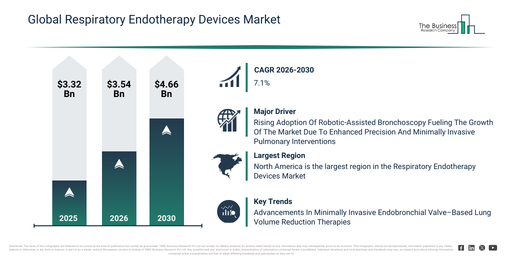
The market for respiratory endotherapy devices has shown substantial growth over recent years. Looking ahead, its valuation is set to climb from $3.32 billion in 2025 to $3.54 billion in 2026, maintaining a compound annual growth rate (CAGR) of 6.9%. The historical expansion can be traced to various factors including a rise in chronic respiratory diseases, an increase in lung cancer diagnosis, the expansion of interventional pulmonology, growth in hospital endoscopy units, and the demand for minimally invasive procedures.
The respiratory endotherapy devices market is projected for substantial growth over the next few years. It is anticipated to expand to $4.66 billion by 2030, driven by a compound annual growth rate (CAGR) of 7.1%. This expansion during the forecast period can be attributed to an increase in early lung screening programs, robotic bronchoscopy adoption, outpatient pulmonary procedures growth, advanced imaging integration, and precision airway therapy demand. Significant trends expected in the forecast period include minimally invasive airway intervention devices, disposable bronchoscope adoption, image guided bronchoscopic procedures, advanced endobronchial ablation systems, and smart navigation bronchoscopy tools.
Get A Free Sample Report With In-Depth Market Insights:
Respiratory Endotherapy Devices Market Growth Factors Behind Sustained Expansion
The increasing use of robotic-assisted bronchoscopy is projected to fuel the expansion of the respiratory endotherapy devices market moving forward. These advanced robotic-assisted bronchoscopy systems allow for precise navigation within the respiratory tract, leading to improved diagnostic accuracy and better therapeutic results. Demand for these systems is surging as healthcare providers seek less invasive options that reduce procedure time, bolster patient safety, and enhance clinical efficiency. Respiratory endotherapy devices, when assisted by robotics, facilitate complex interventions by offering real-time imaging, superior maneuverability, and greater control. For instance, in September 2025, the European Respiratory Society International Congress, a Switzerland-based membership organization, noted that the utilization of robotic-assisted bronchoscopy with integrated cone beam CT for peripheral lung lesions soared to 84.6% in 2025, a substantial rise from only 23.1% with conventional bronchoscopy in 2024. Hence, the increasing embrace of robotic-assisted bronchoscopy is propelling the growth of the respiratory endotherapy devices market.
Respiratory Endotherapy Devices Market Segment Landscape: Which Areas Lead Development?
The respiratory endotherapy devices market covered in this report is segmented –
1) By Product Type: Bronchoscopes; Endobronchial Ultrasound Systems; Biopsy Forceps; Guidewires; Catheters; Airway Stents; Endobronchial Valves; Ablation Devices; Other Endotherapy Accessories
2) By Diagnostic Devices: Trans Bronchial Aspiration; Biopsy Forceps; Cytology Brushes; Other Diagnostic Devices
3) By Patient Type: Adult Patients; Pediatric Patients
4) By Specialist: Hospitals; Diagnostic Centers; Ambulatory Surgical Centers
5) By End User: Peripheral Vascular Intervention; Endovascular Interventions; Cardiac; Interventional Radiology; Venous; Other End Users
Subsegments:
1) By Bronchoscopes: Flexible Bronchoscopes; Rigid Bronchoscopes; Video Bronchoscopes; Disposable Bronchoscopes; Therapeutic Bronchoscopes
2) By Endobronchial Ultrasound Systems: Radial Endobronchial Ultrasound Systems; Linear Endobronchial Ultrasound Systems; Portable Endobronchial Ultrasound Systems; Cart Based Endobronchial Ultrasound Systems; High Resolution Endobronchial Ultrasound Systems
3) By Biopsy Forceps: Flexible Biopsy Forceps; Rigid Biopsy Forceps; Disposable Biopsy Forceps; Alligator Jaw Biopsy Forceps; Cup Biopsy Forceps
4) By Guidewires: Hydrophilic Guidewires; Non Coated Guidewires; Steerable Guidewires; Flexible Tip Guidewires; High Strength Guidewires
5) By Catheters: Balloon Catheters; Aspiration Catheters; Delivery Catheters; Diagnostic Catheters; Therapeutic Catheters
6) By Airway Stents: Silicone Airway Stents; Metallic Airway Stents; Covered Airway Stents; Uncovered Airway Stents; Expandable Airway Stents
7) By Endobronchial Valves: One Way Endobronchial Valves; Permanent Endobronchial Valves; Temporary Endobronchial Valves; Adjustable Endobronchial Valves; Implantable Endobronchial Valves
8) By Ablation Devices: Radiofrequency Ablation Devices; Cryoablation Devices; Laser Ablation Devices; Thermal Ablation Devices; Microwave Ablation Devices
9) By Other Endotherapy Accessories: Suction Tubes; Specimen Collection Traps; Bronchoscopy Brushes; Biopsy Needles; Airway Dilators
Respiratory Endotherapy Devices Market Industry Trends Fueling Future Revenue Growth
Leading firms in the respiratory endotherapy devices market are concentrating on creating innovative solutions, like endobronchial valves, with the aim of reducing treatment risks and achieving specific lung volume reduction without irreversible tissue removal. An endobronchial valve represents a minimally invasive implant, inserted via bronchoscopy into chosen airways to impede airflow to affected lung regions, thereby enabling healthier parts to operate more efficiently. For example, Olympus Canada Inc., a medical technology company based in Canada, introduced the Spiration Valve System in February 2024, designed for managing severe emphysema. This umbrella-shaped device is intended for placement in the most severely diseased lung areas through a minimally invasive bronchoscopic procedure. Its unique mechanism redirects airflow away from hyperinflated lung areas towards healthier tissue, which aids in enhancing respiratory mechanics. Being the sole endobronchial valve therapy presently accessible in Canada, it fulfills an unaddressed requirement in the treatment of severe emphysema. Clinical data from the EMPROVE trial illustrates lasting advantages over 24 months, encompassing significant enhancements in lung function, reduced breathlessness, and an improved quality of life for patients.
Respiratory Endotherapy Devices Market Industry Leaders And Competitive Landscape
Major companies operating in the respiratory endotherapy devices market are Johnson & Johnson, Medtronic plc, Siemens Healthineers, Stryker Corporation, GE Healthcare Technologies Inc., Boston Scientific Corporation, Intuitive Surgical Inc., Olympus Corporation, Hoya Corporation, Steris Healthcare, Teleflex Incorporated, Karl Storz SE & Co. KG, CookMedical, Merit Medical Systems Inc., Ambu A/S, Vygon, Richard Wolf GmbH, Vapotherm Inc, Scholly Fiberoptic GmbH, Clarus Medical LLC, ENDO-FLEX GmbH, The Lung Docs Inc., and Broncus Medical Inc.
View The Full Respiratory Endotherapy Devices Market Report:
Respiratory Endotherapy Devices Market Regional Analysis And Top Geography
North America was the largest region in the respiratory endotherapy devices market in 2025. Asia-Pacific is expected to be the fastest-growing region in the forecast period. The regions covered in the respiratory endotherapy devices market report are Asia-Pacific, South East Asia, Western Europe, Eastern Europe, North America, South America, Middle East, Africa.
Reach Out To Our Team:
The Business Research Company: https://www.thebusinessresearchcompany.com/
Americas: +1 310-496-7795
Asia: +44 7882 955267 & +91 8897263534
Europe: +44 7882 955267
Email us at: marketing@tbrc.info
Follow us on:
LinkedIn: https://in.linkedin.com/company/the-business-research-company
YouTube: https://www.youtube.com/channel/UC24_fI0rV8cR5DxlCpgmyFQ
Global Market Model: https://www.thebusinessresearchcompany.com/global-market-model