
Scientific Instruments Market Growth To $62.24 Billion By 2030: What’s Driving The Expansion?
Built to provide research that’s more actionable and strategically valuable, The Business Research Company’s 2026 market reports include market attractiveness analysis, total addressable market sizing, company benchmarking matrices, interactive Excel dashboards, broader supply chain intelligence, emerging startup tracking, and in-depth product insights.
Scientific Instruments Market Revenue Outlook: What CAGR Lies Ahead Through 2030?
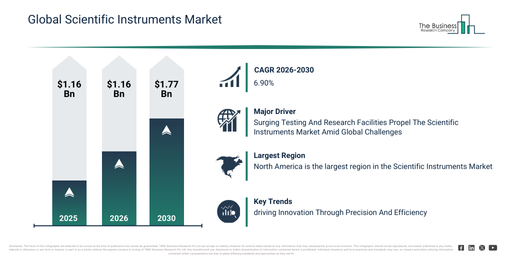
The scientific instruments market has experienced substantial growth over recent years. It is projected to expand from $44.64 billion in 2025 to $47.62 billion in 2026, achieving a compound annual growth rate (CAGR) of 6.7%. Historically, this market expansion can be attributed to the broadening of scientific research activities, increased pharmaceutical R&D spending, a growing need for advanced diagnostic solutions, the implementation of modern laboratory infrastructure, and rising financial commitments to academic research facilities.
The scientific instruments market is anticipated to show robust expansion in the coming years, with its size expected to reach $62.24 billion in 2030, exhibiting a compound annual growth rate (CAGR) of 6.9%. This projected growth throughout the forecast period can be attributed to an increased focus on precision medicine research, the rising adoption of smart laboratories, expanded funding for life science research, a growing demand for high-throughput analytical tools, and the increasing integration of digital laboratory ecosystems. Significant trends for this period include the rising adoption of AI-enabled analytical instruments, increased integration of automated laboratory systems, a growing demand for high-precision measurement tools, the expansion of advanced imaging technologies, and an enhanced focus on data-driven research platforms.
Get A Free Sample Report With In-Depth Market Insights:
Scientific Instruments Market Growth Backed By Core Demand Fundamentals
The expansion of testing and research facilities is a primary factor propelling the scientific instruments market. There has been a swift rise in these testing and research facilities, largely due to the pervasive virus and the intensified efforts to mitigate its subsequent effects. These facilities inherently require scientific instruments to perform accurate testing and formulate viable solutions. For instance, in April 2025, the Office for National Statistics, a UK-based government agency, reported that the UK government’s net expenditure on research and development (R&D) escalated from USD 20.4 billion (£16.1 billion) in 2022 to USD 22 billion (£17.4 billion) in 2023, marking an 8.2% increase. Consequently, the growth in testing and research facilities is a key driver for the scientific instruments market.
Scientific Instruments Market Segmentation: How Does The Market Break Down By Category?
The scientific instruments market covered in this report is segmented –
1) By Type: Clinical Analyzers, Analytical Instruments
2) By Application: Research, Clinical And Diagnostics, Other Applications
3) By End User: Hospitals And Diagnostic Laboratories, Pharmaceutical And Biotechnology Companies, Other End-Users
Subsegments:
1) By Clinical Analyzers: Hematology Analyzers, Biochemistry Analyzers, Immunoassay Analyzers
2) By Analytical Instruments: Chromatography Instruments, Spectroscopy Instruments, Mass Spectrometry Instruments
Scientific Instruments Market Growth Trends Reshaping The Competitive Landscape
Leading companies within the scientific instruments market are prioritizing the integration of artificial intelligence (AI)-driven monitoring and low dispersion nebulizer nozzle technology to elevate sensitivity, robustness, and operational efficiency. Low dispersion nebulizer nozzles are specialized components of electrospray ionization sources that produce finer, more consistent droplets while reducing nebulizer gas consumption, thereby enhancing ion intake efficiency. For instance, in August 2025, Shimadzu Scientific Instruments, a US based analytical instrumentation company, unveiled the LCMS 8065XE triple quadrupole mass spectrometer. This next generation analytical instrument is engineered to provide world class sensitivity, long term stability, and energy efficient performance, featuring streamfocus ionization technology, automated tuning and system monitoring intelligence through Performance Concierge, and an Ecology Mode designed to reduce power consumption. The LCMS 8065XE thereby improves analytical performance, uptime, and operational cost efficiency.
Scientific Instruments Market Key Players Shaping Industry Direction
Major companies operating in the scientific instruments market are Thermo Fisher Scientific Inc., Agilent Technologies Inc., Bruker Corporation, Danaher Corporation, Waters Corporation, Horiba Limited, PerkinElmer Inc., Carl Zeiss AG, Shimadzu Corporation, Mettler-Toledo International Inc., Oxford Instruments PLC, Eppendorf AG, JEOL Ltd., Hitachi High-Technologies Corporation, Malvern Panalytical GmbH, Bio-Rad Laboratories Inc., Sartorius AG, Hamilton Company, The Merck Group, Becton Dickinson and Company, Illumina Inc., Bio-Techne Corporation
View The Full Scientific Instruments Market Report:
Scientific Instruments Market Regional Analysis: Which Region Leads By Revenue?
North America was the largest region in the scientific instruments market in 2025. Asia-Pacific is expected to be the fastest-growing region in the forecast period. The regions covered in the scientific instruments market report are Asia-Pacific, South East Asia, Western Europe, Eastern Europe, North America, South America, Middle East, Africa.
Reach Out To Our Team:
The Business Research Company: https://www.thebusinessresearchcompany.com/
Americas: +1 310-496-7795
Asia: +44 7882 955267 & +91 8897263534
Europe: +44 7882 955267
Email us at: marketing@tbrc.info
Follow us on:
LinkedIn: https://in.linkedin.com/company/the-business-research-company
YouTube: https://www.youtube.com/channel/UC24_fI0rV8cR5DxlCpgmyFQ
Global Market Model: https://www.thebusinessresearchcompany.com/global-market-model

