Built to provide research that’s more actionable and strategically valuable, The Business Research Company’s 2026 market reports include market attractiveness analysis, total addressable market sizing, company benchmarking matrices, interactive Excel dashboards, broader supply chain intelligence, emerging startup tracking, and in-depth product insights.
Sensorimotor Neuropathy Market Growth Potential: How Will Market Size Shift Through 2030?
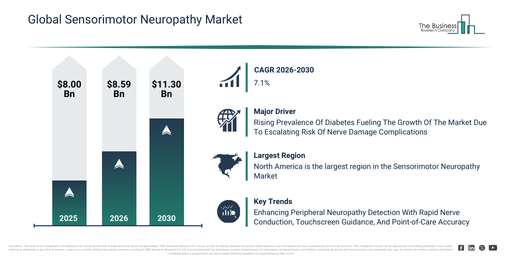
The sensorimotor neuropathy market has experienced substantial growth in recent years. It is anticipated to expand from $8.00 billion in 2025 to $8.59 billion by 2026, achieving a compound annual growth rate (CAGR) of 7.4%. This historical growth can be attributed to factors such as the increasing prevalence of diabetes, an expanding geriatric population, heightened awareness of neuropathy complications, the development of hospital and clinical infrastructure, and the rising adoption of diagnostic technologies.
The sensorimotor neuropathy market is projected to experience robust expansion over the coming years, reaching $11.30 billion in 2030, exhibiting a compound annual growth rate (CAGR) of 7.1%. This anticipated growth during the forecast period is primarily driven by escalating research and development efforts, increased investment in neurotherapeutics, greater integration of genetic testing, the expansion of personalized medicine solutions, and the rising adoption of digital and remote monitoring technologies. Key trends influencing the market in this timeframe include advancements in molecular genetic testing, the development of minimally invasive therapies, innovations in neuroprotective drug design, the increasing utilization of artificial intelligence in diagnostics, and the broadening of patient-centric and telemedicine solutions.
Get A Free Sample Report With In-Depth Market Insights:
Sensorimotor Neuropathy Market Growth Catalysts And Demand Drivers
The increasing occurrence of diabetes is anticipated to propel the growth of the sensorimotor neuropathy market in the future. Diabetes is defined as a chronic health condition that affects how the body converts food into energy, characterized by elevated blood sugar levels resulting from defects in insulin production or action. The prevalence of diabetes is rising due to a surge in obesity rates, which are driven by sedentary lifestyles and increased consumption of processed high-sugar and high-fat foods, consequently reducing physical activity levels. Sensorimotor neuropathy aids diabetic patients by facilitating targeted sensorimotor training, which improves gait stability, ankle proprioception, and overall quality of life through enhanced balance and reduced fall risk. For instance, in 2025, according to the International Diabetes Federation, a Belgium-based health organization, in 2024, approximately 589 million adults aged 20-79 were living with diabetes. This total number is projected to reach 853 million by 2050, with more than 4 in 5 adults with diabetes residing in low and middle-income countries. Therefore, the rising prevalence of diabetes is driving the growth of the sensorimotor neuropathy market.
Sensorimotor Neuropathy Market Segment Landscape: Which Areas Lead Development?
The sensorimotor neuropathy market covered in this report is segmented –
1) By Type: Diabetic Neuropathy, Hereditary Neuropathy, Charcot-Marie-Tooth Disease, Guillain-Barré Syndrome, Chronic Inflammatory Demyelinating Polyneuropathy (CIDP), Toxic Neuropathy, Infectious Neuropathy
2) By Treatment: Medications, Physical Therapy, Occupational Therapy, Transcutaneous Electrical Nerve Stimulation (TENS), Surgery
3) By Diagnosis: Electromyography And Motor Nerve Conduction Test, Specialized Deoxyribonucleic Acid Blood Tests, Molecular Genetic Testing, Other Diagnosis
4) By Distribution Channel: Hospital Pharmacies, Retail And Online Pharmacies
Subsegments:
1) By Diabetic Neuropathy: Insulin Related Neuropathy, Glucose Induced Neuropathy, Chronic Diabetes Induced Neuropathy, Peripheral Neuropathy, Autonomic Neuropathy
2) By Hereditary Neuropathy: Charcot Marie Tooth Disease, Hereditary Sensory Neuropathy, Familial Amyloid Polyneuropathy, Genetic Peripheral Neuropathy, Hereditary Motor Neuropathy
3) By Charcot-Marie-Tooth Disease: Type One Demyelinating, Type Two Axonal, Intermediate Form, Dominant Form, Recessive Form
4) By Guillain-Barré Syndrome: Acute Inflammatory Demyelinating Polyneuropathy, Acute Motor Axonal Neuropathy, Acute Motor Sensory Axonal Neuropathy, Miller Fisher Syndrome, Other Variants
5) By Chronic Inflammatory Demyelinating Polyneuropathy: Typical Chronic Inflammatory Demyelinating Polyneuropathy, Multifocal Acquired Demyelinating Sensory And Motor Neuropathy, Distal Acquired Demyelinating Symmetric Neuropathy, Other Forms, Treatment Responsive Type
6) By Toxic Neuropathy: Alcohol Induced Neuropathy, Drug Induced Neuropathy, Heavy Metal Induced Neuropathy, Chemical Exposure Neuropathy, Other Toxin Related Neuropathy
7) By Infectious Neuropathy: Viral Induced Neuropathy, Bacterial Induced Neuropathy, Fungal Induced Neuropathy, Parasitic Induced Neuropathy, Other Infection Related Neuropathy
Sensorimotor Neuropathy Market Trends Shaping Long-Term Demand
Leading companies active in the sensorimotor neuropathy market are concentrating on developing sophisticated diagnostic technology, particularly enhanced nerve conduction devices with improved user interfaces. The aim is to advance early detection, objective assessment, and monitoring of nerve damage linked to peripheral neuropathy. Nerve conduction devices with better user interfaces refer to systems that merge quantitative nerve signal measurement with intuitive displays and guided operational processes, enabling clinicians to perform accurate evaluations efficiently at the point of care. For instance, in January 2023, NeuroMetrix Inc., a US-based medical device company, introduced the DPNCheck 2.0 peripheral neuropathy testing device, which is an enhanced nerve conduction device equipped with an improved user interface. This updated system measures sural nerve conduction velocity and response amplitude, both recognized biomarkers of peripheral neuropathy, and features an easy-to-use, large touchscreen display that guides clinicians through the test while presenting real-time results more clearly than earlier models. The device also includes enhanced temperature compensation to ensure consistent performance across various clinical environments.
Sensorimotor Neuropathy Market Competitive Landscape: Who Leads The Industry?
Major companies operating in the sensorimotor neuropathy market are Johnson & Johnson, Merck & Co Inc., Pfizer Inc., Abbvie Inc., Sanofi S.A, Novartis AG, Astrazeneca plc, Abbott Laboratories, Glaxosmithkline plc, Eli Lilly Company, Takeda Pharmaceutical Company Ltd., Teva Pharmaceutical Industries Ltd., Viatris Inc., Biogen Inc., Intas Pharmaceutical Limited, Ucb S.A., Sun Pharmaceutical Industries Ltd., Aurobindo Pharma Limited, Dr.Reddy’s Laboratories Limited, Cipla Limited, Lupin Limited, Torrent Pharmaceuticals Ltd., Alembic Pharmaceutical Limited, Boehringer Ingelheim International GmbH, Otuska Pharmaceutical Co. Ltd.
View The Full Sensorimotor Neuropathy Market Report:
Sensorimotor Neuropathy Market Geographic Landscape: Which Region Leads Industry Growth?
North America was the largest region in the sensorimotor neuropathy market in 2025. Asia-Pacific is expected to be the fastest-growing region in the forecast period. The regions covered in the sensorimotor neuropathy market report are Asia-Pacific, South East Asia, Western Europe, Eastern Europe, North America, South America, Middle East, Africa.
Reach Out To Our Team:
The Business Research Company: https://www.thebusinessresearchcompany.com/
Americas: +1 310-496-7795
Asia: +44 7882 955267 & +91 8897263534
Europe: +44 7882 955267
Email us at: marketing@tbrc.info
Follow us on:
LinkedIn: https://in.linkedin.com/company/the-business-research-company
YouTube: https://www.youtube.com/channel/UC24_fI0rV8cR5DxlCpgmyFQ
Global Market Model: https://www.thebusinessresearchcompany.com/global-market-model