
Sleep Apnea Implants Market Trends Are Creating New Opportunities For Industry Leaders
Enhanced with market attractiveness analysis, total addressable market evaluation, company benchmarking matrices, interactive Excel dashboards, expanded supply chain intelligence, emerging startup coverage, and detailed product insights, The Business Research Company’s 2026 market reports deliver more actionable and strategically valuable research.
Sleep Apnea Implants Market Growth Potential: How Will Market Size Change Through 2030?
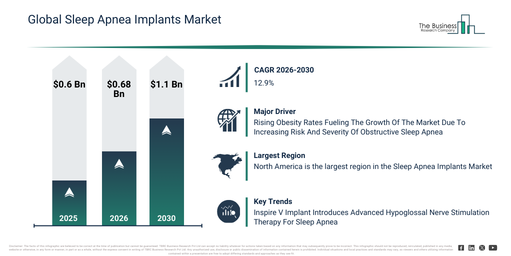
The sleep apnea implants market size has seen rapid growth recently. It is projected to expand from $0.6 billion in 2025 to $0.68 billion in 2026, demonstrating a compound annual growth rate (CAGR) of 12.6%. The expansion observed in the historic period can be linked to rising sleep apnea prevalence, CPAP intolerance rates, growth in sleep disorder diagnosis, an increase in obesity levels, and the expansion of sleep clinics.
The sleep apnea implants market is anticipated to experience rapid growth in the coming years. It is set to expand to $1.1 billion by 2030, achieving a compound annual growth rate (CAGR) of 12.9%. This expansion during the forecast period can be attributed to the demand for long-term implant therapy, an increase in minimally invasive procedures, rising awareness of sleep health, the expansion of reimbursement coverage, and innovation in neurostimulation devices. Key trends for the forecast period include hypoglossal nerve stimulation devices, implantable airway support systems, programmable neurostimulation implants, minimally invasive sleep implants, and wireless controlled implant platforms.
Download A Free Sample Report For Comprehensive Market Insights:
Sleep Apnea Implants Market Growth Drivers: What Factors Are Accelerating Expansion?
The increasing incidence of obesity is projected to drive the expansion of the sleep apnea implants market in the future. Obesity is defined as a medical state marked by an excessive build-up of body fat, substantially elevating the likelihood of negative health consequences and chronic illnesses. The rise in obesity is primarily attributed to greater intake of high-calorie, highly processed foods, which offer surplus energy but minimal nutritional benefit, leading to sustained weight gain. As obesity expands, the demand for sleep apnea implants grows because surplus fat in the neck and upper airway region escalates the risk and seriousness of obstructive sleep apnea, prompting more patients unable to use CPAP to seek long-term implantable treatment options. For example, data from May 2024, provided by the Office for Health Improvement and Disparities, a UK-based government department, indicated that approximately 64% of adults aged 18 and older in England were considered overweight or obese, with men showing a higher rate of about 69% compared to roughly 59% for women. Consequently, the growing occurrence of obesity is fueling the development of the sleep apnea implants market.
Sleep Apnea Implants Market Segmentation: How Is The Market Structured Across Key Categories?
The sleep apnea implants market covered in this report is segmented –
1) By Product: Phrenic Nerve Stimulator; Hypoglossal Neurostimulation Devices; Bone Screw Implant System; Palatal Implants; Pillar Procedure
2) By Indication: Central Sleep Apnea; Obstructive Sleep Apnea
3) By Distribution Channel: Direct Sales to Hospitals; Medical Device Distributors; Specialty Medical Suppliers
4) By End Use: Hospitals; Ambulatory Surgical Centers
Subsegments:
1) By Phrenic Nerve Stimulator: Implantable Phrenic Nerve Stimulators; Rechargeable Phrenic Nerve Stimulators; Fully Programmable Phrenic Nerve Stimulators; Wireless Controlled Phrenic Nerve Stimulators; Long Term Use Phrenic Nerve Stimulators
2) By Hypoglossal Neurostimulation Devices: Implantable Hypoglossal Neurostimulation Devices; Rechargeable Hypoglossal Neurostimulation Devices; Programmable Hypoglossal Neurostimulation Devices; Wireless Controlled Hypoglossal Neurostimulation Devices; Sleep Activated Hypoglossal Neurostimulation Devices
3) By Bone Screw Implant System: Titanium Bone Screw Implant Systems; Adjustable Bone Screw Implant Systems; Self Tapping Bone Screw Implant Systems; Long Term Fixation Bone Screw Implant Systems; Minimally Invasive Bone Screw Implant Systems
4) By Palatal Implants: Soft Palate Implants; Rigid Palatal Implants; Bio Compatible Palatal Implants; Permanent Palatal Implants; Minimally Invasive Palatal Implants
5) By Pillar Procedure: Single Implant Pillar Procedures; Multiple Implant Pillar Procedures; Office Based Pillar Procedures; Minimally Invasive Pillar Procedures; Outpatient Pillar Procedures
Sleep Apnea Implants Market Trends: What Is Shaping Future Industry Growth?
Major companies in the sleep apnea implants market are prioritizing technological innovation, specifically hypoglossal nerve stimulation (HNS) therapy, to enhance airway patency and decrease obstructive sleep apnea events. Hypoglossal nerve stimulation (HNS) therapy is an implantable medical intervention designed to treat obstructive sleep apnea by electrically stimulating the hypoglossal nerve, which controls tongue movements, to maintain an open airway during sleep. For example, in November 2025, Children’s Hospital of Pittsburgh, a US-based pediatric hospital, introduced the Inspire V implant by performing its first implantation. This system features an integrated respiratory sensor that reduces the implanted system from three components to two, along with updated software that boosts patient management efficiency and accessibility, requiring minimal recovery usually involving one night of observation. The Inspire V implant system treats obstructive sleep apnea by stimulating the hypoglossal nerve to keep the airway open during sleep, benefiting patients with its integrated respiratory sensor, a simplified two-component design, and updated software that improves therapy management and reduces procedural complexity.
Sleep Apnea Implants Market Competitive Landscape And Leading Companies
Major companies operating in the sleep apnea implants market are Medtronic Plc, Koninklijke Philips N.V., Asahi Kasei Corporation, Nyxoah SA, Fisher & Paykel Healthcare Limited, LivaNova Plc, Contec Medical Systems Co. Ltd., Inspire Medical Systems Inc., Drive DeVilbiss Healthcare GmbH, Pillar Palatal LLC, SomnoMed Limited, Respicardia, Inc., Sibel Health Inc., LinguaFlex LLC, Advanced Brain Monitoring Inc, Cleveland Medical Devices Inc., Siesta Medical, Inc., Avery Biomedical Devices Inc., and Nox Medical, Somnowell Ltd.
Access The Complete Sleep Apnea Implants Market Report:
Sleep Apnea Implants Market Leading Geography: Which Region Generates The Most Revenue?
North America was the largest region in the sleep apnea implants market in 2025. Asia-Pacific is expected to be the fastest-growing region in the forecast period. The regions covered in the sleep apnea implants market report are Asia-Pacific, South East Asia, Western Europe, Eastern Europe, North America, South America, Middle East, Africa.
Get in touch with us:
The Business Research Company: https://www.thebusinessresearchcompany.com/
Americas: +1 310-496-7795
Asia: +44 7882 955267 & +91 8897263534
Europe: +44 7882 955267
Email us at: marketing@tbrc.info
Follow us on:
LinkedIn: https://in.linkedin.com/company/the-business-research-company
YouTube: https://www.youtube.com/channel/UC24_fI0rV8cR5DxlCpgmyFQ
Global Market Model: https://www.thebusinessresearchcompany.com/global-market-model