Sleep Disorder Market Growth To $65.51 Billion By 2030: What’s Driving The Expansion?
Built to provide research that’s more actionable and strategically valuable, The Business Research Company’s 2026 market reports include market attractiveness analysis, total addressable market sizing, company benchmarking matrices, interactive Excel dashboards, broader supply chain intelligence, emerging startup tracking, and in-depth product insights.
Sleep Disorder Market Size And Revenue Outlook Through 2030
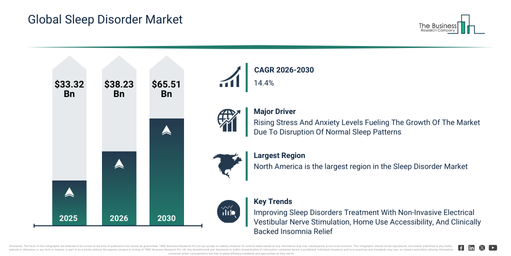
The sleep disorder market has experienced substantial expansion in recent years. It is projected to grow from $33.32 billion in 2025 to $38.23 billion in 2026, demonstrating a compound annual growth rate (CAGR) of 14.7%. The market’s historical growth can be attributed to factors such as increasing awareness about sleep health, a rising prevalence of insomnia and sleep apnea, greater adoption of sleep diagnostic services, an expanding geriatric population, an increase in stress and lifestyle-related sleep issues, and the growing usage of smartphones and wearable devices for sleep tracking.
The sleep disorder market is projected to experience substantial expansion over the upcoming years. Its valuation is anticipated to reach $65.51 billion by 2030, exhibiting a compound annual growth rate (CAGR) of 14.4%. This anticipated growth during the forecast period can be primarily ascribed to factors such as the increasing availability of telemedicine services for sleep-related conditions, the growing embrace of wearable sleep tracking devices, a surge in home-based diagnostic assessments, the proliferation of cognitive behavioral therapy applications, and heightened governmental efforts to promote awareness of sleep health. Key trends defining this forecast period encompass advancements in wearable devices for sleep monitoring, enhancements in home-based tools for sleep diagnosis, progress in AI-powered sleep analysis, novel developments in non-invasive treatments for sleep apnea, new approaches in telemedicine for sleep consultations, and creative improvements in cognitive behavioral therapy applications.
Get A Free Sample Report With In-Depth Market Insights:
Sleep Disorder Market Growth Factors Behind Sustained Expansion
Rising stress and anxiety levels are anticipated to fuel the expansion of the sleep disorder market moving ahead. These levels denote the occurrence of psychological strain and undue concern in a population, frequently stemming from environmental, societal, or financial pressures. An uptick in stress and anxiety is observed, driven by work-related pressures where individuals contend with increased workloads, stringent deadlines, and employment instability. Such levels contribute to sleep disorders by interfering with regular sleep cycles and making it harder to initiate or maintain sleep. Furthermore, they deteriorate general health through hindering restorative sleep, which results in tiredness, reduced mental function, and an elevated susceptibility to chronic illnesses. For example, in May 2024, data from the American Psychiatric Association (APA), a US-based professional organization, indicated that 43% of U.S. adults reported feeling more anxious in 2024 compared to the prior year, an increase from 37% in 2023 and 32% in 2022. Consequently, the escalation of stress and anxiety levels is propelling the expansion of the sleep disorder market.
Sleep Disorder Market Segment Analysis And Revenue Potential
The sleep disorder market covered in this report is segmented –
1) By Disorder Type: Insomnia, Sleep Apnea, Restless Legs Syndrome, Narcolepsy, Circadian Rhythm Disorders
2) By Treatment: Cognitive Behavioral Therapy, Medication Therapy, Psychiatric Treatment, Behavioral Treatment
3) By Diagnostic Method: Polysomnography, Home Sleep Testing, Actigraphy, Sleep Diaries, Questionnaires and Screening
4) By Distribution Channel: Retail Pharmacies, Online Sales, Hospital Pharmacies
5) By End-User: Hospitals And Sleep Centers, Home Care Settings, Academic
Subsegments:
1) By Insomnia: Acute Insomnia, Chronic Insomnia, Onset Insomnia, Maintenance Insomnia, Behavioral Insomnia, Medication-Induced Insomnia
2) By Sleep Apnea: Obstructive Sleep Apnea, Central Sleep Apnea, Complex Sleep Apnea Syndrome, Mild Sleep Apnea, Moderate Sleep Apnea, Severe Sleep Apnea, Pediatric Sleep Apnea, Treatment-Resistant Sleep Apnea
3) By Restless Legs Syndrome: Primary Restless Legs Syndrome, Secondary Restless Legs Syndrome, Mild Restless Legs Syndrome, Moderate Restless Legs Syndrome, Severe Restless Legs Syndrome, Intermittent Restless Legs Syndrome, Chronic Persistent Restless Legs Syndrome
4) By Narcolepsy: Narcolepsy Type 1, Narcolepsy Type 2, Idiopathic Hypersomnia, Pediatric Narcolepsy, Treatment-Resistant Narcolepsy, Secondary Narcolepsy
5) By Circadian Rhythm Disorders: Delayed Sleep Phase Disorder, Advanced Sleep Phase Disorder, Shift Work Sleep Disorder, Jet Lag Disorder, Irregular Sleep-Wake Rhythm Disorder, Non-24-Hour Sleep-Wake Disorder
Sleep Disorder Market Industry Trends Fueling Future Revenue Growth
Leading companies in the sleep disorder market are directing their efforts towards developing advanced therapeutic technologies, such as electrical vestibular nerve stimulation (VeNS) methods. The objective is to provide non-pharmacological treatment options designed to enhance sleep quality, regulate circadian rhythms, and support patients dealing with chronic insomnia. The electrical vestibular nerve stimulation (VeNS) method itself describes a non-invasive therapeutic approach that administers low-level electrical pulses to the vestibular nerve. This nerve is a critical neural pathway influencing brain regions involved in sleep regulation, without the need for surgical intervention or pharmaceutical drugs. For example, in October 2024, Neurovalens Ltd., a health-tech company based in the UK, launched Modius Sleep. This FDA-cleared non-invasive device is engineered to treat chronic insomnia by employing electrical vestibular nerve stimulation (VeNS). This headset-style medical device is intended to be worn for about 30 minutes each evening. It works by sending safe electrical pulses to the vestibular nerve, thereby influencing the hypothalamus and brainstem areas that control circadian rhythm and sleep patterns, which helps users to fall asleep more quickly and sustain sleep for longer periods.
Sleep Disorder Market Leading Players And Competitive Positioning
Major companies operating in the sleep disorder market are Johnson & Johnson, Merck & Co. Inc., Pfizer Inc., Sanofi S.A., GlaxoSmithKline plc, Eli Lilly and Company, Takeda Pharmaceutical Company Limited, Teva Pharmaceutical Industries Ltd., Otsuka Holdings Co. Ltd., Biogen Inc., Union Chimique Belge S.A., Sun Pharmaceutical Industries Ltd., Eisai Co. Ltd., Jazz Pharmaceuticals plc, Aurobindo Pharma Ltd., Dr. Reddy’s Laboratories Limited, H. Lundbeck A/S, Sumitomo Pharma Co. Ltd., Neurocrine Biosciences Inc., Harmony Biosciences Holdings Inc., Vanda Pharmaceuticals Inc.
View The Full Sleep Disorder Market Report:
Sleep Disorder Market Regional Distribution: Which Areas Power Market Growth?
North America was the largest region in the sleep disorder market in 2025. Asia-Pacific is expected to be the fastest-growing region in the forecast period. The regions covered in the sleep disorder market report are Asia-Pacific, South East Asia, Western Europe, Eastern Europe, North America, South America, Middle East, Africa.
Reach Out To Our Team:
The Business Research Company: https://www.thebusinessresearchcompany.com/
Americas: +1 310-496-7795
Asia: +44 7882 955267 & +91 8897263534
Europe: +44 7882 955267
Email us at: marketing@tbrc.info
Follow us on:
LinkedIn: https://in.linkedin.com/company/the-business-research-company
YouTube: https://www.youtube.com/channel/UC24_fI0rV8cR5DxlCpgmyFQ
Global Market Model: https://www.thebusinessresearchcompany.com/global-market-model