
Smart Oximetry Devices Market Outlook Through 2030: Understanding The Growth Opportunity
Featuring market attractiveness scoring, total addressable market sizing, company benchmarking matrices, interactive Excel dashboards, deeper supply chain intelligence, emerging startup tracking, and granular product-level insights, The Business Research Company’s 2026 market reports are built to deliver research that is both more actionable and more strategically valuable.
Smart Oximetry Devices Market Size, Value And Growth Trajectory Through 2030
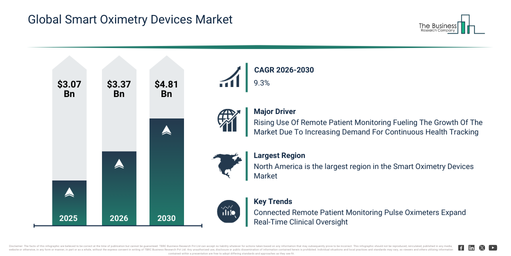
The smart oximetry devices market has experienced significant expansion recently. Its valuation is predicted to rise from $3.07 billion in 2025 to $3.37 billion in 2026, reflecting a compound annual growth rate (CAGR) of 9.6%. This historical expansion can be attributed to elements such as early adoption within hospital settings, the clinical validation of SpO2 monitoring, integration with bedside monitors, obtaining regulatory approvals for pulse oximeters, and the expansion of critical care infrastructure.
The smart oximetry devices market is projected to experience substantial expansion over the coming years. This market is anticipated to reach $4.81 billion by 2030, demonstrating a compound annual growth rate (CAGR) of 9.3%. Key factors contributing to this growth during the forecast period include the rising incidence of respiratory conditions, the broader integration of remote patient monitoring, an escalating need for home healthcare equipment, the widening availability of telehealth services, and a growing elderly demographic. Significant trends expected within this period involve technological improvements in sensor precision, novel developments in wearable oximetry devices, progress in wireless and Bluetooth connectivity, ongoing research and development in multi-parameter monitoring, and enhancements in AI-powered data analytics.
Get A Free Sample Report With In-Depth Market Insights:
Smart Oximetry Devices Market Growth Momentum: What Factors Are Shaping Demand?
The increasing implementation of remote patient monitoring is anticipated to propel the expansion of the smart oximetry devices market moving forward. Remote patient monitoring involves leveraging digital technologies to observe and collect medical and other health information from patients, subsequently sending this data electronically to healthcare providers for evaluation, and if necessary, for guidance and instructions. The adoption of remote patient monitoring is escalating as healthcare providers and payers increasingly depend on continuous data gathered at home to manage chronic diseases more proactively, thereby decreasing hospital readmissions and overall healthcare expenditures. Smart oximetry devices facilitate remote patient monitoring by constantly measuring blood oxygen levels and transmitting this real-time data directly to healthcare professionals. These devices enhance patient care by enabling the prompt detection of hypoxia, facilitating timely medical interventions, and allowing for improved management of chronic respiratory and cardiovascular conditions. For instance, data from September 2025, as reported by the U.S. Department of Health and Human Services Office of Inspector General (OIG), a US-based government agency, indicated that payments for remote patient monitoring reached $536 million across Original Medicare also known as Medicare fee for service and Medicare Advantage, marking a 31% increase from 2023. Concurrently, close to 1 million Medicare enrollees utilized remote patient monitoring services, which represents a 27% increase compared to 2023. Consequently, the increasing utilization of remote patient monitoring is a key factor propelling the expansion of the smart oximetry devices market.
Smart Oximetry Devices Market Segment Breakdown: Which Categories Lead On Revenue?
The smart oximetry devices market covered in this report is segmented –
1) By Product Type: Fingertip Oximeters, Handheld Oximeters, Wrist-Worn Oximeters, Tabletop Or Bedside Oximeters, Other Produt Types
2) By Technology: Conventional, Bluetooth-Enabled, Wi-Fi Enabled
3) By Distribution Channel: Online, Offline
4) By End-User: Hospitals And Clinics, Homecare Settings, Ambulatory Surgical Centers, Others
Subsegments:
1) By Fingertip Oximeters: Basic Fingertip Oximeters, Rechargeable Fingertip Oximeters, Bluetooth-Enabled Fingertip Oximeters
2) By Handheld Oximeters: Portable Handheld Oximeters, Multi-Parameter Handheld Oximeters, Clinical-Grade Handheld Oximeters
3) By Wrist-Worn Oximeters: Fitness Wrist-Worn Oximeters, Medical Wrist-Worn Oximeters, Continuous Monitoring Wrist-Worn Oximeters
4) By Tabletop Or Bedside Oximeters: Standard Bedside Oximeters, Advanced Monitoring Bedside Oximeters, Multi-Parameter Bedside Oximeters
5) By Other Produt Types: Pediatric Oximeters, Veterinary Oximeters, Specialty Application Oximeters
Smart Oximetry Devices Market Trends Redefining Industry Growth
Leading companies within the smart oximetry devices market are concentrating on developing sophisticated monitoring solutions, such as cellular-enabled pulse oximeters, to deliver secure, real-time SpO2 and pulse rate data to clinicians for proactive patient care. Cellular-enabled pulse oximeters refer to devices equipped with integrated cellular connectivity, capable of transmitting oxygen saturation (SpO2) and pulse rate information directly to healthcare providers or cloud platforms in real time. For instance, in August 2024, Prevounce Health, a US-based remote care management provider, introduced the Pylo OX1-LTE pulse oximeter. This clinically validated, cellular-enabled device features roaming 5G/4G LTE connectivity with 2G fallback, provides highly accurate SpO2 and pulse rate measurements, and includes a bright OLED display for clear readings. The Pylo OX1-LTE also ensures secure data transmission directly to remote monitoring platforms and is compatible with third-party health software to support extensive remote patient monitoring programs.
Smart Oximetry Devices Market Company Landscape And Competitive Strategy
Major companies operating in the smart oximetry devices market are Medtronic plc, GE HealthCare Technologies Inc., Koninklijke Philips N.V., Shenzhen Mindray Bio-Medical Electronics Co. Ltd., Masimo Corporation, Nihon Kohden Corporation, Lepu Medical Technology Co. Ltd., Contec Medical Systems Co. Ltd., Beurer GmbH, Heal Force Bio-Meditech Holdings Ltd., Edan Instruments Inc., Biolight Meditech Co. Ltd., Omron Healthcare Co. Ltd., Nonin Medical Inc., Viatom Technology Co. Ltd., A&D Company Limited, iHealth Labs Inc., Smiths Medical International Ltd., Wellue Health Inc., Creative Medical Technology Co. Ltd., Berry Global Healthcare, Oxitone Medical Ltd., Movano Health Inc., ChoiceMMed America Corp.
View The Full Smart Oximetry Devices Market Report:
Smart Oximetry Devices Market Largest Region: Which Geography Holds The Highest Market Share?
North America was the largest region in the smart oximetry devices market in 2025. Asia-Pacific is expected to be the fastest-growing region in the forecast period. The regions covered in the smart oximetry devices market report are Asia-Pacific, South East Asia, Western Europe, Eastern Europe, North America, South America, Middle East, Africa.
Reach Out To Our Team:
The Business Research Company: https://www.thebusinessresearchcompany.com/
Americas: +1 310-496-7795
Asia: +44 7882 955267 & +91 8897263534
Europe: +44 7882 955267
Email us at: marketing@tbrc.info
Follow us on:
LinkedIn: https://in.linkedin.com/company/the-business-research-company
YouTube: https://www.youtube.com/channel/UC24_fI0rV8cR5DxlCpgmyFQ
Global Market Model: https://www.thebusinessresearchcompany.com/global-market-model