The Business Research Company’s 2026 market reports feature enhanced tools like market attractiveness analysis, TAM assessment, and company scoring matrices, along with interactive dashboards, deeper supply chain insights, and startup coverage strengthening the depth, usability, and strategic value of insights.
How Is The Market Size Of The Spatial omics Market Expected To Scale Between 2026 And 2030?
The spatial omics market size has seen significant expansion in recent years. It is projected to increase from $0.33 billion in 2025 to $0.37 billion in 2026, growing at a compound annual growth rate (CAGR) of 11.3%. The market’s past development can be attributed to increased funding for genomics research, the broadening of academic life sciences research, advancements in molecular imaging technologies, a greater supply of omics consumables, and an elevated focus on disease biology research.
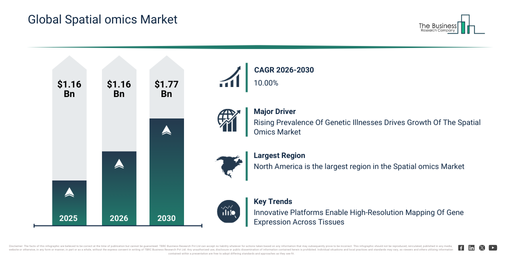
The spatial omics market is projected to experience substantial expansion in the coming years. This market is anticipated to reach $0.54 billion by 2030, demonstrating a compound annual growth rate (CAGR) of 10.0%. This projected growth is driven by factors such as the increasing integration into drug discovery processes, heightened investments in precision medicine studies, the expansion of AI-powered biological data analysis, a rising need for spatially resolved biomarkers, and increased pharmaceutical research and development expenditure. Key trends expected during this period involve the greater uptake of spatial transcriptomics platforms, enhanced integration of multi-omics data analysis, wider application of high-resolution imaging systems, the proliferation of advanced data visualization tools, and a sharpened emphasis on molecular mapping at the tissue level.
Access Your Free Sample Report For In-Depth Market Analysis:
https://www.thebusinessresearchcompany.com/report/spatial-omics-global-market-report
Which Major Drivers Are Influencing The Expansion Of The Spatial omics Market?
The increasing incidence of genetic disorders is anticipated to boost the expansion of the spatial omics market. These conditions are defined as ailments resulting from DNA irregularities passed down from either one or both parents. The surge in genetic diseases can be attributed to heightened awareness, advancements in diagnostic methods, shifts in lifestyle, and environmental elements that promote mutations. Spatial omics technologies provide an effective method for investigating genetic illnesses through the creation of elaborate spatial maps detailing molecular and genetic characteristics within tissues. As an illustration, in July 2025, the National Blood Authority, an Australia-based blood management agency, reported that 2,788 patients were living with hereditary haemophilia A (HMA) in 2023–2024, an increase from 2,681 patients in 2022–2023. Consequently, the growing occurrence of genetic illnesses is stimulating the growth of the spatial omics market.
Which Segment Classifications Are Used In The Spatial omics Market Segment Analysis?
The spatial omics market covered in this report is segmented –
1) By Product: Instruments, Consumables, Software
2) By Sample Type: Formalin-Fixed Paraffin-Embedded (FFPE), Fresh Frozen
3) By Workflow: Sample Preparation, Instrumental Analysis, Data Analysis
4) By Technology: Spatial Transcriptomics, Spatial Genomics, Spatial Proteomics
5) By End-Use: Academic And Translational Research Institutes, Pharmaceutical And Biotechnology Companies
Subsegments:
1) By Instruments: Spatial Transcriptomics Instruments, Imaging Systems, Mass Spectrometers
2) By Consumables: Reagents, Kits, Sample Preparation Materials
3) By Software: Data Analysis Software, Visualization Tools, Integration Platforms
Which Trends Are Shaping The Spatial omics Market?
Companies prominent in the spatial omics market are concentrating on developing novel solutions, such as comprehensive end-to-end spatial transcriptomics platforms. These platforms aim to facilitate detailed mapping of gene expression within tissue contexts, yielding more precise biological insights. End-to-end spatial transcriptomics platforms are unified systems that allow researchers to capture, visualize, and analyze gene expression across tissues through a single workflow, covering everything from sample preparation to data interpretation. For example, in February 2025, Illumina Inc., a US-based biotechnology firm, introduced spatial transcriptomics technology intended to transform tissue analysis and cellular mapping. This technology provides unbiased whole-transcriptome profiling at single-cell resolution with high sensitivity, empowering researchers to map intricate tissues with exceptional detail. It boasts a capture area nine times bigger and four times greater in resolution compared to current methods, making it possible to analyze millions of cells per experiment and identify rare cell types. The technology is also integrated with Illumina’s NextSeq and NovaSeq sequencers and operates alongside the Illumina Connected Multiomics (ICM) platform, which offers sophisticated multiomic visualization and analysis functionalities for thorough spatial data exploration.
Which Firms Are Contributing To The Spatial omics Market Ecosystem?
Major companies operating in the spatial omics market are Agilent Technologies Inc., PerkinElmer Inc., Illumina Inc., Bruker Corporation, QIAGEN N.V., 10x Genomics Inc., Luminex Corporation, Takara Bio Inc., Oxford Nanopore Technologies, NanoString Technologies Inc., Standard BioTools Inc., Akoya Biosciences Inc., CrestOptics, Indica Labs Inc., Resolve Biosciences GmbH, Pixelgen Technologies, Ionpath Inc., RareCyte Inc., S2 Genomics Inc., Vizgen Inc., BioSpyder Technologies, Ultivue Inc.
Get The Full Spatial omics Market Report:
https://www.thebusinessresearchcompany.com/report/spatial-omics-global-market-report
Where Is The Spatial omics Market Primarily Concentrated By Region?
North America was the largest region in the Spatial OMICS market in 2025. Asia-Pacific is expected to be the fastest-growing region in the forecast period. The regions covered in the spatial omics market report are Asia-Pacific, South East Asia, Western Europe, Eastern Europe, North America, South America, Middle East, Africa.
Request A Customized Spatial omics Market Report For Competitive Insights:
https://www.thebusinessresearchcompany.com/report/spatial-omics-global-market-report
Browse Through More Reports Similar to the Global Spatial omics Market 2026, By The Business Research Company
Geographic Information System Market Report 2026
https://www.thebusinessresearchcompany.com/report/geographic-information-system-global-market-report
Geospatial Analytics Market Report 2026
https://www.thebusinessresearchcompany.com/report/geospatial-analytics-global-market-report
Geophysical Data Sales Market Report 2026
https://www.thebusinessresearchcompany.com/report/geophysical-data-sales-global-market-report
Get in touch with us:
The Business Research Company: https://www.thebusinessresearchcompany.com/
Americas +1 310-496-7795
Asia +44 7882 955267 & +91 8897263534
Europe +44 7882 955267
Email us at info@tbrc.info
Follow us on:
LinkedIn: https://in.linkedin.com/company/the-business-research-company
YouTube: https://www.youtube.com/channel/UC24_fI0rV8cR5DxlCpgmyFQ
Global Market Model: https://www.thebusinessresearchcompany.com/global-market-model