Enhanced with market attractiveness analysis, total addressable market evaluation, company benchmarking matrices, interactive Excel dashboards, expanded supply chain intelligence, emerging startup coverage, and detailed product insights, The Business Research Company’s 2026 market reports deliver more actionable and strategically valuable research.
The 3D medical imaging devices market is experiencing rapid growth, driven by technological advancements and expanding healthcare needs. As demand for detailed anatomical visualization and improved diagnostic accuracy rises, this sector is poised for significant development through 2030. Let’s explore the current market size, key growth drivers, major players, emerging trends, and future opportunities shaping this important healthcare technology field.
Steady Growth Forecast in the 3D Medical Imaging Devices Market
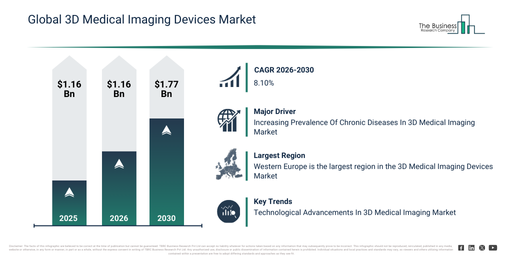
The market for 3D medical imaging devices has expanded notably over recent years. It is projected to increase from $13.68 billion in 2025 to $14.76 billion in 2026, reflecting a compound annual growth rate (CAGR) of 7.9%. This upward trajectory during the historic period has been fueled by advances in medical imaging technology, a rise in diagnostic imaging centers, increased demand for detailed anatomical views, the growing burden of chronic diseases, and enhancements in hospital imaging infrastructure. Looking ahead, the market is expected to reach $20.16 billion by 2030, with a slightly higher CAGR of 8.1%. Key factors contributing to this forecast include the rising use of AI-powered diagnostic tools, greater investments in precision medicine, expanded applications in oncology and cardiology imaging, increased focus on early disease detection, and the integration of cloud-based imaging solutions. Notable trends anticipated in the coming years are the adoption of AI-enabled image reconstruction, more widespread use of high-resolution 3D imaging systems, advanced visualization software, multi-modality imaging platforms, and an emphasis on improving diagnostic speed and accuracy.
Download A Free Sample Report For Comprehensive Market Insights:
https://www.thebusinessresearchcompany.com/sample.aspx?id=2513&type=smp
How Chronic Disease Prevalence Fuels Market Expansion
One of the primary forces driving the growth of the 3D medical imaging devices market is the increasing prevalence of chronic diseases. Chronic illnesses, defined as long-term health conditions lasting three months or more, require precise and early diagnosis to manage effectively. 3D imaging techniques such as computed tomography (CT) scans and magnetic resonance imaging (MRI) provide detailed three-dimensional views of internal anatomy, enabling healthcare providers to identify chronic conditions at earlier stages. For instance, data from the National Library of Medicine in January 2023 highlighted that the population of Americans aged 50 and older with at least one chronic condition is expected to rise by 99.5%, reaching 142.66 million by 2050. This surge highlights a growing need for sophisticated imaging solutions, directly boosting demand in the 3D medical imaging market.
Additional Factors Supporting Market Growth
Beyond chronic disease, ongoing improvements in hospital infrastructure and the expansion of diagnostic imaging centers worldwide are strengthening the market. The increasing utilization of 3D imaging technologies in routine clinical practice and the broadening range of diagnostic applications also contribute significantly. Furthermore, advancements in imaging algorithms and hardware are making these devices more accessible and effective, encouraging adoption across diverse healthcare settings.
https://www.thebusinessresearchcompany.com/report/3d-medical-imaging-devices-global-market-report
3D Medical Imaging Devices Market Regional Outlook: Where Are The Largest Opportunities Located?
Segment Overview Highlighting Opportunities in the 3D Medical Imaging Devices Market
This report divides the 3D medical imaging devices market into several key segments for deeper analysis:
1) By Type: Ultrasound, X-ray, CT Scan, and Other Types
2) By Application: Gynecology and Obstetrics, Cardiology, Neurology, Orthopedics, and Oncology
3) By End User: Diagnostic Centers, Hospitals, and Research Centers
Further subcategories provide detail on ultrasound types such as 3D/4D ultrasound and contrast-enhanced ultrasound; X-ray modalities including 3D mammography or tomosynthesis, cone beam CT (CBCT) for X-ray imaging, and fluoroscopy; CT scans featuring spiral/helical CT, cone beam CT, and dual-energy CT; and other types encompassing MRI, positron emission tomography (PET), single photon emission computed tomography (SPECT), and 3D endoscopic imaging systems. This segmentation highlights where the most promising growth opportunities are unfolding within the market.
Innovative Trends Driving Future Growth in 3D Medical Imaging
Leading players in this market are pushing forward innovations such as immersive learning platforms that utilize hyper-realistic 3D medical images derived from MRI and CT scans. These platforms aim to enhance training for medical professionals and students by providing precise, interactive diagnostic images. For example, in August 2023, GigXR, Inc., a US-based pioneer in holographic training solutions, launched the DICOM XR Library. This shared resource offers 3D DICOM holograms from computed tomography and magnetic resonance imaging, enabling a 360-degree diagnostic imaging experience. Such innovations improve educational outcomes and prepare healthcare providers with accurate simulation tools for observation and assessment.
Key Companies Competing in the 3D Medical Imaging Devices Market
The market features a broad range of influential companies, including GE Healthcare, Royal Philips, Siemens AG, Materialise NV, Toshiba Group, Samsung Medison Co. Ltd., Shimadzu Corporation, Analogic Corporation, Digirad Corporation, Del Medical Systems Group, Hologic Inc., Carestream Health Inc., Ambra Health, Fovia, Mach7 Technologies Ltd., Barco NV, TomTec Imaging Systems GmbH, Fujifilm Holdings Corporation, 3D Systems Healthcare, Canon Medical Systems Corporation, ContextVision AB, Curvebeam AI Ltd., EchoPixel Inc., EOS Imaging, Esaote SpA, Hitachi Healthcare, Intrasense, Konica Minolta Healthcare, Mobius Imaging, Neusoft Medical Systems, Pie Medical Imaging, Planmed Oy, Sectra, Shenzhen Mindray Bio-Medical Electronics, Varian Medical Systems, and Ziehm Imaging GmbH. These companies are instrumental in driving innovation, expanding market reach, and enhancing product portfolios.
Regional Market Dynamics and Growth Hotspots
In 2025, Western Europe stood as the largest market for 3D medical imaging devices, with Asia-Pacific ranking as the second largest. The report covers key regions including Asia-Pacific, South East Asia, Western Europe, Eastern Europe, North America, South America, the Middle East, and Africa. Each of these areas offers unique opportunities and challenges, contributing to a comprehensive global perspective on the market’s growth and development.
Get in touch with us:
The Business Research Company: https://www.thebusinessresearchcompany.com/
Americas: +1 310-496-7795
Asia: +44 7882 955267 & +91 8897263534
Europe: +44 7882 955267
Email us at: marketing@tbrc.info
Follow us on:
LinkedIn: https://in.linkedin.com/company/the-business-research-company
YouTube: https://www.youtube.com/channel/UC24_fI0rV8cR5DxlCpgmyFQ
Global Market Model: https://www.thebusinessresearchcompany.com/global-market-model