Through market attractiveness analysis, total addressable market evaluation, company benchmarking matrices, interactive Excel dashboards, expanded supply chain intelligence, emerging startup coverage, and detailed product insights, The Business Research Company’s 2026 market reports provide more actionable and strategically valuable research.
The 3D printed implants industry is witnessing swift advancement as more healthcare providers adopt additive manufacturing technologies for customized medical solutions. This market is evolving rapidly due to technological breakthroughs and growing acceptance among surgeons, promising significant expansion in the coming years. Below is an overview of the market size, key growth drivers, segment highlights, strategic trends, leading companies, and regional influences shaping this sector.
Market Size and Projected Growth Trajectory of the 3D Printed Implants Market
The 3D printed implants market has experienced rapid growth recently and is projected to increase from $3.9 billion in 2025 to $4.64 billion in 2026, representing a compound annual growth rate (CAGR) of 18.9%. This historic growth phase is driven by factors such as the rising prevalence of orthopedic and dental disorders, early adoption of additive manufacturing in healthcare, advancements in medical-grade 3D printing materials, improved acceptance of customized implants by surgeons, and regulatory approvals for printed implant products.
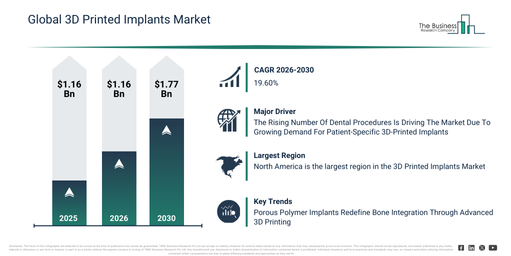
Looking ahead, the market is expected to expand significantly, reaching $9.51 billion by 2030 with an accelerated CAGR of 19.6%. This forecasted growth stems from increasing demand for personalized healthcare solutions, a rise in cranio-maxillofacial and orthopedic surgeries, greater investments in biocompatible materials, enhanced use of digital twin technologies for implant design, and progress in high-resolution 3D printing systems. Key trends predicted to influence this period include greater adoption of patient-specific implant designs, expanded use of advanced metal and polymer materials, integration of digital surgical planning tools, extension into complex anatomical implant applications, and a stronger focus on implant fit and precision.
Download A Free Sample Report For Comprehensive Market Insights:
https://www.thebusinessresearchcompany.com/sample.aspx?id=2460&type=smp
Growth Factors Propelling the 3D Printed Implants Market
The increase in dental procedures is poised to be a major catalyst for the 3D printed implants market’s growth. Dental procedures encompass a range of medical treatments performed by dentists and dental hygienists to diagnose, prevent, and treat various oral health issues. The rising volume of these procedures is driving demand for patient-specific 3D printed implants such as crowns, bridges, and prosthetic devices tailored to individual dental anatomy.
For instance, according to data from the UK’s NHS Business Services Authority in November 2024, dental services delivered 34 million treatment courses—an increase of 4.3% from 2022/23. Additionally, total dental activity rose by 3.4% to 73 million units, with 18 million adults and 6.6 million children receiving care within the last year. Notably, 31% of adult treatments involved scale and polish procedures. This rise in dental interventions is directly fueling the demand for customized 3D printed implants, thereby boosting market growth.
Segment Overview: Key Categories Driving Expansion in the 3D Printed Implants Market
This report breaks down the 3D printed implants market into several segments:
1) Implantation Technology: Laser Beam Melting and Electronic Beam Melting
2) Application Areas: Dental, Orthopedic, and Cranio-maxillofacial
3) End Users: Medical and Surgical Centers, Medical Institutions
Further subsegments include specific techniques such as Selective Laser Melting (SLM) and Direct Metal Laser Sintering (DMLS) under Laser Beam Melting, and Vacuum and Atmospheric Electronic Beam Melting (EBM). These classifications help identify which technologies and applications are contributing most to market growth.
https://www.thebusinessresearchcompany.com/report/3d-printed-implants-global-market-report
3D Printed Implants Market Regional Distribution: Which Areas Drive Market Expansion?
Strategic Innovations Defining the Future of the 3D Printed Implants Market
Leading companies in the 3D printed implants field are focusing on innovative products designed to improve clinical outcomes. A prime example is the development of porous PEEK implants, which are additively manufactured polymer devices with interconnected porous structures to support bone ingrowth while maintaining mechanical properties compatible with natural bone.
In September 2024, Nvision Biomedical Technologies, a US-based implant manufacturer, received FDA clearance for the first 3D-printed PEEK interbody system made from PEEK-OPTIMA. This system features an additively manufactured porous architecture aimed at promoting multidirectional bone growth and enhancing implant fixation in cervical and lumbar spinal fusion procedures. It also offers mechanical performance similar to natural bone and improved radiolucency, allowing surgeons to more accurately monitor fusion progress while reducing risks such as implant subsidence.
Top Players and Competitive Landscape in the 3D Printed Implants Market
The market features several prominent companies, including: Johnson & Johnson, Medtronic plc, Stryker Corporation, Zimmer Biomet Holdings Inc, Lima Corporation, Smith & Nephew plc, Globus Medical Inc, Exactech Inc, KLS Martin Group, Materialise NV, Xilloc Medical B V, 3D LifePrints Ltd, Oxford Performance Materials, Cyfuse Medical, Cyfuse Biomedical K K, SINTX Technologies Inc, restor3d Inc, Additive Orthopaedics Inc, Conformis Inc, and Anatomics Pty Ltd. These industry leaders are driving innovation and competitive positioning across global markets.
Regional Market Insights Highlighting Growth Hotspots for 3D Printed Implants
In 2025, North America held the largest share of the 3D printed medical implants market, reflecting strong adoption and infrastructure in this region. Asia-Pacific ranked as the second-largest market, showing considerable potential due to growing healthcare investments and expanding surgical volumes. The analysis spans key regions including Asia-Pacific, South East Asia, Western and Eastern Europe, North America, South America, the Middle East, and Africa, offering a comprehensive global perspective on market dynamics.
Get in touch with us:
The Business Research Company: https://www.thebusinessresearchcompany.com/
Americas: +1 310-496-7795
Asia: +44 7882 955267 & +91 8897263534
Europe: +44 7882 955267
Email us at: marketing@tbrc.info
Follow us on:
LinkedIn: https://in.linkedin.com/company/the-business-research-company
YouTube: https://www.youtube.com/channel/UC24_fI0rV8cR5DxlCpgmyFQ
Global Market Model: https://www.thebusinessresearchcompany.com/global-market-model