Backed by market attractiveness analysis, total addressable market sizing, company benchmarking matrices, interactive Excel dashboards, wider supply chain intelligence, emerging startup coverage, and detailed product-level insights, The Business Research Company’s 2026 market reports are designed to offer research that is more actionable and strategically valuable than ever.
Antifungals Market Growth Potential: How Will Market Size Shift Through 2030?
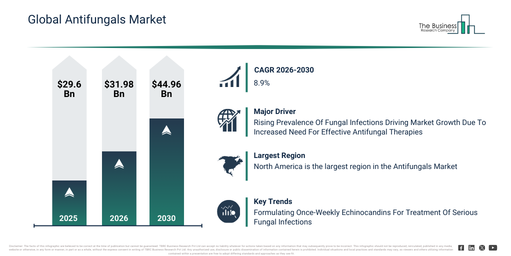
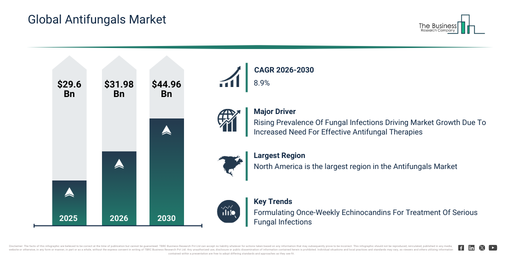
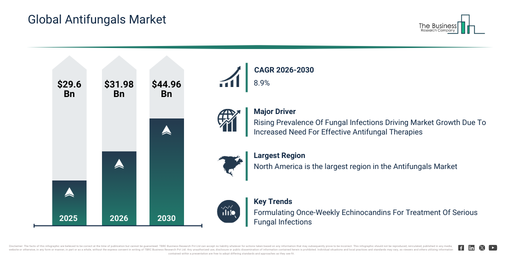
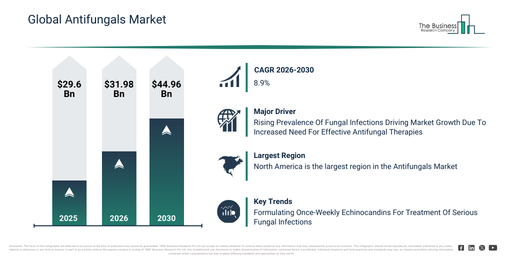
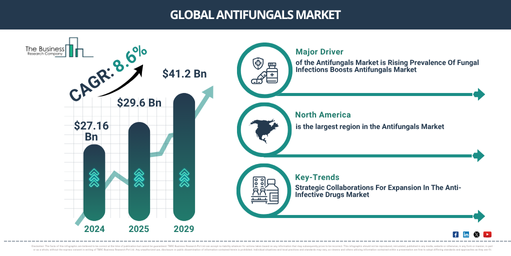
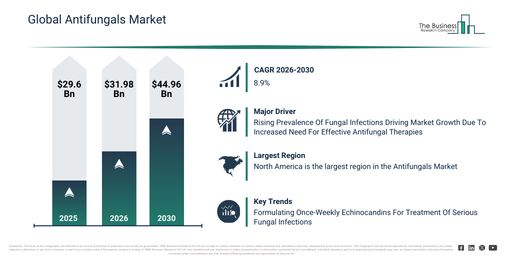
The antifungals market has experienced robust expansion in recent times. This market is projected to expand from $29.6 billion in 2025 to reach $31.98 billion in 2026, demonstrating a compound annual growth rate (CAGR) of 8.1%. Historically, this expansion has been driven by factors such as a rise in hospital-acquired infections, the prevalent application of azoles, an increasing number of immunosuppressed individuals, well-established antifungal treatments, and the worldwide prevalence of mycoses.
The antifungals market is projected to experience robust expansion over the coming years. Its valuation is set to reach $44.96 billion by 2030, exhibiting a compound annual growth rate (CAGR) of 8.9%. This anticipated growth during the forecast period is primarily driven by factors such as an increase in systemic fungal infections, rising concerns about antifungal resistance, a growing demand for safer therapeutic options, the expansion of hospital care services, and improved diagnosis rates. Key trends anticipated during this period encompass the increasing prevalence of fungal infections, an escalating need for broad-spectrum antifungal agents, the widening availability of topical antifungal treatments, enhanced application in patients with compromised immune systems, and the innovation of new classes of antifungal drugs.
Get A Free Sample Report With In-Depth Market Insights:
Antifungals Market Growth Momentum: What Factors Are Shaping Demand?
The increasing prevalence of fungal infections is anticipated to propel the growth of the antifungals market moving forward. Fungal infections are conditions caused by fungi invading and growing within or on the body, affecting various parts such as the skin, nails, lungs, and mucous membranes. The rising incidence of these infections is attributed to climate change, which creates favorable environments for fungi to spread and adapt to higher temperatures, thereby increasing human exposure and infection risks. Antifungals play a crucial role in treating fungal diseases by inhibiting the growth and reproduction of fungi, either by disrupting their cell wall or membrane, blocking essential enzymatic processes, or interfering with their ability to synthesize vital components. This action reduces the fungal load, alleviates symptoms, and prevents the spread of infection within the body. For instance, in May 2025, according to the UK Health Security Agency, a UK-based government department, bloodstream infections caused by yeast increased by 4% in 2024 compared with 2023, rising from 2,170 reported cases to 2,247. Consequently, the increasing incidence of fungal infections is a key factor driving the expansion of the antifungals market. The expansion of healthcare infrastructure is projected to fuel the growth of the antifungals market in the future. Healthcare infrastructure refers to the foundational physical and organizational frameworks, facilities, and systems that facilitate the provision of healthcare services. The primary driver behind the rise in healthcare infrastructure is increased government backing and financial commitments, channeled through various policies and incentives aimed at advancing healthcare facility development. This infrastructure provides the essential facilities, systems, and resources required for effective management of fungal infections. For illustration, in May 2024, according to Baker McKenzie, an Australia based law firm, the Australian government allocated $1.82 billion (AUD 2.8 billion) to strengthen Medicare, building on the $3.95 billion (AUD 6.1 billion) Medicare investment in the 2023-24 Federal Budget, along with USD 91.48million (AUD 141.1 million) designated for medical research and services for individuals with chronic conditions such as bowel and skin cancer, diabetes, and dementia. Therefore, the expanding healthcare infrastructure is a significant factor propelling the antifungals market forward.
Antifungals Market Segments: Where Is Growth Concentrated?
The antifungals market covered in this report is segmented –
1) By Drug Type: Echinocandins, Azoles, Polyenes, Allylamines
2) By Route of Administration: Oral, Parenteral, Topical
3) By End users: Hospitals & Clinics, Dermatology clinics, Other Users
Subsegments:
1) By Echinocandins: Caspofungin, Micafungin, Anidulafungin
2) By Azoles: Fluconazole, Itraconazole, Voriconazole, Posaconazole, Ketoconazole
3) By Polyenes: Amphotericin B, Nystatin
4) By Allylamines: Terbinafine, Naftifine
Antifungals Market Trends Redefining Industry Growth
Major corporations operating in the antifungals market are concentrating on developing innovative products and formulations, including long-acting echinocandin therapies. This initiative aims to bolster patient compliance, diminish the need for frequent dosing, and fulfill unmet clinical requirements concerning invasive fungal infections. Through extending their half-life and modifying their pharmacokinetics, these advanced antifungals provide effective fungal suppression with more convenient administration regimens. For example, in March 2023, Cidara Therapeutics, a US-based biotechnology company, alongside Melinta Therapeutics (U.S.), publicized the FDA’s clearance for REZZAYO (rezafungin for injection) for managing candidemia and invasive candidiasis. Rezafungin is an echinocandin administered once-weekly, exhibiting non-inferior effectiveness compared to daily caspofungin in clinical trials (ReSTORE Phase 3), while possessing a comparable safety record. The prolonged dosing potential of REZZAYO addresses a significant deficiency in antifungal treatment, thereby enhancing treatment consistency and easing the load on hospitals in acute-care settings.
Antifungals Market Key Participants And Competitive Landscape
Major companies operating in the antifungals market are Pfizer Inc., Novartis International AG, Merck & Co. Inc., Bayer AG, Abbott Laboratories, Sanofi S.A., Kramer Laboratories Inc., GlaxoSmithKline plc, Gilead Sciences Inc., Basilea Pharmaceutica AG, Sigma-Aldrich, Astellas Pharma Inc., Janssen Pharmaceutica NV, Zydus Cadila Healthcare Ltd., Teva Pharmaceutical Industries Ltd., Sun Pharmaceutical Industries Ltd., Sumitomo Dainippon Pharma Co. Ltd., Scynexis Inc., Mayne Pharma Inc., Cosmo Pharmaceuticals NV, Leadiant Biosciences Inc, Glenmark Pharmaceuticals Limited, Cidara Therapeutics, MATINAS BIOPHARMA, Mylan N.V., Perrigo Company plc, Wockhardt Ltd., Lupin Limited, Dr. Reddy’s Laboratories Ltd, Torrent Pharmaceuticals Ltd., Hikma Pharmaceuticals PLC, Mayne Pharma Group Limited, Fresenius Kabi AG, Baxter International Inc., Akorn Operating Company LLC, Amphastar Pharmaceuticals Inc., Mylan Institutional LLC, West-Ward Pharmaceuticals Corp., Gland Pharma Limited, Aurobindo Pharma Limited
View The Full Antifungals Market Report:
Antifungals Market Regional Analysis And Leading Geography
North America was the largest region in the drugs for antifungals market in 2025. The Middle East is expected to be the fastest-growing region in the antifungals market. The regions covered in the antifungals market report are Asia-Pacific, South East Asia, Western Europe, Eastern Europe, North America, South America, Middle East, Africa.
Reach Out To Our Team:
The Business Research Company: https://www.thebusinessresearchcompany.com/
Americas: +1 310-496-7795
Asia: +44 7882 955267 & +91 8897263534
Europe: +44 7882 955267
Email us at: marketing@tbrc.info
Follow us on:
LinkedIn: https://in.linkedin.com/company/the-business-research-company
YouTube: https://www.youtube.com/channel/UC24_fI0rV8cR5DxlCpgmyFQ
Global Market Model: https://www.thebusinessresearchcompany.com/global-market-model