Built to provide research that’s more actionable and strategically valuable, The Business Research Company’s 2026 market reports include market attractiveness analysis, total addressable market sizing, company benchmarking matrices, interactive Excel dashboards, broader supply chain intelligence, emerging startup tracking, and in-depth product insights.
Artificial Vital Organs And Medical Bionics Market CAGR Outlook And Future Development
The artificial vital organs and medical bionics market has demonstrated substantial expansion in recent years. It is projected to expand from $46.95 billion in 2025 to $51.07 billion in 2026, achieving a compound annual growth rate (CAGR) of 8.8%. The expansion witnessed in the historical timeframe is primarily attributable to factors such as the restricted accessibility of artificial organ technologies, the elevated cost associated with early bionic devices, the prevalent dependence on mechanical organ systems, the escalating occurrence of organ failure, and the initial regulatory clearances granted for medical bionic devices.
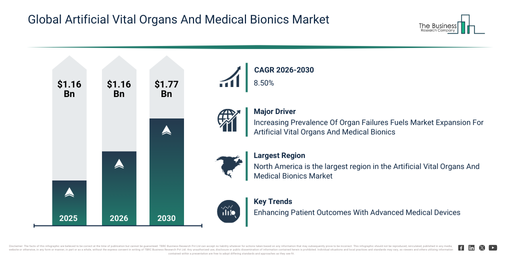
The market for artificial vital organs and medical bionics is projected to experience substantial expansion over the coming years. This market is anticipated to reach a valuation of $70.67 billion by 2030, exhibiting a compound annual growth rate (CAGR) of 8.5%. Key factors driving this growth during the projection period include progress in electronic and intelligent bionic devices, increasing research and development (R&D) investments for artificial organs, wider acceptance of minimally invasive implantation techniques, the expansion of personalized medicine and tailored patient solutions, and the increasing availability of bionic therapies through hospitals and clinics. Significant trends expected within the forecast timeframe encompass the growing acceptance of artificial heart and kidney devices, enhanced integration of neural implants and bionic organs, advancements in rehabilitation and assistive technologies, a stronger focus on customizable and patient-specific solutions, and the broadening of clinical trials and research applications.
Get A Free Sample Report With In-Depth Market Insights:
Artificial Vital Organs And Medical Bionics Market Growth Catalysts And Demand Drivers
The increasing frequency of organ failures is projected to boost the expansion of the Artificial Vital Organs And Medical Bionics Market. Organ failure represents a severe condition where one or multiple organs lose their capacity to perform essential roles, resulting in significant health complications and potentially life-threatening outcomes. The growing incidence of organ failures is attributable to higher rates of chronic illnesses like diabetes, hypertension, and heart disease, alongside hereditary conditions and genetic predispositions that can lead to organ malfunction. Artificial vital organs and medical bionics offer solutions for organ failures by providing life-sustaining assistance and restoring critical functions for patients with damaged organs. For example, in January 2025, the Organ Procurement and Transplantation Network, a US-based non-profit scientific organ donation transplantation system, reported that organ transplants surpassed 48,000 in 2024, indicating a 3.3 percent increase from the transplants carried out in 2023. Consequently, the escalating occurrence of organ failures is set to propel the growth of the Artificial Vital Organs And Medical Bionics Market. The growing demographic of the elderly population is anticipated to stimulate the expansion of the Artificial Vital Organs And Medical Bionics Market moving forward. The elderly population encompasses individuals aged 60 or 65 and older, who often require specialized care and services due to health and lifestyle challenges associated with aging. This demographic is expanding due to enhanced life expectancy, driven by improvements in healthcare and living standards. Artificial vital organs and medical bionics provide support to the elderly by substituting or enhancing failing biological functions, thereby improving their mobility, independence, and overall quality of life. As an illustration, in January 2024, a report from the Population Reference Bureau, a US-based non-profit organization dedicated to collecting statistics for research and academic purposes, indicated that the number of Americans aged 65 and older is expected to increase from 58 million in 2022 to 82 million by 2050, representing a 47% rise. During this period, the proportion of this age group within the total U.S. population is projected to grow from 17% to 23%. Therefore, the expanding elderly population is a key driver for the growth of the Artificial Vital Organs And Medical Bionics Market.
Artificial Vital Organs And Medical Bionics Market Segments: Where Is Growth Concentrated?
The artificial vital organs and medical bionics market covered in this report is segmented –
1) By Type: Artificial Vital Organs, Medical Bionics
2) By Technology: Mechanical, Electronic
3) By Application: Hospitals, Clinics, Other Applications
Subsegments:
1) By Artificial Vital Organs: Artificial Heart, Artificial Kidney, Artificial Liver, Artificial Lungs, Artificial Pancreas
2) By Medical Bionics: Bionic Limbs, Bionic Eyes, Bionic Ears, Neural Implants, Bionic Organs
Artificial Vital Organs And Medical Bionics Market Trends Shaping Long-Term Demand
Major companies operating in the artificial vital organs and medical bionics market are engaged in developing advanced products, such as the bionic pancreas, to enhance patient outcomes and address the growing demand for sophisticated medical solutions. A bionic pancreas represents an advanced medical device designed to automate blood sugar regulation for individuals with diabetes by mimicking the natural functions of a healthy pancreas. For instance, in December 2023, Beta Bionics Inc., a US-based medical technology firm, launched the iLet Bionic Pancreas, an autonomous insulin delivery system that simplifies diabetes management through automatic adjustment of insulin delivery based on the user’s weight. This development eliminates the necessity for healthcare providers to configure complex settings like correction factors, insulin-to-carb ratios, or pre-set basal rates, thereby lessening the burden on both patients and medical professionals.
Artificial Vital Organs And Medical Bionics Market Company Landscape And Competitive Strategy
Major companies operating in the artificial vital organs and medical bionics market are Abiomed Inc., Abbott Laboratories, Medtronic Plc, Fresenius Medical Care AG, Asahi Kasei Corporation, Boston Scientific Corporation, Biomet Inc., Terumo Corporation, Edwards Lifesciences Corporation, Otto Bock Healthcare GmbH, Nikkiso Co. Ltd., Cochlear Ltd., Ossur, Cirtec Medical, Heartware International Inc., Berlin Heart GmbH, SynCardia Systems LLC, Ekso Bionics Holdings Inc., Jarvik Heart Inc., CARMAT, Iwalk Inc., BiVACOR Inc., Nano Retina Inc., Second Sight Medical Products Inc., St. Jude Medical Inc.
View The Full Artificial Vital Organs And Medical Bionics Market Report:
Artificial Vital Organs And Medical Bionics Market Largest Region: Which Geography Holds The Highest Market Share?
North America was the largest region in the artificial vital organs and medical bionics market in 2025. Asia-Pacific is expected to be the fastest-growing region in the forecast period. The regions covered in the artificial vital organs and medical bionics market report are Asia-Pacific, South East Asia, Western Europe, Eastern Europe, North America, South America, Middle East, Africa.
Reach Out To Our Team:
The Business Research Company: https://www.thebusinessresearchcompany.com/
Americas: +1 310-496-7795
Asia: +44 7882 955267 & +91 8897263534
Europe: +44 7882 955267
Email us at: marketing@tbrc.info
Follow us on:
LinkedIn: https://in.linkedin.com/company/the-business-research-company
YouTube: https://www.youtube.com/channel/UC24_fI0rV8cR5DxlCpgmyFQ
Global Market Model: https://www.thebusinessresearchcompany.com/global-market-model