Tag: at-home dermatology devices market growth

  • At-Home Dermatology Devices Market Reaches $17.7 Billion In 2026: Key Developments Shaping Expansion

    At-Home Dermatology Devices Market Reaches $17.7 Billion In 2026: Key Developments Shaping Expansion

    Backed by market attractiveness analysis, total addressable market sizing, company benchmarking matrices, interactive Excel dashboards, wider supply chain intelligence, emerging startup coverage, and detailed product-level insights, The Business Research Company’s 2026 market reports are designed to offer research that is more actionable and strategically valuable than ever.

    At-Home Dermatology Devices Market Size Outlook: How Quickly Will Revenue Expand Through 2030?

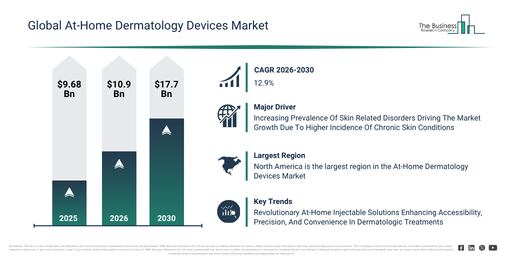
    The at-home dermatology devices market size has experienced rapid growth in recent years. This market is projected to expand from $9.68 billion in 2025 to $10.9 billion in 2026, at a compound annual growth rate (CAGR) of 12.6%. Historically, this growth can be attributed to heightened consumer awareness regarding skin health, increasing demand for anti-aging solutions, the rising popularity of non-invasive home treatments, advancements in laser and light therapy technology, and the expansion of e-commerce channels for skincare devices.

    The at-home dermatology devices market size is poised for substantial growth in the upcoming years. It is projected to expand to $17.7 billion by 2030, achieving a compound annual growth rate (CAGR) of 12.9%. This anticipated growth can be attributed to several factors, including the increasing incorporation of AI and diagnostic sensors into devices, a rise in the adoption of personalized skin treatment solutions, the development of online and subscription-based distribution models, the proliferation of multi-functional and combination therapy devices, and a heightened focus on safety and regulatory compliance for home-use dermatology tools. Noteworthy trends expected during this forecast period involve the growing adoption of portable at-home dermatology devices, an escalating demand for combination skincare therapy devices, the expanding integration of light and laser-based treatment devices, the widening use of automated microneedling and serum delivery systems, and an increased emphasis on online and direct-to-consumer distribution channels.

    Get A Free Sample Report With In-Depth Market Insights:

    https://thebusinessresearchcompany.com/sample_request?id=87340391&type=smp&name=At-Home%20Dermatology%20Devices%20Market%20Report%202026&utm_source=Blogs&utm_medium=Paid&utm_campaign=Oct_PR

    At-Home Dermatology Devices Market Growth Backed By Core Demand Fundamentals

    The expanding occurrence of skin conditions is anticipated to fuel the future expansion of the at home dermatology devices market. These disorders encompass conditions like eczema, dermatitis, psoriasis, and various other chronic or acute inflammatory skin ailments. The rise in their prevalence stems from evolving lifestyle factors, including inadequate diet, heightened stress, insufficient physical activity, and increased exposure to environmental contaminants, all of which can initiate or exacerbate conditions like eczema, acne, and psoriasis. At-home dermatology devices empower individuals to proactively manage these conditions through features such as real-time monitoring, tailored treatment application, and progress tracking, thereby decreasing reliance on face-to-face consultations and enhancing overall skin health. For example, in August 2023, Skin Health Institute Inc., a non-profit organization based in Australia, reported that psoriasis impacts an estimated 2–3% of the population in Australia, underscoring its status as a relatively common skin ailment. Consequently, the growing incidence of skin related disorders is a key impetus for the expansion of the at home dermatology devices market.

    At-Home Dermatology Devices Market Segment Analysis Spotlighting Growth Areas

    The at-home dermatology devices market covered in this report is segmented –

    1) By Product Type: Light Therapy Devices, Microdermabrasion Devices, Laser Devices, Radiofrequency Devices, Microneedling Devices, Other Product Types

    2) By Distribution Channel: Online Stores, Pharmacies, Specialty Stores, Other Distribution Channels

    3) By Application: Acne Treatment, Hair Removal, Skin Rejuvenation, Wrinkle Reduction, Psoriasis, Other Applications

    4) By End-User: Individuals, Home Care Settings

    Subsegments:

    1) By Light Therapy Devices: Blue Light Therapy Devices, Red Light Therapy Devices, Combination Red And Blue Light Therapy Devices, Portable Light Therapy Devices

    2) By Microdermabrasion Devices: Crystal-Based Microdermabrasion Devices, Diamond-Tip Microdermabrasion Devices, Handheld Microdermabrasion Devices, Professional-Grade At-Home Microdermabrasion Devices

    3) By Laser Devices: Fractional Laser Devices, Non-Ablative Laser Devices, Ablative Laser Devices, Portable At-Home Laser Devices

    4) By Radiofrequency Devices: Monopolar Radiofrequency Devices, Bipolar Radiofrequency Devices, Tripolar Radiofrequency Devices, Portable Radiofrequency Skin Devices

    5) By Microneedling Devices: Manual Microneedling Rollers, Automated Microneedling Pens, At-Home Microneedling Kits, Combination Microneedling And Serum Devices

    6) By Other Product Types: Ultrasonic Skin Devices, Hydration And Infusion Devices, Light Emitting Diode Facial Mask Devices, Combination Skincare Therapy Devices

    At-Home Dermatology Devices Market Growth Trends Reshaping The Competitive Landscape

    Leading companies in the At-Home Dermatology Devices market are concentrating on developing innovative products, such as at-home microneedle injectable devices, to offer convenient, effective, and self-administered treatments for common skin conditions. These compact tools deliver precise doses of medication directly into the skin, aiding in the reduction of inflammation, treating acne or other dermatologic conditions, and providing professional-level results within the home setting. For instance, in October 2025, Indomo Therapeutics Inc., a US-based clinical-stage company, introduced ClearPen, an investigational at-home injectable candidate designed for treating inflammatory acne lesions. ClearPen integrates a proprietary microneedle delivery device with triamcinolone acetonide, a corticosteroid consistent with American Academy of Dermatology guidelines. The device enables accurate, low-dose intradermal injections that decrease inflammation and lesion size, allowing patients to safely self-administer treatment at home. Its design emphasizes ease of use, accuracy, and convenience compared with traditional in-office intralesional injections. Beyond acne, Indomo aims to broaden the platform for other corticosteroid-responsive conditions, such as keloids and hidradenitis suppurativa, thereby providing wider access to timely dermatologic care.

    At-Home Dermatology Devices Market Top Companies Driving Competitive Growth

    Major companies operating in the at-home dermatology devices market are Procter & Gamble Co., Panasonic Corporation, L’Oréal S.A., Koninklijke Philips N.V., Nu Skin Enterprises Inc., YA-MAN Ltd., Therabody Inc., FOREO AB, CurrentBody Ltd., Home Skinovations Ltd., Project E Beauty Inc., The Beauty Tech Group Inc., LightStim Inc., Beurer GmbH, PMD Beauty Inc., ZIIP Beauty Inc., Microderm GLO LLC, BSG Aesthetics Solutions Inc., Nood Ventures LLC, Reviva Labs Inc., Kenzzi Limited, Homiley Brands LLC, Nooance Inc.

    View The Full At-Home Dermatology Devices Market Report:

    https://thebusinessresearchcompany.com/report/at-home-dermatology-devices-market-report?utm_source=Blogs&utm_medium=Paid&utm_campaign=Oct_PR

    At-Home Dermatology Devices Market Global Footprint: Which Region Leads The Market?

    North America was the largest region in the at-home dermatology devices market in 2025. Asia-Pacific is expected to be the fastest-growing region in the forecast period. The regions covered in the at-home dermatology devices market report are Asia-Pacific, South East Asia, Western Europe, Eastern Europe, North America, South America, Middle East, Africa.

    Reach Out To Our Team:

    The Business Research Company: https://www.thebusinessresearchcompany.com/

    Americas: +1 310-496-7795

    Asia: +44 7882 955267 & +91 8897263534

    Europe: +44 7882 955267

    Email us at: marketing@tbrc.info

    Follow us on:

    LinkedIn: https://in.linkedin.com/company/the-business-research-company

    YouTube: https://www.youtube.com/channel/UC24_fI0rV8cR5DxlCpgmyFQ

    Global Market Model: https://www.thebusinessresearchcompany.com/global-market-model
  • Global At-Home Dermatology Devices Market Forecast To Achieve $17.7 Billion By 2030 At 12.9% CAGR

    Global At-Home Dermatology Devices Market Forecast To Achieve $17.7 Billion By 2030 At 12.9% CAGR

    The Business Research Company’s 2026 market reports feature enhanced tools like market attractiveness analysis, TAM assessment, and company scoring matrices, along with interactive dashboards, deeper supply chain insights, and startup coverage strengthening the depth, usability, and strategic value of insights.

    What Level Of Market Value Growth Is Predicted For The At-Home Dermatology Devices Market From 2026 To 2030?

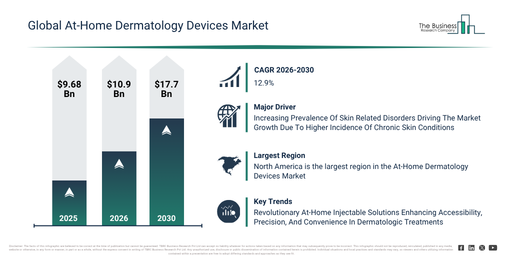
    The market size for at-home dermatology devices has experienced significant expansion in recent years. It is projected to increase from $9.68 billion in 2025 to $10.9 billion in 2026, demonstrating a compound annual growth rate (CAGR) of 12.6%. This growth in past periods can be linked to factors such as rising consumer awareness about skin health, increasing demand for anti-aging solutions, the growing popularity of non-invasive home treatments, advancements in laser and light therapy technology, and the broader expansion of e-commerce channels for skincare devices.

    The at-home dermatology devices market size is anticipated to undergo rapid expansion over the coming years, projected to reach $17.7 billion by 2030, demonstrating a compound annual growth rate (CAGR) of 12.9%. This substantial growth during the forecast period is attributed to several factors, including the increasing integration of AI and diagnostic sensors in devices, the rising adoption of personalized skin treatment solutions, the development of online and subscription-based distribution models, the expansion of multi-functional and combination therapy devices, and an increasing focus on safety and regulatory compliance for home-use dermatology tools. Key trends expected in this period involve the increasing adoption of portable at-home dermatology devices, a rising demand for combination skincare therapy devices, the growing integration of light and laser-based treatment devices, the expansion of automated microneedling and serum delivery systems, and an increased focus on online and direct-to-consumer distribution channels.

    Access Your Free Sample Report For In-Depth Market Analysis:

    https://www.thebusinessresearchcompany.com/sample_request?id=43505279&type=smp&name=At-Home%20Dermatology%20Devices%20Market%20Report%202026

    Which Key Drivers Are Affecting The At-Home Dermatology Devices Market Development?

    The escalating occurrence of skin-related ailments is anticipated to fuel the expansion of the at home dermatology devices market. These conditions, which include eczema, dermatitis, psoriasis, and various other chronic or acute inflammatory diseases, are seeing a rise in prevalence. This increase is linked to lifestyle changes such as poor diet, heightened stress, insufficient physical activity, and greater exposure to environmental pollutants, all of which can provoke or worsen conditions like eczema, acne, and psoriasis. At-home dermatology devices empower individuals to actively manage skin-related disorders through real-time monitoring, personalized treatment application, and progress tracking. This reduces dependence on in-person consultations while simultaneously improving skin health outcomes. For instance, in August 2023, Skin Health Institute Inc., an Australia-based non-profit organization, noted that psoriasis affects an estimated 2–3% of the Australian population, underscoring its commonality. Therefore, the increasing prevalence of skin-related disorders is a significant factor driving the growth of the at home dermatology devices market.

    How Are Segments Identified Within The At-Home Dermatology Devices Market Segment Framework?

    The at-home dermatology devices market covered in this report is segmented –

    1) By Product Type: Light Therapy Devices, Microdermabrasion Devices, Laser Devices, Radiofrequency Devices, Microneedling Devices, Other Product Types

    2) By Distribution Channel: Online Stores, Pharmacies, Specialty Stores, Other Distribution Channels

    3) By Application: Acne Treatment, Hair Removal, Skin Rejuvenation, Wrinkle Reduction, Psoriasis, Other Applications

    4) By End-User: Individuals, Home Care Settings

    Subsegments:

    1) By Light Therapy Devices: Blue Light Therapy Devices, Red Light Therapy Devices, Combination Red And Blue Light Therapy Devices, Portable Light Therapy Devices

    2) By Microdermabrasion Devices: Crystal-Based Microdermabrasion Devices, Diamond-Tip Microdermabrasion Devices, Handheld Microdermabrasion Devices, Professional-Grade At-Home Microdermabrasion Devices

    3) By Laser Devices: Fractional Laser Devices, Non-Ablative Laser Devices, Ablative Laser Devices, Portable At-Home Laser Devices

    4) By Radiofrequency Devices: Monopolar Radiofrequency Devices, Bipolar Radiofrequency Devices, Tripolar Radiofrequency Devices, Portable Radiofrequency Skin Devices

    5) By Microneedling Devices: Manual Microneedling Rollers, Automated Microneedling Pens, At-Home Microneedling Kits, Combination Microneedling And Serum Devices

    6) By Other Product Types: Ultrasonic Skin Devices, Hydration And Infusion Devices, Light Emitting Diode Facial Mask Devices, Combination Skincare Therapy Devices

    What Trends Are Transforming The At-Home Dermatology Devices Market?

    Leading companies in the At-Home Dermatology Devices market are concentrating on developing innovative products, such as at-home microneedle injectable devices, to offer convenient, effective, and self-administered solutions for common skin conditions. These at-home microneedle injectable devices are compact instruments designed to deliver precise doses of medication directly into the skin, helping to reduce inflammation, treat acne or other dermatologic issues, and provide clinic-level results conveniently at home. For instance, in October 2025, Indomo Therapeutics Inc., a US-based clinical-stage company, introduced ClearPen, an investigational at-home injectable candidate specifically for treating inflammatory acne lesions. ClearPen integrates a proprietary microneedle delivery device with triamcinolone acetonide, a corticosteroid consistent with American Academy of Dermatology guidelines. The device enables accurate, low-dose intradermal injections that effectively reduce inflammation and lesion size, allowing patients to safely self-administer treatment at home. Its design emphasizes ease of use, accuracy, and convenience compared to traditional in-office intralesional injections. Beyond acne, Indomo plans to expand the platform for other corticosteroid-responsive conditions, such as keloids and hidradenitis suppurativa, thereby providing broader access to timely dermatologic care.

    Who Are The Companies Competing Within The At-Home Dermatology Devices Market?

    Major companies operating in the at-home dermatology devices market are Procter & Gamble Co., Panasonic Corporation, L’Oréal S.A., Koninklijke Philips N.V., Nu Skin Enterprises Inc., YA-MAN Ltd., Therabody Inc., FOREO AB, CurrentBody Ltd., Home Skinovations Ltd., Project E Beauty Inc., The Beauty Tech Group Inc., LightStim Inc., Beurer GmbH, PMD Beauty Inc., ZIIP Beauty Inc., Microderm GLO LLC, BSG Aesthetics Solutions Inc., Nood Ventures LLC, Reviva Labs Inc., Kenzzi Limited, Homiley Brands LLC, Nooance Inc.

    Get The Full At-Home Dermatology Devices Market Report:

    https://www.thebusinessresearchcompany.com/report/at-home-dermatology-devices-market-report

    Which Geographic Region Dominates The At-Home Dermatology Devices Market?

    North America was the largest region in the at-home dermatology devices market in 2025. Asia-Pacific is expected to be the fastest-growing region in the forecast period. The regions covered in the at-home dermatology devices market report are Asia-Pacific, South East Asia, Western Europe, Eastern Europe, North America, South America, Middle East, Africa.

    Request A Customized At-Home Dermatology Devices Market Report For Competitive Insights:

    https://www.thebusinessresearchcompany.com/Customise?id=43505279&name=At-Home%20Dermatology%20Devices%20Market%20Report%202026&type=smp

    Browse Through More Reports Similar to the Global At-Home Dermatology Devices Market 2026, By The Business Research Company

    connected health personal medical devices market report 2026

    https://www.thebusinessresearchcompany.com/report/connected-health-personal-medical-devices-global-market-report

    contract sterilization market report 2026

    https://www.thebusinessresearchcompany.com/report/contract-sterilization-global-market-report

    orthotic insole 3-d printer market report 2026

    https://www.thebusinessresearchcompany.com/report/orthotic-insole-3-d-printer-global-market-report

    Get in touch with us:

    The Business Research Company: https://www.thebusinessresearchcompany.com/

    Americas +1 310-496-7795

    Asia +44 7882 955267 & +91 8897263534

    Europe +44 7882 955267

    Email us at marketing@tbrc.info

    Follow us on:

    LinkedIn: https://in.linkedin.com/company/the-business-research-company

    YouTube: https://www.youtube.com/channel/UC24_fI0rV8cR5DxlCpgmyFQ

    Global Market Model: https://www.thebusinessresearchcompany.com/global-market-model