Backed by market attractiveness analysis, total addressable market sizing, company benchmarking matrices, interactive Excel dashboards, wider supply chain intelligence, emerging startup coverage, and detailed product-level insights, The Business Research Company’s 2026 market reports are designed to offer research that is more actionable and strategically valuable than ever.
Audiology Devices Market Forecast: What Value Will The Market Reach By 2030?
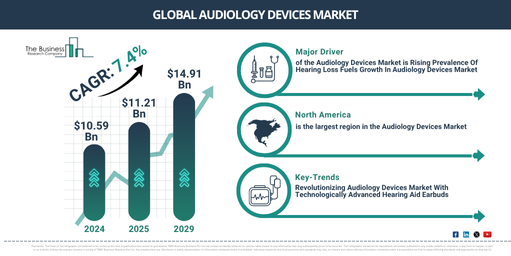
The audiology devices market has experienced robust expansion in recent years. It is projected to grow from $11.21 billion in 2025 to $12.02 billion in 2026, at a compound annual growth rate (CAGR) of 7.2%. The historical increase in this market can be linked to the rising prevalence of hearing loss disorders, an increasing aging population, wider availability of digital hearing aids, the expansion of audiology clinics, and growing awareness of early hearing diagnosis.
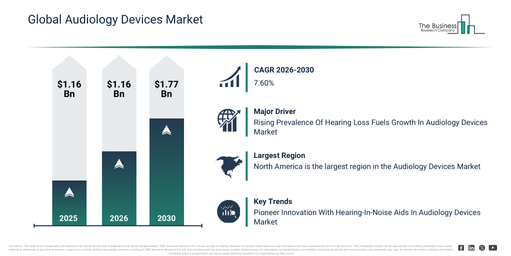
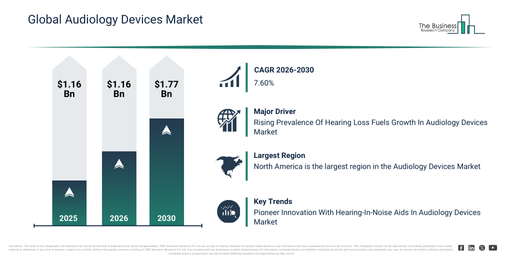
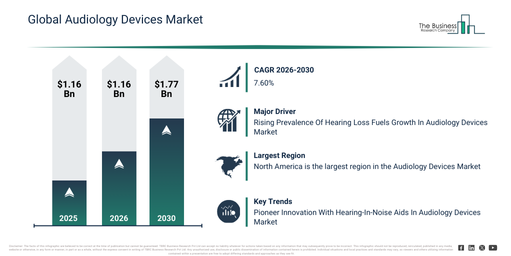
The audiology devices market is projected to experience robust expansion over the coming years. This market is set to reach $16.11 billion in 2030, exhibiting a compound annual growth rate (CAGR) of 7.6%. The anticipated growth during this period stems from factors such as a heightened demand for wireless and app-integrated devices, an uptick in the adoption of hearing solutions for children, the broadening scope of cochlear implant surgeries, an increasing emphasis on at-home hearing care, and ongoing advancements in audiology software platforms. Key developments expected in the forecast timeframe encompass the wider integration of smart and internet-connected hearing devices, a surge in the need for rechargeable hearing aids, the expanding application of AI-powered sound processing, the proliferation of less invasive implant techniques, and a sharpened emphasis on customized hearing solutions.
Get A Free Sample Report With In-Depth Market Insights:
Audiology Devices Market Development Factors: What’s Supporting Demand?
The increasing incidence of hearing impairment is anticipated to boost the expansion of the audiology devices market in the future. Hearing loss, defined as a partial or complete inability to perceive sounds in one or both ears, stems from various factors such as genetic predispositions, advancing age, exposure to loud noise, ear injuries or trauma, infections, and certain medications or diseases. Audiology devices play a crucial role in managing and treating hearing deficits by enhancing speech clarity and improving communication capabilities, thus the rising prevalence of hearing loss directly fuels the demand within the audiology devices market. For example, a February 2023 article from the World Health Organization, a public health body based in Switzerland, reported that approximately 430 million people, constituting over 5% of the global population (specifically 432 million adults and 34 million children), will require rehabilitation for their disabling hearing loss. Furthermore, more than 25% of individuals aged 60 and above experience hearing loss, with nearly 80% of those having permanent hearing loss residing in developing or underdeveloped countries. Projections also indicate that over 700 million individuals are expected to suffer from hearing loss by 2050. Consequently, the growing occurrence of hearing loss is a significant catalyst for the growth of the audiology devices market.
Audiology Devices Market Segment Performance And Emerging Opportunities
The audiology devices market covered in this report is segmented –
1) By Product: Hearing Aids, In-The-Ear Hearing Aids (ITE), Receiver-In-The-Ear Hearing Aids (RITE), Behind-The-Ear Hearing Aids (BTE), Canal Hearing Aids (CHA), Cochlear Implants, Bone Anchored Healing Aids, Diagnostic Devices
2) By Technology: Digital, Analog, Wireless & Bluetooth-Enabled Devices
3) By Diseases Type: Otosclerosis, Meniere’s Disease, Acoustic Tumors, Otitis Media, Other Diseases
4) By End User: Hospitals,ENT Clinics & Audiology Clinics, Research Institutes
Subsegments:
1) By Hearing Aids: Digital Hearing Aids, Analog Hearing Aids, Wireless Hearing Aids, Rechargeable Hearing Aids, Pediatric Hearing Aids, High-Gain Hearing Aids, Low-Noise Hearing Aids
2) By In-The-Ear (ITE) Hearing Aids: Full Shell ITE, Half Shell ITE, Mini ITE, Wireless ITE, Rechargeable ITE, Directional Microphone ITE
3) By Receiver-In-The-Ear (RITE) Hearing Aids: Mini RITE, Power RITE, Rechargeable RITE, RITE with Telecoil, Wireless RITE, Invisible RITE
4) By Behind-The-Ear (BTE) Hearing Aids: Standard BTE, Mini BTE, Power BTE, Open-Fit BTE, Rechargeable BTE, Wireless BTE, Water-Resistant BTE
5) By Canal Hearing Aids (CHA): Completely-in-the-Canal (CIC), Invisible-in-the-Canal (IIC), Low Profile CHA, Wireless CIC/IIC, Directional Microphone CHA, Rechargeable CHA
6) By Cochlear Implants: Single-Sided Cochlear Implants, Bilateral Cochlear Implants, Hybrid Cochlear Implants, Fully Implantable Cochlear Implants, Pediatric Cochlear Implants, Advanced Cochlear Implants
7) By Bone Anchored Hearing Aids (BAHA): Percutaneous BAHA, Transcutaneous BAHA, Active Bone Conduction Implant, Non-Surgical BAHA, Pediatric BAHA, Rechargeable BAHA
8) By Diagnostic Devices: Audiometers, Otoacoustic Emission (OAE) Devices, Tympanometers
Audiology Devices Market Transformation Trends: What Innovations Are Driving Change?
Leading companies within the audiology devices market are concentrating on developing groundbreaking products, such as hearing-in-noise aids, to establish a competitive edge. Hearing-in-noise aids represent a specialized category of hearing device engineered to enhance an individual’s capacity to comprehend speech in loud settings. For example, in September 2023, ReSound, a Denmark-based supplier of advanced hearing solutions, unveiled its Nexia Hearing Aids. This product integrates Auracast broadcast audio technology, which permits Nexia users to seamlessly link to public sound systems in locations like airports, theaters, and restaurants. This design ensures that crucial announcements or information are not overlooked. Utilizing Auracast and Bluetooth LE Audio, Nexia hearing aids achieve effortless connectivity with various devices, delivering a genuine wireless experience. Additionally, the Nexia hearing aids are entirely dustproof and water-resistant, allowing customers to use them confidently in any weather conditions.
Audiology Devices Market Competitive Analysis Of Leading Industry Participants
Major companies operating in the audiology devices market are Sonova Holding AG, Demant A/S, GN Store Nord A/S, Cochlear Ltd., MED-EL Medical Electronics, Starkey Laboratories Inc., WS Audiology A/S, RION Co. Ltd., Natus Medical Incorporated, MedRx Inc., Inventis s.r.l., MAICO Diagnostics GmbH, Benson Medical Instruments, Horentek Hearing Diagnostic, Zhejiang Nurotron Biotechnology Co. Ltd., Audina Hearing Instruments Inc., Elkon Pvt. Ltd., Eargo Inc., SeboTek Hearing Systems LLC, BHM-Tech Produktionsgesellschaft mbH, Earlens Corporation, Austar Hearing Science and Technology (Xiamen) Co. Ltd.
View The Full Audiology Devices Market Report:
Audiology Devices Market Geographic Distribution And Regional Opportunities
North America was the largest region in the audiology devices market in 2025. Asia-Pacific is expected to be the fastest-growing region in the global audiology devices market report during the forecast period. The regions covered in the audiology devices market report are Asia-Pacific, South East Asia, Western Europe, Eastern Europe, North America, South America, Middle East, Africa.
Reach Out To Our Team:
The Business Research Company: https://www.thebusinessresearchcompany.com/
Americas: +1 310-496-7795
Asia: +44 7882 955267 & +91 8897263534
Europe: +44 7882 955267
Email us at: marketing@tbrc.info
Follow us on:
LinkedIn: https://in.linkedin.com/company/the-business-research-company
YouTube: https://www.youtube.com/channel/UC24_fI0rV8cR5DxlCpgmyFQ
Global Market Model: https://www.thebusinessresearchcompany.com/global-market-model