Tag: automated compounding devices market trends

  • Automated Compounding Devices Market Growth Forecast Through 2030: Market Size And Trends In 2026

    Automated Compounding Devices Market Growth Forecast Through 2030: Market Size And Trends In 2026

    Backed by market attractiveness analysis, total addressable market sizing, company benchmarking matrices, interactive Excel dashboards, wider supply chain intelligence, emerging startup coverage, and detailed product-level insights, The Business Research Company’s 2026 market reports are designed to offer research that is more actionable and strategically valuable than ever.

    Automated Compounding Devices Market Poised To Hit $3.53 Billion By 2030 With A 7% CAGR

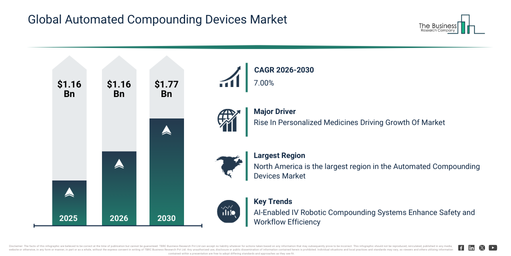
    The automated compounding devices market size has experienced robust expansion in recent years. It is projected to increase from $2.51 billion in 2025 to $2.69 billion in 2026, demonstrating a compound annual growth rate (CAGR) of 7.1%. Historically, this expansion has been driven by factors such as an increasing hospital pharmacy workload, a rising demand for sterile IV preparation, the early adoption of TPN compounding automation, hospital initiatives aimed at reducing compounding errors, and the expansion of inpatient medication therapy volumes.

    The automated compounding devices market is projected to experience substantial expansion over the upcoming years, with its valuation anticipated to reach $3.53 billion in 2030, exhibiting a compound annual growth rate (CAGR) of 7.0%. This projected growth is driven by several factors, including a heightened focus on ensuring medication safety and compliance, increased capital allocation towards automated pharmacy technologies, a rise in the outsourcing of sterile compounding services, the expanding scope of oncology and critical care drug compounding, and the greater incorporation of digital workflow and reporting systems. Key trends during this period encompass the increased deployment of automated compounding devices to minimize errors in manual medication preparation within hospitals and pharmacies, a heightened need for precise compounding of IV formulations, oncology drugs, and TPN solutions, a noticeable transition towards centralized and high-volume sterile compounding centers within healthcare networks, wider implementation of automated workflow validation and barcode-based verification in compounding procedures, and a growing inclination towards automated compounding platforms that are compact, modular, and upgradable for pharmacy operations.

    Get A Free Sample Report With In-Depth Market Insights:

    https://thebusinessresearchcompany.com/sample_request?id=38123567&type=smp&name=Automated%20Compounding%20Devices%20Market%20Report%202026&utm_source=Blogs&utm_medium=Paid&utm_campaign=Sep_PR

    Automated Compounding Devices Market Demand Drivers: What’s Powering Industry Growth?

    A rising count of personalized medicines is anticipated to propel the expansion of the automated compounding devices market in the future. This medical approach, known as personalized medicine, involves customizing healthcare choices, methods, interventions, and treatments to align with each patient’s unique attributes. The surge in personalized medicines stems from enhanced genetic comprehension, patient-specific information, and supportive regulations. Automated compounding devices (ACDs) are vital in personalized medicine, facilitating the exact and accurate creation of custom medication blends designed for specific patient requirements. These instruments automate the mixing of diverse pharmaceutical components in precise ratios, which is fundamental for developing personalized therapies. For example, in February 2024, the Personalized Medicine Coalition, a US-based non-profit organization, reported that the FDA granted approval to 16 novel personalized therapies for rare disease patients in 2023, an increase from six in 2022. Consequently, the growing prevalence of personalized medicines is a key factor boosting the growth of the automated compounding devices market.

    Automated Compounding Devices Market Segmentation And Category Overview

    The automated compounding devices market covered in this report is segmented –

    1) By Component: Automated Compounding Systems Equipment, Automated Compounding Systems Software

    2) By Product Type: Intravenous Compounding Systems, Oral Compounding Systems, Total Parenteral Nutrition (TPN) Compounding Systems

    3) By Mode Of Operation: Fully Automated Compounding Systems, Semi-Automated Compounding Systems

    4) By End-User: Hospitals, Ambulatory Surgical Centers, Other End Users

    Subsegments:

    1) By Automated Compounding Systems Equipment: Compounding Workstations, Compounding Pumps, Mixing Chambers, Scales And Balances, Dispensing Units, Vial And Syringe Filling Systems, Other Related Equipment (Filtration Devices)

    2) By Automated Compounding Systems Software: Prescription Management Software, Workflow Management Software, Monitoring And Control Software, Data Analytics And Reporting Software, Safety And Compliance Software, Integration Software For Hospital Or Pharmacy Management Systems

    Automated Compounding Devices Market Innovation Trends: What Developments Are Reshaping The Industry?

    Major companies engaged in the automated compounding devices market are increasingly focusing on AI-powered robotic compounding, including AI-enabled IV compounding platform systems that harness artificial intelligence, gravimetric verification, and cloud-based monitoring to automate sterile admixture preparation with considerable precision, instant quality checks, and constant oversight. For instance, in August 2025, Omnicell, a US-based health-technology company, unveiled an AI-enhanced update to its IV compounding system, intended to reinforce safety and accuracy in medication preparation. The updated system incorporates advanced AI-based quality-assurance mechanisms that continuously observe compounding activities, automatically identifying and highlighting any deviations from expected procedures. By introducing this level of automated supervision, Omnicell aims to minimize human error, improve workflow efficiency, and support elevated standards of medication quality in pharmacy operations.

    Automated Compounding Devices Market Industry Leaders And Competitive Landscape

    Major companies operating in the automated compounding devices market are Becton Dickinson and Company, Baxter International Inc, B Braun Melsungen AG, Fresenius Kabi AG, Terumo Corporation, ICU Medical Inc., Omnicell Inc., Tecan Group Ltd., Fagron NV, Swisslog Healthcare, ScriptPro LLC, PharMEDium Services LLC, Loccioni Group SPA, ARxIUM Inc., Codonics Inc., Equashield LLC, Yuyama Mfg Co Ltd, Shanghai Weibond Technology Co Ltd, Medimpex LLC, Medica Inc

    View The Full Automated Compounding Devices Market Report:

    https://thebusinessresearchcompany.com/report/automated-compounding-devices-global-market-report?utm_source=Blogs&utm_medium=Paid&utm_campaign=Sep_PR

    Automated Compounding Devices Market Regional Analysis And Top Geography

    North America was the largest region in the automated compounding devices market in 2025. Asia-Pacific is expected to be the fastest-growing region in the forecast period. The regions covered in the automated compounding devices market report are Asia-Pacific, South East Asia, Western Europe, Eastern Europe, North America, South America, Middle East, Africa.

    Reach Out To Our Team:

    The Business Research Company: https://www.thebusinessresearchcompany.com/

    Americas: +1 310-496-7795

    Asia: +44 7882 955267 & +91 8897263534

    Europe: +44 7882 955267

    Email us at: marketing@tbrc.info

    Follow us on:

    LinkedIn: https://in.linkedin.com/company/the-business-research-company

    YouTube: https://www.youtube.com/channel/UC24_fI0rV8cR5DxlCpgmyFQ

    Global Market Model: https://www.thebusinessresearchcompany.com/global-market-model

  • Automated Compounding Devices Market Future Analysis Covering Industry Shifts And Growth Potential

    Automated Compounding Devices Market Future Analysis Covering Industry Shifts And Growth Potential

    The Business Research Company’s 2026 market reports feature advanced enhancements such as market attractiveness analysis, total addressable market evaluation, company benchmarking matrices, interactive Excel dashboards, expanded supply chain intelligence, emerging startup coverage, and detailed product insights, delivering more actionable and strategically valuable research.

    What Market Size Is Forecasted For The Automated Compounding Devices Market By 2030 Based On Its 2026 Value?

    The automated compounding devices market has experienced significant expansion recently. This market is projected to expand from $2.51 billion in 2025 to $2.69 billion in 2026, demonstrating a compound annual growth rate (CAGR) of 7.1%. The historical growth can be linked to factors such as an increasing workload in hospital pharmacies, a heightened demand for sterile iv preparations, the early implementation of tpn compounding automation, hospital-led efforts to minimize compounding errors, and a rise in inpatient medication therapy volumes.

    The automated compounding devices market size is projected to experience substantial expansion over the coming years, reaching $3.53 billion by 2030, demonstrating a compound annual growth rate (CAGR) of 7.0%. This anticipated growth during the forecast period is primarily driven by a heightened focus on medication safety compliance, increased investments in automated pharmacy technology, a rise in the outsourcing of sterile compounding services, the broadening scope of oncology and critical care drug compounding, and the expanding integration of digital workflow and reporting systems. Key trends anticipated in this period include a greater uptake of automated compounding devices to mitigate manual medication preparation errors in hospital and pharmacy environments, an escalating demand for high-precision compounding of IV formulations, oncology drugs, and TPN solutions, a developing transition towards centralized and large-volume sterile compounding facilities across healthcare systems, a widening application of automated workflow validation and barcode-based verification in compounding procedures, and a growing preference for compact, modular, and upgradeable automated compounding platforms for pharmacy operations.

    Download A Free Sample Report For Comprehensive Market Insights:

    https://www.thebusinessresearchcompany.com/sample.aspx?id=18231&type=smp

    What Key Growth Drivers Are Influencing The Automated Compounding Devices Market?

    A rise in personalized medicines is anticipated to propel the expansion of the automated compounding devices market in the future. Personalized medicine describes a healthcare strategy where decisions, methods, actions, and therapies are customized to meet the unique characteristics of every patient. The growing prevalence of personalized medicines stems from enhanced genetic comprehension, specific patient information, and supportive regulations. Automated compounding devices (ACDs) are vital in personalized medicine, facilitating the precise and accurate creation of custom medication formulas that match individual patient requirements. Such devices automate the blending of different pharmaceutical components in exact ratios, which is fundamental for developing tailored treatments. For example, data from February 2024, provided by the Personalized Medicine Coalition, a US-based non-profit organization, shows that the FDA cleared 16 new personalized therapies for rare disease patients in 2023, an increase from six in 2022. Consequently, the growing volume of personalized medicines is boosting the expansion of the automated compounding devices market.

    How Does Segment Analysis Break Down The Automated Compounding Devices Market Structure?

    The automated compounding devices market covered in this report is segmented –

    1) By Component: Automated Compounding Systems Equipment, Automated Compounding Systems Software

    2) By Product Type: Intravenous Compounding Systems, Oral Compounding Systems, Total Parenteral Nutrition (TPN) Compounding Systems

    3) By Mode Of Operation: Fully Automated Compounding Systems, Semi-Automated Compounding Systems

    4) By End-User: Hospitals, Ambulatory Surgical Centers, Other End Users

    Subsegments:

    1) By Automated Compounding Systems Equipment: Compounding Workstations, Compounding Pumps, Mixing Chambers, Scales And Balances, Dispensing Units, Vial And Syringe Filling Systems, Other Related Equipment (Filtration Devices)

    2) By Automated Compounding Systems Software: Prescription Management Software, Workflow Management Software, Monitoring And Control Software, Data Analytics And Reporting Software, Safety And Compliance Software, Integration Software For Hospital Or Pharmacy Management Systems

    What Trends Are Shaping The Automated Compounding Devices Market Structure?

    Major companies operating in the automated compounding devices market are prioritizing AI-driven robotic compounding, such as AI-enabled IV compounding platforms systems that leverage artificial intelligence, gravimetric verification, and cloud-based monitoring to automate sterile admixture preparation with high precision, real-time quality assessments, and continuous oversight. For example, in August 2025, Omnicell, a US-based health-technology company, launched an AI-enhanced upgrade to its IV compounding system, designed to bolster safety and accuracy in medication preparation. The updated system integrates sophisticated AI-based quality-assurance tools that continuously supervise compounding activities, automatically detecting and flagging any departures from expected procedures. By implementing this level of automated oversight, Omnicell aims to mitigate human error, enhance workflow efficiency, and support elevated standards of medication quality in pharmacy operations.

    Which Companies Are Influencing The Automated Compounding Devices Market?

    Major companies operating in the automated compounding devices market are Becton Dickinson and Company, Baxter International Inc, B Braun Melsungen AG, Fresenius Kabi AG, Terumo Corporation, ICU Medical Inc., Omnicell Inc., Tecan Group Ltd., Fagron NV, Swisslog Healthcare, ScriptPro LLC, PharMEDium Services LLC, Loccioni Group SPA, ARxIUM Inc., Codonics Inc., Equashield LLC, Yuyama Mfg Co Ltd, Shanghai Weibond Technology Co Ltd, Medimpex LLC, Medica Inc

    Access The Complete Automated Compounding Devices Market Report:

    https://www.thebusinessresearchcompany.com/report/automated-compounding-devices-global-market-report

    Which Region Stands As The Largest Contributor To The Automated Compounding Devices Market?

    North America was the largest region in the automated compounding devices market in 2025. Asia-Pacific is expected to be the fastest-growing region in the forecast period. The regions covered in the automated compounding devices market report are Asia-Pacific, South East Asia, Western Europe, Eastern Europe, North America, South America, Middle East, Africa.

    Access a Customized Automated Compounding Devices Market Report for Deeper Competitive Insights

    https://www.thebusinessresearchcompany.com/customise?id=18231&type=smp

    Browse Through More Reports Similar to the Global Automated Compounding Devices Market 2026, By The Business Research Company

    Plastic Compounding Market Report 2026

    https://www.thebusinessresearchcompany.com/report/plastic-compounding-global-market-report

    Compound Management Market Report 2026

    https://www.thebusinessresearchcompany.com/report/compound-management-global-market-report

    Electronic Products Market 2026

    https://www.thebusinessresearchcompany.com/report/electronic-products-market

    Get in touch with us:

    The Business Research Company: https://www.thebusinessresearchcompany.com/

    Americas: +1 310-496-7795

    Asia: +44 7882 955267 & +91 8897263534

    Europe: +44 7882 955267

    Email us at: marketing@tbrc.info

    Follow us on:

    LinkedIn: https://in.linkedin.com/company/the-business-research-company

    YouTube: https://www.youtube.com/channel/UC24_fI0rV8cR5DxlCpgmyFQ

    Global Market Model: https://www.thebusinessresearchcompany.com/global-market-model
  • The Automated Compounding Devices Market Is Growing Due To Rising Demand For Personalized Medicine

    The Automated Compounding Devices Market Is Growing Due To Rising Demand For Personalized Medicine

    The Business Research Company’s 2026 market reports feature enhanced tools like market attractiveness analysis, TAM assessment, and company scoring matrices, along with interactive dashboards, deeper supply chain insights, and startup coverage strengthening the depth, usability, and strategic value of insights.

    How Much Growth In Market Value Is Expected For The Automated Compounding Devices Market Between 2026 And 2030?

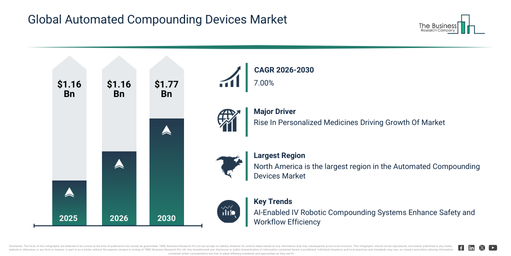
    The automated compounding devices market has experienced robust expansion in recent years. It is projected to increase from $2.51 billion in 2025 to $2.69 billion in 2026, exhibiting a compound annual growth rate (CAGR) of 7.1%. This historical growth can be attributed to several factors, including an escalating hospital pharmacy workload, a rising demand for sterile IV preparation, the early adoption of TPN compounding automation, hospital initiatives aimed at reducing compounding errors, and the expansion of inpatient medication therapy volumes.

    The market for automated compounding devices is projected to experience substantial expansion in the coming years. This sector is anticipated to reach a valuation of $3.53 billion by 2030, exhibiting a compound annual growth rate (CAGR) of 7.0%. The growth during this forecast period can be primarily attributed to a heightened focus on medication safety compliance, increased capital allocation towards automated pharmacy technologies, a rise in the outsourcing of sterile compounding operations, the broadening scope of drug compounding for oncology and critical care, and the expanded incorporation of digital workflow and reporting platforms. Key trends expected over the forecast horizon include the wider uptake of automated compounding devices aimed at minimizing errors in manual medication preparation within hospitals and pharmacies, an escalating need for highly precise compounding of IV formulations, oncology medications, and TPN solutions, a developing move towards centralized and high-volume sterile compounding facilities within healthcare systems, the increased application of automated workflow validation and barcode verification in compounding processes, and a growing inclination towards compact, modular, and upgradeable automated compounding platforms for pharmacy use.

    Access Your Free Sample Report For In-Depth Market Analysis:

    https://www.thebusinessresearchcompany.com/sample.aspx?id=18231&type=smp

    Which Key Drivers Are Affecting The Automated Compounding Devices Market Development?

    The expansion in personalized medical treatments is projected to propel the automated compounding devices market forward. Personalized medicine describes a healthcare strategy where decisions, practices, and treatments are customized to each patient’s unique attributes. This rise in personalized medicines stems from enhanced genetic understanding, patient-specific data analysis, and supportive regulations. Automated compounding devices (ACDs) are vital in personalized medicine, facilitating the precise creation of custom drug formulations for specific patient requirements. These devices automate the blending of pharmaceutical components in exact ratios, which is fundamental for developing individualized therapies. As an illustration, in February 2024, the Personalized Medicine Coalition, a US-based non-profit organization, reported that the FDA sanctioned 16 new personalized treatments for rare diseases in 2023, up from six in 2022. Consequently, the growing volume of personalized medicines is boosting the automated compounding devices market’s expansion.

    Which Segments Define The Automated Compounding Devices Market Segment Structure?

    The automated compounding devices market covered in this report is segmented –

    1) By Component: Automated Compounding Systems Equipment, Automated Compounding Systems Software

    2) By Product Type: Intravenous Compounding Systems, Oral Compounding Systems, Total Parenteral Nutrition (TPN) Compounding Systems

    3) By Mode Of Operation: Fully Automated Compounding Systems, Semi-Automated Compounding Systems

    4) By End-User: Hospitals, Ambulatory Surgical Centers, Other End Users

    Subsegments:

    1) By Automated Compounding Systems Equipment: Compounding Workstations, Compounding Pumps, Mixing Chambers, Scales And Balances, Dispensing Units, Vial And Syringe Filling Systems, Other Related Equipment (Filtration Devices)

    2) By Automated Compounding Systems Software: Prescription Management Software, Workflow Management Software, Monitoring And Control Software, Data Analytics And Reporting Software, Safety And Compliance Software, Integration Software For Hospital Or Pharmacy Management Systems

    What Trends Are Transforming The Automated Compounding Devices Market?

    Major companies operating in the automated compounding devices market are focusing on AI-powered robotic compounding, such as AI-enabled IV compounding platform systems. These systems leverage artificial intelligence, gravimetric verification, and cloud-based monitoring to automate sterile admixture preparation with high precision, real-time quality checks, and continuous oversight. For instance, in August 2025, Omnicell, a US-based health-technology company, unveiled an AI-enhanced upgrade to its IV compounding system designed to bolster safety and accuracy in medication preparation. The updated system integrates advanced AI-based quality-assurance tools that continuously monitor compounding activities, automatically detecting and flagging any deviations from expected procedures. Through the introduction of this automated oversight, Omnicell aims to reduce human error, improve workflow efficiency, and support higher standards of medication quality in pharmacy operations.

    Who Are The Established Players Within The Automated Compounding Devices Market?

    Major companies operating in the automated compounding devices market are Becton Dickinson and Company, Baxter International Inc, B Braun Melsungen AG, Fresenius Kabi AG, Terumo Corporation, ICU Medical Inc., Omnicell Inc., Tecan Group Ltd., Fagron NV, Swisslog Healthcare, ScriptPro LLC, PharMEDium Services LLC, Loccioni Group SPA, ARxIUM Inc., Codonics Inc., Equashield LLC, Yuyama Mfg Co Ltd, Shanghai Weibond Technology Co Ltd, Medimpex LLC, Medica Inc

    Get The Full Automated Compounding Devices Market Report:

    https://www.thebusinessresearchcompany.com/report/automated-compounding-devices-global-market-report

    Where Is The Automated Compounding Devices Market Primarily Concentrated By Region?

    North America was the largest region in the automated compounding devices market in 2025. Asia-Pacific is expected to be the fastest-growing region in the forecast period. The regions covered in the automated compounding devices market report are Asia-Pacific, South East Asia, Western Europe, Eastern Europe, North America, South America, Middle East, Africa.

    Request A Customized Automated Compounding Devices Market Report For Competitive Insights:

    https://www.thebusinessresearchcompany.com/customise?id=18231&type=smp

    Browse Through More Reports Similar to the Global Automated Compounding Devices Market 2026, By The Business Research Company

    Plastic Compounding Market Report 2026

    https://www.thebusinessresearchcompany.com/report/plastic-compounding-global-market-report

    Compound Management Market Report 2026

    https://www.thebusinessresearchcompany.com/report/compound-management-global-market-report

    Electronic Products Market 2026

    https://www.thebusinessresearchcompany.com/report/electronic-products-market

    Get in touch with us:

    The Business Research Company: https://www.thebusinessresearchcompany.com/

    Americas +1 310-496-7795

    Asia +44 7882 955267 & +91 8897263534

    Europe +44 7882 955267

    Email us at info@tbrc.info

    Follow us on:

    LinkedIn: https://in.linkedin.com/company/the-business-research-company

    YouTube: https://www.youtube.com/channel/UC24_fI0rV8cR5DxlCpgmyFQ

    Global Market Model: https://www.thebusinessresearchcompany.com/global-market-model
  • Automated Compounding Devices Market Growth Prospects 2026–2030 with Innovation Trends and Competitive Landscape

    Automated Compounding Devices Market Growth Prospects 2026–2030 with Innovation Trends and Competitive Landscape

    The Business Research Company’s 2026 market reports include new capabilities such as market attractiveness scoring and analysis, total addressable market analysis, company scoring matrix, interactive excel data dashboard, improved supply chain analysis, upcoming startups in the market, and overview of key products, aimed at improving the depth, usability, and strategic value of the insights delivered.

    What Market Valuation Is Forecasted For The Automated Compounding Devices Market By 2030 Starting From Its 2026 Size?

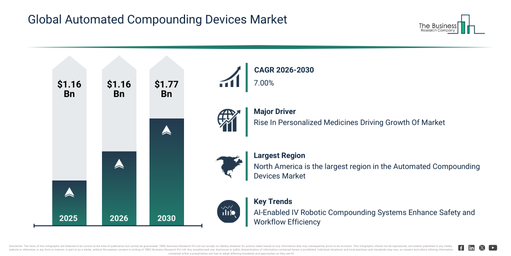
    The automated compounding devices market has experienced robust expansion in recent years. This market is projected to grow from $2.51 billion in 2025 to $2.69 billion in 2026, demonstrating a compound annual growth rate (CAGR) of 7.1%. Key drivers for this historical growth include an escalating workload in hospital pharmacies, a rising demand for sterile IV preparation, the early adoption of TPN compounding automation, hospital initiatives aimed at reducing compounding errors, and the expansion of inpatient medication therapy volumes.

    The automated compounding devices market is expected to experience robust growth in the coming years, with its size projected to reach $3.53 billion by 2030, demonstrating a compound annual growth rate (CAGR) of 7.0%. This expansion during the forecast period is fueled by a growing emphasis on medication safety compliance, increasing investments in automated pharmacy technology, the rising outsourcing of sterile compounding services, the expansion of oncology and critical care drug compounding, and the greater integration of digital workflow and reporting systems. Key trends anticipated include the increasing adoption of automated compounding devices to reduce errors in manual medication preparation within hospital and pharmacy environments, a rising demand for high-precision compounding of IV formulations, oncology drugs, and TPN solutions, a growing transition toward centralized and large-volume sterile compounding facilities in healthcare systems, the expanding use of automated workflow validation and barcode-based verification in compounding processes, and an increasing preference for compact, modular, and upgradeable automated compounding platforms for pharmacy operations.

    Download the Free Sample Report to Explore Key Market Insights:

    https://www.thebusinessresearchcompany.com/sample.aspx?id=18231&type=smp

    Which Market Drivers Are Supporting The Expansion Of The Automated Compounding Devices Market?

    The automated compounding devices market is expected to grow, driven by the increasing prevalence of personalized medicines. This medical approach tailors healthcare decisions and treatments to the unique characteristics of individual patients, a trend fueled by improved understanding of genetics, patient-specific data, and robust regulatory support. Automated compounding devices (ACDs) are essential in personalized medicine, enabling the precise preparation of custom medication formulations by automating the process of combining various pharmaceutical ingredients in specific proportions to create tailored treatments. For example, in February 2024, the Personalized Medicine Coalition reported that the FDA approved 16 novel personalized therapies for patients with rare diseases in 2023, a significant rise from six in 2022. This expanding landscape of personalized medicines is therefore a key factor driving the growth of the automated compounding devices market.

    Which Segment Categories Define The Automated Compounding Devices Market?

    The automated compounding devices market covered in this report is segmented –

    1) By Component: Automated Compounding Systems Equipment, Automated Compounding Systems Software

    2) By Product Type: Intravenous Compounding Systems, Oral Compounding Systems, Total Parenteral Nutrition (TPN) Compounding Systems

    3) By Mode Of Operation: Fully Automated Compounding Systems, Semi-Automated Compounding Systems

    4) By End-User: Hospitals, Ambulatory Surgical Centers, Other End Users

    Subsegments:

    1) By Automated Compounding Systems Equipment: Compounding Workstations, Compounding Pumps, Mixing Chambers, Scales And Balances, Dispensing Units, Vial And Syringe Filling Systems, Other Related Equipment (Filtration Devices)

    2) By Automated Compounding Systems Software: Prescription Management Software, Workflow Management Software, Monitoring And Control Software, Data Analytics And Reporting Software, Safety And Compliance Software, Integration Software For Hospital Or Pharmacy Management Systems

    What Major Market Trends Are Driving Changes In The Automated Compounding Devices Market?

    Leading companies in the automated compounding devices market are focusing on AI-powered robotic compounding, specifically AI-enabled IV compounding platform systems that utilize artificial intelligence, gravimetric verification, and cloud-based monitoring to automate sterile admixture preparation with high precision, real-time quality checks, and continuous oversight. For instance, in August 2025, Omnicell, a US-based health-technology company, launched an AI-enhanced upgrade for its IV compounding system, designed to bolster safety and accuracy in medication preparation. This updated system integrates advanced AI-based quality-assurance tools that continuously monitor compounding activities, automatically detecting and flagging any deviations from expected procedures. By introducing this level of automated oversight, Omnicell aims to reduce human error, improve workflow efficiency, and support higher standards of medication quality in pharmacy operations.

    Who Are The Top Companies Competing In The Automated Compounding Devices Market?

    Major companies operating in the automated compounding devices market are Becton Dickinson and Company, Baxter International Inc, B Braun Melsungen AG, Fresenius Kabi AG, Terumo Corporation, ICU Medical Inc., Omnicell Inc., Tecan Group Ltd., Fagron NV, Swisslog Healthcare, ScriptPro LLC, PharMEDium Services LLC, Loccioni Group SPA, ARxIUM Inc., Codonics Inc., Equashield LLC, Yuyama Mfg Co Ltd, Shanghai Weibond Technology Co Ltd, Medimpex LLC, Medica Inc

    Read the full automated compounding devices market report here:

    https://www.thebusinessresearchcompany.com/report/automated-compounding-devices-global-market-report

    How Is The Automated Compounding Devices Market Distributed Across Key Geographic Regions?

    North America was the largest region in the automated compounding devices market in 2025. Asia-Pacific is expected to be the fastest-growing region in the forecast period. The regions covered in the automated compounding devices market report are Asia-Pacific, South East Asia, Western Europe, Eastern Europe, North America, South America, Middle East, Africa.

    Request A Tailored Automated Compounding Devices Market Research Report For Competitive Advantage:

    https://www.thebusinessresearchcompany.com/customise?id=18231&type=smp

    Browse Through More Reports Similar to the Global Automated Compounding Devices Market 2026, By The Business Research Company

    Plastic Compounding Market Report 2026

    https://www.thebusinessresearchcompany.com/report/plastic-compounding-global-market-report

    Compound Management Market Report 2026

    https://www.thebusinessresearchcompany.com/report/compound-management-global-market-report

    Electronic Products Market 2026

    https://www.thebusinessresearchcompany.com/report/electronic-products-market

    Get in touch with us:

    The Business Research Company: https://www.thebusinessresearchcompany.com/

    Americas +1 310-496-7795

    Asia +44 7882 955267 & +91 8897263534

    Europe +44 7882 955267

    Email us at info@tbrc.info

    Follow us on:

    LinkedIn: https://in.linkedin.com/company/the-business-research-company

    YouTube: https://www.youtube.com/channel/UC24_fI0rV8cR5DxlCpgmyFQ

    Global Market Model: https://www.thebusinessresearchcompany.com/global-market-model

  • Automated Compounding Devices Industry Growth Insights: Revenue Forecast to 2030

    Automated Compounding Devices Industry Growth Insights: Revenue Forecast to 2030

    Uncover key drivers, emerging technologies, and competitive movements shaping the international normalized ratio (inr) test meter market from 2026–2035 with trusted insights from The Business Research Company

    What long-term size projections exist for the Automated Compounding Devices Market covering 2026–2035?

    The automated compounding devices market has experienced significant growth over recent years. Projections indicate its expansion from $2.51 billion in 2025 to $2.69 billion in 2026, demonstrating a compound annual growth rate (CAGR) of 7.1%. Historically, this growth has stemmed from factors such as increasing hospital pharmacy workload, rising demand for sterile iv preparation, early adoption of tpn compounding automation, hospital initiatives to reduce compounding errors, and the expansion of inpatient medication therapy volumes.

    The automated compounding devices market size is anticipated to experience robust expansion in the coming years. It is projected to reach $3.53 billion by 2030, demonstrating a compound annual growth rate (CAGR) of 7.0%. This growth during the forecast period can be attributed to a heightened focus on medication safety compliance, increased investments in automated pharmacy technology, a rise in the outsourcing of sterile compounding services, the expansion of oncology and critical care drug compounding, and the growing integration of digital workflow and reporting systems. Significant trends expected during this period include the increasing adoption of automated compounding devices to reduce manual medication preparation errors in hospital and pharmacy environments, a rising demand for high-precision compounding of IV formulations, oncology drugs, and TPN solutions, a growing transition towards centralized and large-volume sterile compounding facilities within healthcare systems, an expanding application of automated workflow validation and barcode-based verification in compounding processes, and an increasing preference for compact, modular, and upgradeable automated compounding platforms for pharmacy operations.

    Access Your Free Sample Report for In-Depth Market Insights:

    https://www.thebusinessresearchcompany.com/sample.aspx?id=18231&type=smp

    Which Drivers Are Impacting The Competitive Landscape Of The Automated Compounding Devices Market?

    An expanding volume of personalized medicines is projected to propel the automated compounding devices market forward. This medical strategy involves customizing healthcare choices, methods, interventions, and therapies to suit each patient’s unique attributes. The rise in personalized medicines can be attributed to enhanced genetic comprehension, distinct patient data, and supportive regulations. Automated compounding devices (ACDs) are vital in personalized medicine, facilitating the exact and precise creation of bespoke medication formulations designed for individual patient requirements. They automate the mixing of diverse pharmaceutical components in precise ratios, a fundamental step for developing customized treatments. As an illustration, in February 2024, the Personalized Medicine Coalition, a US-based non-profit organization, reported that the FDA cleared 16 novel personalized therapies for patients with rare diseases in 2023, an increase from six in 2022. Consequently, the growing availability of personalized medicines is boosting the expansion of the automated compounding devices market.

    What Segments Are Identified Within The Structure Of The Automated Compounding Devices Market?

    The automated compounding devices market covered in this report is segmented –

    1) By Component: Automated Compounding Systems Equipment, Automated Compounding Systems Software

    2) By Product Type: Intravenous Compounding Systems, Oral Compounding Systems, Total Parenteral Nutrition (TPN) Compounding Systems

    3) By Mode Of Operation: Fully Automated Compounding Systems, Semi-Automated Compounding Systems

    4) By End-User: Hospitals, Ambulatory Surgical Centers, Other End Users

    Subsegments:

    1) By Automated Compounding Systems Equipment: Compounding Workstations, Compounding Pumps, Mixing Chambers, Scales And Balances, Dispensing Units, Vial And Syringe Filling Systems, Other Related Equipment (Filtration Devices)

    2) By Automated Compounding Systems Software: Prescription Management Software, Workflow Management Software, Monitoring And Control Software, Data Analytics And Reporting Software, Safety And Compliance Software, Integration Software For Hospital Or Pharmacy Management Systems

    Which Trends Are Expected To Influence The Automated Compounding Devices Market In The Upcoming Years?

    Major companies operating in the automated compounding devices market are focusing on AI-powered robotic compounding, specifically AI-enabled IV compounding platform systems that utilize artificial intelligence, gravimetric verification, and cloud-based monitoring to automate sterile admixture preparation with exceptional precision, real-time quality checks, and continuous oversight. For instance, in August 2025, Omnicell, a US-based health-technology company, launched an AI-enhanced upgrade to its IV compounding system, which is designed to improve both safety and accuracy in medication preparation. This updated system integrates advanced AI-based quality-assurance tools that constantly monitor compounding activities, automatically detecting and flagging any deviations from expected procedures. By introducing this level of automated oversight, Omnicell aims to reduce human error, enhance workflow efficiency, and support higher standards of medication quality in pharmacy operations.

    Which Key Market Players Are Investing In Expansion And Innovation Within The Automated Compounding Devices Market?

    Major companies operating in the automated compounding devices market are Becton Dickinson and Company, Baxter International Inc, B Braun Melsungen AG, Fresenius Kabi AG, Terumo Corporation, ICU Medical Inc., Omnicell Inc., Tecan Group Ltd., Fagron NV, Swisslog Healthcare, ScriptPro LLC, PharMEDium Services LLC, Loccioni Group SPA, ARxIUM Inc., Codonics Inc., Equashield LLC, Yuyama Mfg Co Ltd, Shanghai Weibond Technology Co Ltd, Medimpex LLC, Medica Inc

    Access The Complete Report For Deeper Market Insights:

    https://www.thebusinessresearchcompany.com/report/automated-compounding-devices-global-market-report

    Which Regions Are Poised For Strategic Growth In The Automated Compounding Devices Market?

    North America was the largest region in the automated compounding devices market in 2025. Asia-Pacific is expected to be the fastest-growing region in the forecast period. The regions covered in the automated compounding devices market report are Asia-Pacific, South East Asia, Western Europe, Eastern Europe, North America, South America, Middle East, Africa.

    Request Your Customized Automated Compounding Devices Market Research Report for Competitive Advantage:

    https://www.thebusinessresearchcompany.com/customise?id=18231&type=smp

    Browse Through More Reports Similar to the Global Automated Compounding Devices Market 2026, By The Business Research Company

    Plastic Compounding Global Market Report 2026

    https://www.thebusinessresearchcompany.com/report/plastic-compounding-global-market-report

    Compound Management Global Market Report 2026

    https://www.thebusinessresearchcompany.com/report/compound-management-global-market-report

    Electronic Products Market 2026

    https://www.thebusinessresearchcompany.com/report/electronic-products-market

    Get in touch with us:

    The Business Research Company: https://www.thebusinessresearchcompany.com/

    Americas +1 310-496-7795

    Asia +44 7882 955267 & +91 8897263534

    Europe +44 7882 955267

    Email us at info@tbrc.info

    Follow us on:

    LinkedIn: https://in.linkedin.com/company/the-business-research-company

  • Global Automated Compounding Devices Market Valuation and Growth Prospects: $3.3 Billion by 2029

    Global Automated Compounding Devices Market Valuation and Growth Prospects: $3.3 Billion by 2029

    Uncover key drivers, emerging technologies, and competitive movements shaping the automated compounding devices market from 2025–2034 with trusted insights from The Business Research Company

    What Are The Future Growth Projections For The Automated Compounding Devices Market Size?

    The automated compounding devices market size has experienced robust growth in recent years. It is projected to increase from $2.36 billion in 2024 to $2.51 billion in 2025, reflecting a compound annual growth rate (CAGR) of 6.6%. The expansion observed in the historic period is attributable to factors such as the increasing prevalence of chronic diseases, an aging population, the continued development of healthcare infrastructure, various regulatory requirements, and a rise in medication errors.

    The market for automated compounding devices is anticipated to experience substantial expansion over the coming years. This market is projected to reach $3.3 billion by 2029, exhibiting a compound annual growth rate (CAGR) of 7.1%. Factors contributing to this growth during the forecast period include the increasing incidence of cancer, the expansion of healthcare worldwide, a heightened emphasis on patient safety, supportive regulatory frameworks, and a growing commitment to sustainability. Key trends influencing the forecast period encompass telemedicine, the rise of remote healthcare, innovations in artificial intelligence, the ongoing digitalization of healthcare, and continuous real-time monitoring.

    Access A Free Sample Of The Report:

    https://www.thebusinessresearchcompany.com/sample.aspx?id=18231&type=smp

    What Core Market Drivers Are Expanding The Automated Compounding Devices Industry?

    The increasing adoption of personalized medicines is projected to stimulate the expansion of the automated compounding devices market moving forward. Personalized medicine refers to a healthcare strategy that tailors decisions, practices, and treatments to the distinct characteristics of each patient. This growth in personalized medicines stems from an improved understanding of genetics, specific patient data, and supportive regulatory frameworks. Automated compounding devices (ACDs) play a critical role in personalized medicine by enabling the accurate and precise creation of customized medication formulations to meet individual patient requirements. These devices streamline the process of combining various pharmaceutical components in specific proportions, a vital step for developing personalized treatments. For instance, in February 2024, according to the Personalized Medicine Coalition, a US-based non-profit organization, the FDA approved 16 novel personalized therapies for patients with rare diseases in 2023, compared to six in 2022. Therefore, the rise in personalized medicines is a significant driver for the growth of the automated compounding devices market.

    What Segment Insights Are Highlighted In The Automated Compounding Devices Market Report?

    The automated compounding devicesmarket covered in this report is segmented –

    1) By Component: Automated Compounding Systems Equipment, Automated Compounding Systems Software

    2) By Product Type: Intravenous Compounding Systems, Oral Compounding Systems, Total Parenteral Nutrition (TPN) Compounding Systems

    3) By Mode Of Operation: Fully Automated Compounding Systems, Semi-Automated Compounding Systems

    4) By End-User: Hospitals, Ambulatory Surgical Centers, Other End Users

    Subsegments:

    1) By Automated Compounding Systems Equipment: Compounding Workstations, Compounding Pumps, Mixing Chambers, Scales And Balances, Dispensing Units, Vial And Syringe Filling Systems, Other Related Equipment (Filtration Devices)

    2) By Automated Compounding Systems Software: Prescription Management Software, Workflow Management Software, Monitoring And Control Software, Data Analytics And Reporting Software, Safety And Compliance Software, Integration Software For Hospital Or Pharmacy Management Systems

    Which Notable Trends Are Transforming The Automated Compounding Devices Market Outlook?

    Leading firms within the automated compounding device market are prioritizing the reduction of medication mistakes and the enhancement of patient safety through sophisticated technologies, including robotic compounding technology, in pursuit of increased customer confidence, adherence to regulations, and a competitive edge. This technology automates the meticulous preparation and blending of pharmaceutical compounds via advanced robotic systems, thereby boosting precision, operational speed, and security in the compounding process. As an illustration, in March 2022, Omnicell Inc., a healthcare technology company based in the US, introduced the IVX Station, an innovative automated compounding device. This novel solution seeks to broaden the availability of IV robotic technology across the market, leading to improvements in patient safety, precision, cost-effectiveness, supply chain oversight, and regulatory adherence. The IVX Station provides a throughput that is three times quicker than existing IV robotic systems, features a highly dependable design to lessen operational interruptions, and maintains a compact size ideal for pharmacy settings.

    Which Firms Are Driving Innovation Within The Automated Compounding Devices Market?

    Major companies operating in the automated compounding devices market are McKesson Corporation, Amerisource Bergen Corporation, Medtronic PLC, Becton Dickinson and Company, Baxter International Inc, B. Braun Melsungen AG, Fresenius Kabi AG, Grifols International S.A., Terumo Corporation, ICU Medical Inc., Omnicell Inc., Tecan Group Ltd., Cantel Medical Corp., Fagron N.V., Swisslog Healthcare, ScriptPro LLC, PharMEDium Services LLC, Loccioni Group S.p.A., ARxIUM Inc., Codonics Inc., Apexus Inc., Equashield LLC, Yuyama Mfg Co. Ltd., Shanghai Weibond Technology Co. Ltd., Quirem Medical B.V

    Download The Full Report Here:

    https://www.thebusinessresearchcompany.com/report/automated-compounding-devices-global-market-report

    What Regional Trends Are Shaping Growth In The Automated Compounding Devices Market?

    North America was the largest region in the automated compounding devices market in 2024. Asia-Pacific is expected to be the fastest-growing region in the forecast period. The regions covered in the automated compounding devices market report are Asia-Pacific, Western Europe, Eastern Europe, North America, South America, Middle East, Africa.

    Get A Report Customized For You Here:

    https://www.thebusinessresearchcompany.com/customise?id=18231&type=smp

    Browse Through More Reports Similar to the Global Automated Compounding Devices Market 2025, By The Business Research Company

    Automated Breach And Attack Simulation Global Market Report 2025

    https://www.thebusinessresearchcompany.com/report/automated-breach-and-attack-simulation-global-market-report

    Automated Test Equipment Global Market Report 2025

    https://www.thebusinessresearchcompany.com/report/automated-test-equipment-global-market-report

    Automated Storage And Retrieval System Global Market Report 2025

    https://www.thebusinessresearchcompany.com/report/automated-storage-and-retrieval-system-global-market-report

    Get in touch with us:

    The Business Research Company: https://www.thebusinessresearchcompany.com/

    Americas +1 310-496-7795

    Asia +44 7882 955267 & +91 8897263534

    Europe +44 7882 955267

    Email us at info@tbrc.info

    Follow us on:

    LinkedIn: https://in.linkedin.com/company/the-business-research-company

    YouTube: https://www.youtube.com/channel/UC24_fI0rV8cR5DxlCpgmyFQ

    Global Market Model: https://www.thebusinessresearchcompany.com/global-market-model

  • What Are The Strategic Insights Behind The Automated Compounding Devices Market Expansion To $3.3 Billion?

    Claim your 20% discount on Global Market Reports with code ONLINE20. Limited time only.

    #What Are The Future Growth Projections For The Automated Compounding Devices Market Size?#_x000D_

    The increase in the market size for automated compounding devices has been notable in the last few years. The market, expected to escalate from $2.36 billion in 2024 to $2.51 billion in 2025, will witness a compound annual growth rate (CAGR) of 6.6%. The factors triggering this expansion during the historical period include increased cases of chronic ailments, an aging demographic, the development in healthcare infrastructure, regulatory obligations, and a surge in medication-related errors._x000D_

    _x000D_

    In the coming years, the market size for automated compounding devices is projected to experience substantial growth. The market is estimated to reach $3.3 billion by 2029, growing at a compound annual growth rate (CAGR) of 7.1%. This growth in the predicted period is due to factors including an increase in cancer incidence, expansion of global healthcare, enhanced emphasis on patient safety, regulatory backing, and a rising focus on sustainability. Key trends for this forecast period encompass telemedicine, remote healthcare, advancements in artificial intelligence, digitalization in healthcare, and real-time monitoring._x000D_

    _x000D_

    #Get A Free Sample Of The Report:#_x000D_

    https://www.thebusinessresearchcompany.com/sample.aspx?id=18231&type=smp_x000D_

    _x000D_

    #Which Demand Drivers Are Strengthening The Automated Compounding Devices Market?#_x000D_

    The automated compounding devices market’s growth is anticipated to be propelled by the rising prevalence of personalized medicines. Personalized medicine is a tailored medical approach that customizes healthcare decisions, practices, interventions, and treatments according to each patient’s distinct characteristics. The surge in personalized medicines is attributed to an improved grasp of genetics, patient-specific data, and regulatory backing. Automated compounding devices (ACDs) have a significant role in personalized medicine as they allow for the precise and accurate creation of custom medication formulas suited to the needs of each patient. They automate the procedure of merging various pharmaceutical components in exact proportions, vital for fabricating personalized therapies. For instance, as reported by the Personalized Medicine Coalition, a non-profit organization based in the US, the FDA sanctioned 16 unique personalized treatments for patients with rare diseases in 2023, a significant increase from six in 2022. This rise in the use of personalized medicines is thereby propelling the growth of the automated compounding devices market._x000D_

    _x000D_

    #What Segmentation Insights Are Provided In The Automated Compounding Devices Market Research?#_x000D_

    The automated compounding devicesmarket covered in this report is segmented –_x000D_

    _x000D_

    1) By Component: Automated Compounding Systems Equipment, Automated Compounding Systems Software_x000D_

    2) By Product Type: Intravenous Compounding Systems, Oral Compounding Systems, Total Parenteral Nutrition (TPN) Compounding Systems_x000D_

    3) By Mode Of Operation: Fully Automated Compounding Systems, Semi-Automated Compounding Systems_x000D_

    4) By End-User: Hospitals, Ambulatory Surgical Centers, Other End Users_x000D_

    _x000D_

    Subsegments:_x000D_

    1) By Automated Compounding Systems Equipment: Compounding Workstations, Compounding Pumps, Mixing Chambers, Scales And Balances, Dispensing Units, Vial And Syringe Filling Systems, Other Related Equipment (Filtration Devices)_x000D_

    2) By Automated Compounding Systems Software: Prescription Management Software, Workflow Management Software, Monitoring And Control Software, Data Analytics And Reporting Software, Safety And Compliance Software, Integration Software For Hospital Or Pharmacy Management Systems_x000D_

    _x000D_

    #Which Notable Trends Are Transforming The Automated Compounding Devices Market Outlook?#_x000D_

    Leading businesses in the automated compounding device market are prioritizing the reduction of medication errors and the enhancement of patient safety by leveraging advanced technologies such as robotic compounding technology. This strategy seeks to foster customer trust, adhere to regulations, and attain a competitive edge. Robotic compounding technology employs top-notch robotic systems to automate the accurate preparation and blending of pharmaceutical compounds, boosting precision, efficiency, and safety in medication creation. For example, Omnicell Inc., a healthcare technology firm based in the US, unveiled its new automated compounding device, the IVX Station, in March 2022. This cutting-edge solution caters to the larger market by enhancing patient security, precision, cost-effectiveness, supply chain oversight, and regulatory enforcement. The IVX Station boasts a throughput rate three times faster than that of current IV robotic systems, features a robust design to minimize interruptions, and has a compact design suitable for pharmacy operations._x000D_

    _x000D_

    #Which Firms Are Driving Innovation Within The Automated Compounding Devices Market?#_x000D_

    Major companies operating in the automated compounding devices market are McKesson Corporation, Amerisource Bergen Corporation, Medtronic PLC, Becton Dickinson and Company, Baxter International Inc, B. Braun Melsungen AG, Fresenius Kabi AG, Grifols International S.A., Terumo Corporation, ICU Medical Inc., Omnicell Inc., Tecan Group Ltd., Cantel Medical Corp., Fagron N.V., Swisslog Healthcare, ScriptPro LLC, PharMEDium Services LLC, Loccioni Group S.p.A., ARxIUM Inc., Codonics Inc., Apexus Inc., Equashield LLC, Yuyama Mfg Co. Ltd., Shanghai Weibond Technology Co. Ltd., Quirem Medical B.V_x000D_

    _x000D_

    #Access The Complete Report Here:#_x000D_

    https://www.thebusinessresearchcompany.com/report/automated-compounding-devices-global-market-report_x000D_

    _x000D_

    #Which Regional Markets Are Emerging As Key Hubs For The Automated Compounding Devices Market?#_x000D_

    North America was the largest region in the automated compounding devices market in 2024. Asia-Pacific is expected to be the fastest-growing region in the forecast period. The regions covered in the automated compounding devices market report are Asia-Pacific, Western Europe, Eastern Europe, North America, South America, Middle East, Africa._x000D_

    _x000D_

    #Customize Your Report Here:#_x000D_

    https://www.thebusinessresearchcompany.com/customise?id=18231&type=smp_x000D_

    _x000D_

    Browse Through More Reports Similar to the Global Automated Compounding Devices Market 2025, By The Business Research Company_x000D_

    _x000D_

    Automated Breach And Attack Simulation Global Market Report 2025_x000D_

    https://www.thebusinessresearchcompany.com/report/automated-breach-and-attack-simulation-global-market-report_x000D_

    _x000D_

    Automated Test Equipment Global Market Report 2025_x000D_

    https://www.thebusinessresearchcompany.com/report/automated-test-equipment-global-market-report_x000D_

    _x000D_

    Automated Storage And Retrieval System Global Market Report 2025_x000D_

    https://www.thebusinessresearchcompany.com/report/automated-storage-and-retrieval-system-global-market-report_x000D_

    _x000D_

    #About The Business Research Company:#_x000D_

    _x000D_

    With over 15000+ reports from 27 industries covering 60+ geographies, The Business Research Company has built a reputation for offering comprehensive, data-rich research and insights. Armed with 1,500,000 datasets, the optimistic contribution of in-depth secondary research, and unique insights from industry leaders, you can get the information you need to stay ahead in the game._x000D_

    _x000D_

    #Get in touch with us:#_x000D_

    _x000D_

    The Business Research Company: https://www.thebusinessresearchcompany.com/_x000D_

    Americas +1 310-496-7795_x000D_

    Asia +44 7882 955267 & +91 8897263534_x000D_

    Europe +44 7882 955267_x000D_

    Email us at info@tbrc.info_x000D_

    _x000D_

    #Follow us on:#_x000D_

    _x000D_

    LinkedIn: https://in.linkedin.com/company/the-business-research-company_x000D_

    YouTube: https://www.youtube.com/channel/UC24_fI0rV8cR5DxlCpgmyFQ_x000D_

    Global Market Model: https://www.thebusinessresearchcompany.com/global-market-model

  • Major Trends and Emerging Patterns in the Automated Compounding Devices Market: Innovations In IV Robotic Technology For Hospital Pharmacies

    Major Trends and Emerging Patterns in the Automated Compounding Devices Market: Innovations In IV Robotic Technology For Hospital Pharmacies

    Claim your 30% discount on Global Market Reports with code ONLINE30. Limited time only.

    What Are the Key Milestones in the Automated Compounding Devices Market’s Growth Trajectory From 2025 To 2034?

    The market size of automated compounding devices has seen robust growth over the past few years. The market, which was valued at $2.36 billion in 2024, is projected to reach $2.51 billion in 2025, representing a compound annual growth rate (CAGR) of 6.6%. The significant growth during this historic period is linked to a surge in chronic diseases, an older population, development in the healthcare infrastructure, new governance norms, and a rising number of medication errors.

    The market for automated compounding devices is projected to experience robust expansion in the upcoming years, reaching a value of $3.3 billion by 2029, with a compound annual growth rate (CAGR) of 7.1%. Factors contributing to the growth during the forecast period include escalating cancer rates, worldwide healthcare development, heightened attention on patient safety, regulatory backing, and an escalating emphasis on sustainability. Key trends forecasted for this period are telemedicine, remote healthcare, progress in artificial intelligence, the digital transformation of healthcare, and real-time monitoring.

    Download a free sample to assess the report’s scope and structure:

    https://www.thebusinessresearchcompany.com/sample.aspx?id=18231&type=smp

    What Are the Primary Drivers Supporting the Market Growth of the Automated Compounding Devices Market?

    The growth of the automated compounding devices market is expected to be propelled by the rising count of personalized medicines. Personalized medicine is a healthcare approach that adjusts medical decisions, procedures, interventions, and treatments according to the unique specifics of each patient. This surge in personalized medicines can be attributed to improved genetics knowledge, specific patient data, and regulatory backing. Automated compounding devices (ACDs) are vital in personalized medicine as they facilitate the meticulous and exact preparation of custom drug compounds that are adjusted to meet individual patient requirements. These devices mechanize the task of mixing multiple pharmaceutical components in precise ratios, which is crucial for generating customized treatment plans. For example, the Personalized Medicine Coalition, a non-profit organization based in the USA, stated in February 2024 that the FDA granted approval for 16 new personalized therapies for patients suffering from rare diseases in 2023, a significant increase from six in 2022. Hence, the rising prevalence of personalized medicines is fueling the expansion of the automated compounding devices market.

    Which Primary Segments of the Automated Compounding Devices Market Are Driving Growth and Industry Transformations?

    The automated compounding devicesmarket covered in this report is segmented –

    1) By Component: Automated Compounding Systems Equipment, Automated Compounding Systems Software

    2) By Product Type: Intravenous Compounding Systems, Oral Compounding Systems, Total Parenteral Nutrition (TPN) Compounding Systems

    3) By Mode Of Operation: Fully Automated Compounding Systems, Semi-Automated Compounding Systems

    4) By End-User: Hospitals, Ambulatory Surgical Centers, Other End Users

    Subsegments:

    1) By Automated Compounding Systems Equipment: Compounding Workstations, Compounding Pumps, Mixing Chambers, Scales And Balances, Dispensing Units, Vial And Syringe Filling Systems, Other Related Equipment (Filtration Devices)

    2) By Automated Compounding Systems Software: Prescription Management Software, Workflow Management Software, Monitoring And Control Software, Data Analytics And Reporting Software, Safety And Compliance Software, Integration Software For Hospital Or Pharmacy Management Systems

    Request customized data on this market:

    https://www.thebusinessresearchcompany.com/customise?id=18231&type=smp

    Which Regions Are Key Players in the Growth of the #What Are the Primary Drivers Supporting the Market Growth of the Automated Compounding Devices Market?# Market?

    North America was the largest region in the automated compounding devices market in 2024. Asia-Pacific is expected to be the fastest-growing region in the forecast period. The regions covered in the automated compounding devices market report are Asia-Pacific, Western Europe, Eastern Europe, North America, South America, Middle East, Africa.

    What Are the Most Significant Market Trends in the Automated Compounding Devices Market?

    Key players in the automated compounding device market are making strides to minimize medication errors and boost patient safety by utilizing advanced technologies such as robotic compounding technology. This strategy aims to deepen customer trust, align with regulatory standards, and secure a leading edge in the competition. Robotic compounding technology automates the methodical production and blending of drug compounds through high-tech robotic systems, magnifying precision, productivity, and safety in drug preparation. For example, Omnicell Inc., a healthcare technology firm in the US, introduced the IVX Station, an innovative automated compounding device, in March 2022. This cutting-edge solution is designed to extend the reach of IV robotic technology in the wider market, improving patient safety, precision, cost-effectiveness, supply chain operations, and regulatory adherence. The IVX Station has three times the speed of existing IV robotic systems, features a fail-safe design to limit downtime and retains a compact size suitable for pharmacy tasks.

    View the full report here:

    https://www.thebusinessresearchcompany.com/report/automated-compounding-devices-global-market-report

    What Parameters Are Used to Define the Automated Compounding Devices Market?

    Automated compounding devices refer to specialized equipment designed to automate the preparation of medications, including intravenous (IV) solutions, in healthcare settings. These devices ensure precise and efficient compounding, enhancing patient safety and reducing the risk of human error in medication preparation.

    Purchase the full report and get a swift delivery:

    https://www.thebusinessresearchcompany.com/purchaseoptions.aspx?id=18231

    About The Business Research Company:

    With over 15000+ reports from 27 industries covering 60+ geographies, The Business Research Company has built a reputation for offering comprehensive, data-rich research and insights. Armed with 1,500,000 datasets, the optimistic contribution of in-depth secondary research, and unique insights from industry leaders, you can get the information you need to stay ahead in the game.

    Get in touch with us:

    The Business Research Company: https://www.thebusinessresearchcompany.com/

    Americas +1 310-496-7795

    Europe +44 7882 955267

    Asia & Others +44 7882 955267 & +91 8897263534

    Email us at info@tbrc.info

    Follow us on:

    LinkedIn: https://in.linkedin.com/company/the-business-research-company

    YouTube: https://www.youtube.com/channel/UC24_fI0rV8cR5DxlCpgmyFQ

    Global Market Model: https://www.thebusinessresearchcompany.com/global-market-model

  • Automated Compounding Devices Market Trends Report 2025 – For Business Development and Strategy Teams

    Automated Compounding Devices Market Trends Report 2025 – For Business Development and Strategy Teams

    Claim your 30% discount on Global Market Reports with code ONLINE30. Limited time only.

    #How Has the Automated Compounding Devices Market Growth Performance Trended Historically, And What Lies Ahead?

    The market for automated compounding devices has seen robust growth in recent years. Its value is projected to increase from $2.36 billion in 2024 to $2.53 billion in 2025, with a compound annual growth rate (CAGR) of 7.4%. The historic growth in this market can be attributed to factors such as an increase in chronic diseases, a growing older population, the development of healthcare infrastructure, regulatory mandates, and a rise in medication errors.

    What Is the Forecast for the Automated Compounding Devices Market Size Through 2029?

    Strong expansion is anticipated in the automated compounding devices market over the coming years, with predicted growth up to $3.34 billion by 2029, and a compound annual growth rate (CAGR) of 7.2%. Factors contributing to the projected growth during this forecast period include increasing rates of cancer, expansion of global healthcare, heightened focus on patient safety, regulatory backing, and a rising emphasis on sustainability. Significant trends for this period will involve telemedicine, remote healthcare services, breakthroughs in artificial intelligence, the digital transformation of healthcare, and instantaneous monitoring.

    Download The Free Sample Report Here:

    https://www.thebusinessresearchcompany.com/sample.aspx?id=18231&type=smp

    What are the Key Market Players in Automated Compounding Devices Market and How They’re Evolving?

    Major companies operating in the automated compounding devices market are McKesson Corporation, Amerisource Bergen Corporation, Medtronic PLC, Becton Dickinson and Company, Baxter International Inc, B. Braun Melsungen AG, Fresenius Kabi AG, Grifols International S.A., Terumo Corporation, ICU Medical Inc., Omnicell Inc., Tecan Group Ltd., Cantel Medical Corp., Fagron N.V., Swisslog Healthcare, ScriptPro LLC, PharMEDium Services LLC, Loccioni Group S.p.A., ARxIUM Inc., Codonics Inc., Apexus Inc., Equashield LLC, Yuyama Mfg Co. Ltd., Shanghai Weibond Technology Co. Ltd., Quirem Medical B.V

    What Are the Primary Growth Drivers in the Automated Compounding Devices Market?

    The rise in the use of personalized medicines is projected to stimulate the progression of the automated compounding devices market. Personalized medicine involves a healthcare strategy that customizes healthcare decisions, practices, interventions, and treatments based on each patient’s unique characteristics. This growth in the number of personalized medicines can be attributed to advancements in genetics, patient-specific data, and regulatory support. Automated compounding devices (ACDs) have an integral status in personalized medicine as they allow for the reliable and precise preparation of medications distinctively made for each patient’s requirements. These apparatuses mechanize the process of integrating different pharmaceutical ingredients in exact proportions, which is vital for the creation of personalized treatments. For example, the Personalized Medicine Coalition, a non-profit organization headquartered in the US, reported in February 2024 that the FDA sanctioned 16 new personalized therapies for patients suffering from uncommon diseases in 2023, which is an increase from six in 2022. Hence, the rise in the number of personalized medicines is propelling the advancement of the automated compounding devices market.

    Request For A Customized Report:

    https://www.thebusinessresearchcompany.com/customise?id=18231&type=smp

    What Are the Leading Segments in the Global Automated Compounding Devices Industry?

    The automated compounding devices market covered in this report is segmented –

    1) By Component: Automated Compounding Systems Equipment, Automated Compounding Systems Software

    2) By Product Type: Intravenous Compounding Systems, Oral Compounding Systems, Total Parenteral Nutrition (TPN) Compounding Systems

    3) By Mode Of Operation: Fully Automated Compounding Systems, Semi-Automated Compounding Systems

    4) By End-User: Hospitals, Ambulatory Surgical Centers, Other End Users

    Subsegments:

    1) By Automated Compounding Systems Equipment: Compounding Workstations, Compounding Pumps, Mixing Chambers, Scales And Balances, Dispensing Units, Vial And Syringe Filling Systems, Other Related Equipment (Filtration Devices)

    2) By Automated Compounding Systems Software: Prescription Management Software, Workflow Management Software, Monitoring And Control Software, Data Analytics And Reporting Software, Safety And Compliance Software, Integration Software For Hospital Or Pharmacy Management Systems

    What Are the Key Market Trends in the Automated Compounding Devices Industry?

    Leading organizations in the landscape of automated compounding devices are honing their strategies to lessen medication mistakes and advance patient safety. By incorporating high-tech systems such as robotic compounding machines, these firms aim to increase customer trust, adhere to regulatory norms and establish a strong market position. Robotic compounding machines streamline and automate the process of preparing and mixing medical compounds via sophisticated robot interfaces, consequently, improving precision, efficacy, and the safety of medication preparations. For example, in March 2022, a prominent healthcare technology firm based in the US, Omnicell Inc., unveiled the IVX Station, a modern automated compounding apparatus. This inventive product is designed to broaden the reach of IV robotic technology across a wider market, and it brings improvements in patient safety, precision, cost-effectiveness, supply chain administration, and regulatory adherence. The IVX station provides throughput that is triple the speed of the current IV robotic systems, features a highly dependable design to curb downtime and comes with a compact design apt for pharmacy practices.

    Access The Full Report Here:

    https://www.thebusinessresearchcompany.com/report/automated-compounding-devices-global-market-report

    What Is the Regional Outlook for the Automated Compounding Devices Market?

    North America was the largest region in the automated compounding devices market in 2023. Asia-Pacific is expected to be the fastest-growing region in the forecast period. The regions covered in the automated compounding devices market report are Asia-Pacific, Western Europe, Eastern Europe, North America, South America, Middle East, Africa.

    Purchase The Full Report Today:

    https://www.thebusinessresearchcompany.com/purchaseoptions.aspx?id=18231

    This Report Delivers Insight On:

    1. How big is the automated compounding devices market, and how is it changing globally?

    2. Who are the major companies in the automated compounding devices market, and how are they performing?

    3. What are the key opportunities and risks in the automated compounding devices market right now?

    4. Which products or customer segments are growing the most in the automated compounding devices market?

    5. What factors are helping or slowing down the growth of the automated compounding devices market?

    About The Business Research Company:

    With over 15000+ reports from 27 industries covering 60+ geographies, The Business Research Company has built a reputation for offering comprehensive, data-rich research and insights. Armed with 1,500,000 datasets, the optimistic contribution of in-depth secondary research, and unique insights from industry leaders, you can get the information you need to stay ahead in the game.

    Get in touch with us:

    The Business Research Company: https://www.thebusinessresearchcompany.com/

    Americas +1 310-496-7795

    Asia +44 2071930708

    Europe +44 7882 955267

    Email us at info@tbrc.info

    Follow us on:

    LinkedIn: https://in.linkedin.com/company/the-business-research-company

    YouTube: https://www.youtube.com/channel/UC24_fI0rV8cR5DxlCpgmyFQ

    Global Market Model: https://www.thebusinessresearchcompany.com/global-market-model
  • Automated Compounding Devices Market 2025-2034: Key Highlights, Growth Dynamics, and Emerging Trends

    Automated Compounding Devices Market 2025-2034: Key Highlights, Growth Dynamics, and Emerging Trends

    Discover trends, market shifts, and competitive outlooks for the automated compounding devices industry through 2025-2034 with The Business Research Company’s reliable data and in-depth research

    What Are the Key Milestones in the Automated Compounding Devices Market’s Growth Trajectory From 2025 To 2034?

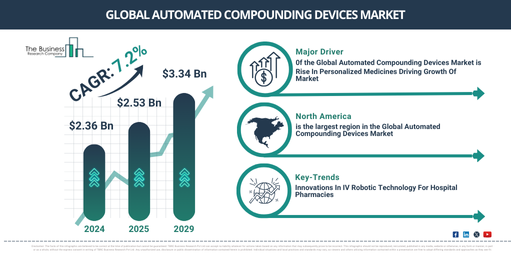
    There has been a considerable growth in the size of the automated compounding devices market in the recent past. The market, which was worth $2.36 billion in 2024, is projected to increase to $2.53 billion in 2025, recording a compound annual growth rate (CAGR) of 7.4%. Factors contributing to this growth during the historic period include the increase in chronic disease incidences, an aging demographic, enhancements in healthcare infrastructure, regulatory stipulations, and the rise in medication mistakes.

    The market for automated compounding devices is predicted to experience a substantial growth in the coming years, increasing to $3.34 billion by 2029 with a 7.2% compound annual growth rate (CAGR). This predicted growth in the forecast period can be credited to the escalating incidence of cancer, the worldwide healthcare growth, a greater emphasis on patient security, regulatory approval, and a heightened focus on sustainability. Key trends for the forecast period encompass telemedicine, remote healthcare, artificial intelligence development, digitization in healthcare, and real-time monitoring.

    Download a free sample to assess the report’s scope and structure:

    https://www.thebusinessresearchcompany.com/sample.aspx?id=18231&type=smp

    How Are Key Drivers in the Industry Acting as Catalysts for the Growth of the Automated Compounding Devices Market?

    The rise in the number of tailored medical treatments is anticipated to propel the growth of the automated compounding devices market. Personalized medicine is a medical strategy that customizes healthcare decisions, practices, procedures, and interventions based on each patient’s specific characteristics. The advancement in the number of individualized medicines is attributed to improved comprehension of genetics, patient-centric data, and regulatory backing. Automated compounding devices are vital instruments that ensure accurate and exact composition of tailor-made medication prescriptions suited to every individual’s needs. These appliances streamline the process of merging various pharmaceutical constituents in precise proportions, a necessary aspect of developing personalized therapies. To illustrate, the Personalized Medicine Coalition, a US-based non-profit organization, pointed out in February 2024 that the FDA approved sixteen new personalized treatments for rare disease patients in 2023 versus just six in 2022. Hence, the surge in the number of tailor-made medicines is assisting in driving the automated compounding devices market’s expansion.

    Which Segments in the Automated Compounding Devices Offer the Most Growth?

    The automated compounding devices market covered in this report is segmented –

    1) By Component: Automated Compounding Systems Equipment, Automated Compounding Systems Software

    2) By Product Type: Intravenous Compounding Systems, Oral Compounding Systems, Total Parenteral Nutrition (TPN) Compounding Systems

    3) By Mode Of Operation: Fully Automated Compounding Systems, Semi-Automated Compounding Systems

    4) By End-User: Hospitals, Ambulatory Surgical Centers, Other End Users

    Subsegments:

    1) By Automated Compounding Systems Equipment: Compounding Workstations, Compounding Pumps, Mixing Chambers, Scales And Balances, Dispensing Units, Vial And Syringe Filling Systems, Other Related Equipment (Filtration Devices)

    2) By Automated Compounding Systems Software: Prescription Management Software, Workflow Management Software, Monitoring And Control Software, Data Analytics And Reporting Software, Safety And Compliance Software, Integration Software For Hospital Or Pharmacy Management Systems

    Request customized data on this market:

    https://www.thebusinessresearchcompany.com/customise?id=18231&type=smp

    What Are the Fastest-Growing Geographies in the Automated Compounding Devices Market?

    North America was the largest region in the automated compounding devices market in 2023. Asia-Pacific is expected to be the fastest-growing region in the forecast period. The regions covered in the automated compounding devices market report are Asia-Pacific, Western Europe, Eastern Europe, North America, South America, Middle East, Africa.

    What Are the Key Market Trends in the Automated Compounding Devices Market Over the Coming Years?

    Leading firms in the automated compounding device sector are striving to decrease medication errors and boost patient safety via cutting-edge technologies like robotic compounding, with an eye to increasing client confidence, achieving regulatory compliance, and securing an edge in the competition. Robotic compounding technology automates the careful preparation and blending of pharmaceutical compounds using sophisticated robotic systems, thereby improving precision, efficiency, and safety in the preparation of medications. To provide an example, in March 2022, Omnicell Inc., a healthcare technology firm based in the United States, introduced the IVX Station, a novel automated compounding device. With this innovative solution, the company hopes to widen the availability of IV robotic technology in the larger market, promoting patient safety, precision, cost-effectiveness, supply chain management, and regulatory conformity. The IVX Station has a throughput speed three times faster than existing IV robotic systems, features a robust design to reduce downtime, and retains a compact size perfect for pharmacy operations.

    View the full report here:

    https://www.thebusinessresearchcompany.com/report/automated-compounding-devices-global-market-report

    What Are the Key Elements That Define the Automated Compounding Devices Market?

    Automated compounding devices refer to specialized equipment designed to automate the preparation of medications, including intravenous (IV) solutions, in healthcare settings. These devices ensure precise and efficient compounding, enhancing patient safety and reducing the risk of human error in medication preparation.

    Purchase the full report and get a swift delivery:

    https://www.thebusinessresearchcompany.com/purchaseoptions.aspx?id=18231

    About The Business Research Company:

    With over 15000+ reports from 27 industries covering 60+ geographies, The Business Research Company has built a reputation for offering comprehensive, data-rich research and insights. Armed with 1,500,000 datasets, the optimistic contribution of in-depth secondary research, and unique insights from industry leaders, you can get the information you need to stay ahead in the game.

    Get in touch with us:

    The Business Research Company: https://www.thebusinessresearchcompany.com/

    Americas +1 3156230293

    Asia +44 2071930708

    Europe +44 2071930708

    Email us at info@tbrc.info

    Follow us on:

    LinkedIn: https://in.linkedin.com/company/the-business-research-company

    YouTube: https://www.youtube.com/channel/UC24_fI0rV8cR5DxlCpgmyFQ

    Global Market Model: https://www.thebusinessresearchcompany.com/global-market-model