Featuring market attractiveness scoring, total addressable market sizing, company benchmarking matrices, interactive Excel dashboards, deeper supply chain intelligence, emerging startup tracking, and granular product-level insights, The Business Research Company’s 2026 market reports are built to deliver research that is both more actionable and more strategically valuable.
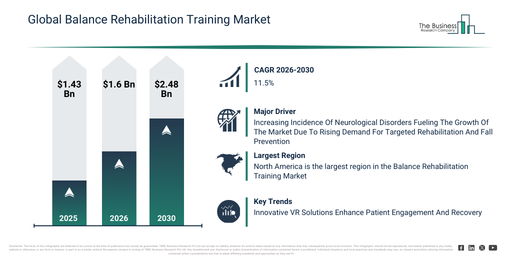
Balance Rehabilitation Training Market Revenue Growth On Track For A 11.5% CAGR Through 2030
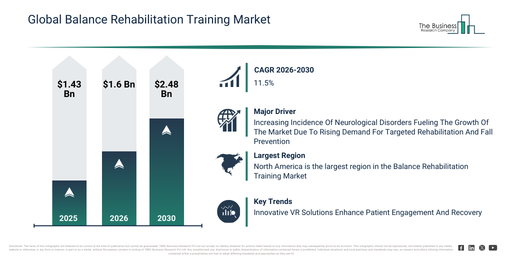
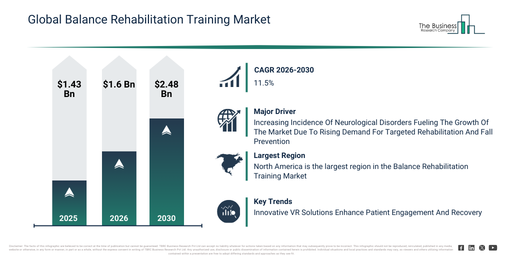
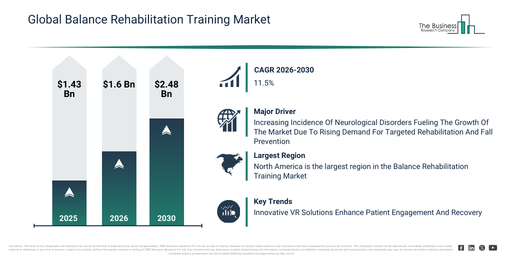
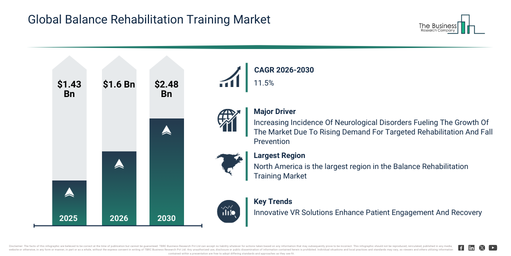
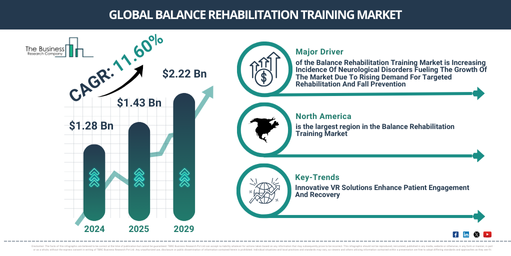
The balance rehabilitation training market has seen rapid expansion in recent years. It is anticipated to increase from $1.43 billion in 2025 to $1.6 billion in 2026, achieving a compound annual growth rate (CAGR) of 11.8%. This historical growth can be attributed to several factors including an aging global population, the rising occurrence of neurological disorders, broader acceptance of physiotherapy-led rehabilitation initiatives, an increase in services for post-injury recovery, and a greater clinical emphasis on balance assessment.
The balance rehabilitation training market size is anticipated to undergo significant growth in the coming years. It is projected to expand to $2.48 billion by 2030, exhibiting a compound annual growth rate (CAGR) of 11.5%. The expansion during the forecast period is attributable to a heightened demand for home-based rehabilitation solutions, an increasing adoption of digital physiotherapy platforms, the widening of preventive healthcare initiatives, a greater emphasis on personalized therapy outcomes, and increased investments in rehabilitation technology. Dominant trends during this period are expected to include a rising adoption of sensor-based balance assessment tools, growing integration of digital feedback systems in training, increasing utilization of personalized rehabilitation protocols, the expansion of hybrid and remote balance training programs, and an enhanced focus on fall prevention solutions.
Get A Free Sample Report With In-Depth Market Insights:
Balance Rehabilitation Training Market Growth Factors: What’s Supporting Expansion?
The anticipated rise in neurological disorder cases is projected to fuel the expansion of the balance rehabilitation training market in the foreseeable future. These disorders represent medical conditions impacting the brain, spinal cord, and nerves, resulting in various symptoms such as cognitive, motor, and sensory deficits. The growing occurrence of neurological disorders is associated with the world’s aging populace, given that aging progressively diminishes neuronal function, lessens brain plasticity, and heightens oxidative stress, thus aiding in the onset and advancement of these conditions. Balance rehabilitation training aids in managing neurological disorders through focused exercises designed to enhance stability, coordination, and motor control. This training boosts patient autonomy by decreasing the risk of falls and encouraging secure movement, thereby elevating their overall quality of life. As an illustration, in July 2024, the National Health Service, a UK government agency, reported 487,432 patients with dementia (a progressive brain disorder impacting memory, thinking, and everyday activities) by June 30, 2024, marking an increase of 3,155 cases from May 31, 2024. Consequently, the rising occurrence of neurological disorders is propelling the growth of the balance rehabilitation training market.
Balance Rehabilitation Training Market Segment Performance And Emerging Opportunities
The balance rehabilitation training market covered in this report is segmented –
1) By Type: Static Balance Training, Dynamic Balance Training, Functional Balance Training, Postural Control Training, Reaction Time Training
2) By Training Mode: Individual Training, Group Training, Online Training, In-Person Training, Hybrid Training
3) By Equipment Type: Balanstones, Balancushions, Wobble Boards, Balance Beams, Stability Balls
4) By Application: Geriatric Rehabilitation, Sports Rehabilitation, Pediatric Rehabilitation, Neurological Rehabilitation, Orthopedic Rehabilitation
5) By End-User: Hospitals, Rehabilitation Centers, Nursing Homes, Physiotherapy Clinics, Home Care Settings
Subsegments:
1) By Static Balance Training: Single Leg Stance Exercises, Tandem Stance Exercises, Romberg Exercises, Balance Board Exercises
2) By Dynamic Balance Training: Walking Exercises, Stepping Exercises, Perturbation Training, Obstacle Navigation Exercises
3) By Functional Balance Training: Sit To Stand Exercises, Reaching Exercises, Carrying Object Exercises, Transitional Movements Exercises
4) By Postural Control Training: Core Stability Exercises, Trunk Control Exercises, Alignment Training, Posture Correction Exercises
5) By Reaction Time Training: Visual Stimulus Response Exercises, Auditory Stimulus Response Exercises, Multi-Sensory Reaction Exercises, Rapid Direction Change Exercises
Balance Rehabilitation Training Market Industry Trends: What’s Reshaping Demand?
Leading companies operating in the balance rehabilitation training market are concentrating on developing innovative solutions, such as virtual reality (VR) platforms, to enhance patient engagement and improve recovery outcomes. Virtual reality (VR) platforms refer to integrated software and hardware ecosystems that create fully immersive, computer-generated environments, allowing users to interact with three-dimensional digital worlds in real time. For instance, in September 2024, Interacoustics A/S, a Denmark-based medical technology company, introduced its Virtualis balance rehabilitation solutions, a virtual reality platform designed to enhance balance, vestibular, and postural rehabilitation. This system combines immersive VR environments with objective measurement tools, such as static and dynamic posturography force plates, enabling patients to engage in interactive and customizable therapy activities. It supports a broad range of rehabilitation programs for neurological, vestibular, and orthopedic conditions, while allowing clinicians to monitor patient progress in real time and personalize therapy plans using secure data analytics.
Balance Rehabilitation Training Market Key Players: Which Companies Lead Industry Competition?
Major companies operating in the balance rehabilitation training market are Aretech LLC, Bioventus Inc., Aegis Care Advisors Pvt. Ltd., Fourier Intelligence Co., zebris Medical GmbH, Medica Medizintechnik GmbH, E3 Diagnostics Inc., MedBridge, Wandercraft, Hocoma AG, Neofect Co. Ltd., Motek Medical B.V., Tyromotion GmbH, Lifeward Ltd., BoBo Healthcare Ltd., 360 Neuro Health, Cyclops MedTech Pvt Ltd, Euleria Health S.r.l., NeuroEquilibrium Diagnostic Systems Pvt Ltd, Framiral S.A.S.
View The Full Balance Rehabilitation Training Market Report:
Balance Rehabilitation Training Market Regional Analysis And Top Geography
North America was the largest region in the balance rehabilitation training market in 2025. Asia-Pacific is expected to be the fastest-growing region in the forecast period. The regions covered in the balance rehabilitation training market report are Asia-Pacific, South East Asia, Western Europe, Eastern Europe, North America, South America, Middle East, Africa.
Reach Out To Our Team:
The Business Research Company: https://www.thebusinessresearchcompany.com/
Americas: +1 310-496-7795
Asia: +44 7882 955267 & +91 8897263534
Europe: +44 7882 955267
Email us at: marketing@tbrc.info
Follow us on:
LinkedIn: https://in.linkedin.com/company/the-business-research-company
YouTube: https://www.youtube.com/channel/UC24_fI0rV8cR5DxlCpgmyFQ
Global Market Model: https://www.thebusinessresearchcompany.com/global-market-model