Featuring market attractiveness scoring, total addressable market sizing, company benchmarking matrices, interactive Excel dashboards, deeper supply chain intelligence, emerging startup tracking, and granular product-level insights, The Business Research Company’s 2026 market reports are built to deliver research that is both more actionable and more strategically valuable.
Bruton’s Tyrosine Kinase (BTK) Inhibitor Market Growth Potential: How Will Market Size Shift Through 2030?
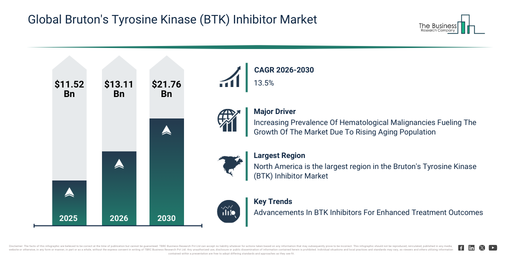
The bruton’s tyrosine kinase (btk) inhibitor market size has experienced significant expansion over recent years. It is projected to increase from $11.52 billion in 2025 to $13.11 billion in 2026, at a compound annual growth rate (CAGR) of 13.8%. The growth observed in the past can be attributed to factors such as the emergence of first-generation BTK inhibitors, the rising prevalence of chronic lymphocytic leukemia, the development of hospital and specialty clinic infrastructure, initial investments in research and development for B-cell malignancies, and the limited therapeutic options for autoimmune diseases.
The bruton’s tyrosine kinase (btk) inhibitor market is anticipated to experience significant expansion in the coming years. It is projected to reach $21.76 billion by 2030, exhibiting a compound annual growth rate (CAGR) of 13.5%. This expansion during the forecast period is fueled by several factors, including the emergence of next-generation btk inhibitors offering enhanced safety, the broadening application of targeted therapies for uncommon b-cell malignancies, the increasing adoption of personalized medicine strategies, heightened investments in clinical trials and research endeavors, and the proliferation of collaborations between biotechnology and pharmaceutical firms. Key trends observed within the forecast period encompass the increasing embrace of second- and third-generation btk inhibitors, the expanding availability of oral and subcutaneous delivery methods, the growing utility in both rare b-cell malignancies and autoimmune conditions, a strong emphasis on clinical trials and research aimed at discovering new applications, and the strengthening partnerships among pharmaceutical entities and research organizations.
Get A Free Sample Report With In-Depth Market Insights:
Bruton’s Tyrosine Kinase (BTK) Inhibitor Market Expansion Drivers: What’s Shaping Future Growth?
The rising occurrence of hematological malignancies is anticipated to fuel the expansion of the bruton’s tyrosine kinase (BTK) inhibitor market in the future. These cancers, which originate in the blood, bone marrow, or lymphatic system, encompass conditions such as leukemia, lymphoma, and multiple myeloma, impacting the performance of blood and immune cells. Globally, the expanding elderly demographic contributes to a heightened susceptibility to blood cancers like leukemia, lymphoma, and myeloma, given that the probability of these illnesses escalates with advancing age. Bruton’s tyrosine kinase (BTK) inhibitors aid in managing hematological malignancies by enabling patients to achieve extended lifespans with controlled disease, mitigating cancer cell proliferation and recurrence, consequently boosting survival rates and playing a role in the upward trend of prevalence data. A relevant example is found in a February 2023 report from the Leukemia Foundation, an Australia-based non-profit organization, which projects that from 2022 to 2035, more than 7,000 children, 6,000 young adults, and 108,000 adults (25–65) are anticipated to receive a diagnosis of blood cancers, primarily acute lymphoblastic leukemia, acute myeloid leukemia, and non-Hodgkin lymphoma. Consequently, the expanding incidence of hematological malignancies is a significant force propelling the bruton’s tyrosine kinase (BTK) inhibitor market’s expansion.
Bruton’s Tyrosine Kinase (BTK) Inhibitor Market Segment Outlook: Which Categories Are Growing Fastest?
The bruton’s tyrosine kinase (btk) inhibitor market covered in this report is segmented –
1) By Drug Type: First-Generation Bruton’s Tyrosine Kinase (BTK) Inhibitors, Second-Generation Bruton’s Tyrosine Kinase (BTK) Inhibitors, Third-Generation Bruton’s Tyrosine Kinase (BTK) Inhibitors
2) By Route Of Administration: Oral Administration, Intravenous Administration, Subcutaneous Administration
3) By Application: Chronic Lymphocytic Leukemia (CLL), Follicular Lymphoma, Mantle Cell Lymphoma, Marginal Zone Lymphoma, Small Lymphocytic Lymphoma (SLL), Waldenstrom Macroglobulinemia, Other Selective B Cell Malignancies, Chronic Graft-Versus-Host Disease, Other Applications
4) By End User: Hospitals, Specialty Clinics, Research Laboratories, Pharmacies, Other End Users
Subsegments:
1) By First-Generation Bruton’s Tyrosine Kinase (BTK) Inhibitors: Ibrutinib, CC-292 (Spebrutinib)
2) By Second-Generation Bruton’s Tyrosine Kinase (BTK) Inhibitors: Acalabrutinib, Zanubrutinib, Tirabrutinib
3) By Third-Generation Bruton’s Tyrosine Kinase (BTK) Inhibitors: Pirtobrutinib (LOXO-305/Jaypirca), Nemtabrutinib (ARQ 531)
Bruton’s Tyrosine Kinase (BTK) Inhibitor Market Strategic Trends: What Defines The Next Growth Phase?
Leading companies in the bruton’s tyrosine kinase (BTK) inhibitor market are concentrating on advancements in drug development, particularly through targeted therapy, to improve treatment outcomes. Targeted therapy is a treatment method employing specific drugs or substances to precisely target and attack cancer cells or disease-related pathways, while causing minimal harm to healthy cells. For instance, in July 2025, Glenmark Pharmaceuticals Ltd., an India-based pharmaceutical company, introduced Brukinsa (zanubrutinib) as a new treatment option for Indian patients with hematological (blood) cancers. This drug is the first and sole Bruton’s tyrosine kinase (BTK) inhibitor in India approved for treating five types of B-cell malignancies. It features unique characteristics that position it as a next-generation Bruton’s tyrosine kinase (BTK) inhibitor for B-cell malignancies. It achieves sustained, high-level BTK occupancy in both blood and lymph nodes, thereby enhancing its effectiveness in blocking cancerous B-cell survival. Brukinsa exhibits an improved safety profile, with fewer cardiac side effects and lower discontinuation rates compared to first-generation BTK inhibitors. Additionally, it offers flexible dosing, allowing patients to take either 160 mg twice daily or 320 mg once daily, based on their tolerance and convenience.
Bruton’s Tyrosine Kinase (BTK) Inhibitor Market Leading Companies And Competitive Benchmarking
Major companies operating in the bruton’s tyrosine kinase (btk) inhibitor market are Johnson & Johnson Inc., AbbVie Inc., Nurix Therapeutics Inc., InnoCare Pharma Limited, Carna Biosciences Inc., Aptose Biosciences Inc
View The Full Bruton’s Tyrosine Kinase (BTK) Inhibitor Market Report:
Bruton’s Tyrosine Kinase (BTK) Inhibitor Market Global Footprint: Which Region Leads The Market?
North America was the largest region in the bruton’s tyrosine kinase (BTK) inhibitor market in 2025. Asia-Pacific is expected to be the fastest-growing region in the forecast period. The regions covered in the bruton’s tyrosine kinase (btk) inhibitor market report are Asia-Pacific, South East Asia, Western Europe, Eastern Europe, North America, South America, Middle East, Africa.
Reach Out To Our Team:
The Business Research Company: https://www.thebusinessresearchcompany.com/
Americas: +1 310-496-7795
Asia: +44 7882 955267 & +91 8897263534
Europe: +44 7882 955267
Email us at: marketing@tbrc.info
Follow us on:
LinkedIn: https://in.linkedin.com/company/the-business-research-company
YouTube: https://www.youtube.com/channel/UC24_fI0rV8cR5DxlCpgmyFQ
Global Market Model: https://www.thebusinessresearchcompany.com/global-market-model