Built to provide research that’s more actionable and strategically valuable, The Business Research Company’s 2026 market reports include market attractiveness analysis, total addressable market sizing, company benchmarking matrices, interactive Excel dashboards, broader supply chain intelligence, emerging startup tracking, and in-depth product insights.
Fitness Tracker Market Revenue Outlook: What CAGR Lies Ahead Through 2030?
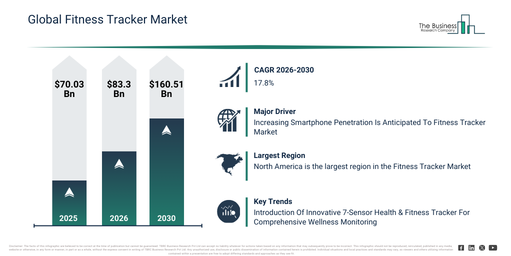
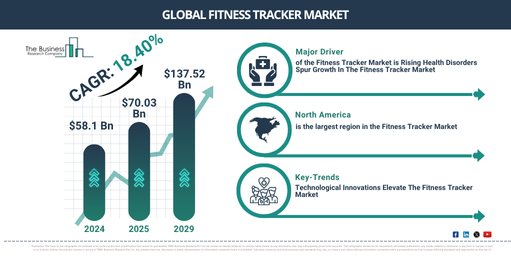
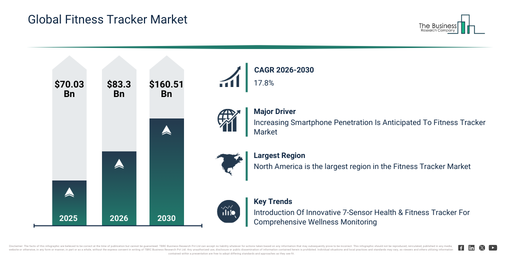
The fitness tracker market has experienced swift expansion recently. It is projected to increase from $70.03 billion in 2025 to $83.3 billion in 2026, exhibiting a compound annual growth rate (CAGR) of 18.9%. The market’s growth in the past can be credited to an increase in health-conscious consumers, the broader adoption of smartphones, the availability of cost-effective wearables, a rise in preventive healthcare initiatives, and continuous advancements in technological sensors.
The fitness tracker market is projected to experience substantial expansion in the coming years. Its value is anticipated to reach $160.51 billion by 2030, exhibiting a compound annual growth rate (CAGR) of 17.8%. This projected growth during the forecast period stems from factors such as the integration of AI-driven analytics, the broadening of medical-grade wearables, an increase in remote health monitoring, heightened fitness awareness, and advancements in battery and sensor technologies. Key trends anticipated within this period encompass the increasing adoption of wearable health monitoring devices, an elevated emphasis on sleep and activity tracking, the incorporation of advanced sensors and analytics, rising consumer desire for smart health insights, and the expansion of online sales channels.
Get A Free Sample Report With In-Depth Market Insights:
Fitness Tracker Market Demand Drivers: What’s Powering Industry Growth?
The fitness tracker market is expected to expand going forward, driven by the increasing penetration of smartphones. A smartphone is a mobile device that integrates cellular phone capabilities with features such as internet access, email, applications, and multimedia. Fitness trackers enhance the utility of smartphones by offering health and activity monitoring functions, empowering users to manage their well-being through their mobile devices. For instance, in October 2023, GSMA, a UK-based telecom industry association, reported that smartphone ownership reached 55 percent of the world’s population in 2023, an increase from 52 percent in 2022. This growing smartphone penetration is consequently propelling the market for fitness trackers.
Fitness Tracker Market Segment Landscape: Which Areas Lead Development?
The fitness tracker market covered in this report is segmented –
1) By Device Type: Smart Watches, Fitness Band, Smart Glasses, Smart Clothing, Other Device Types
2) By Application: Heart Rate Tracking, Sleep Measurement, Glucose Measurement, Sports, Running, Cycling Tracking
3) By Distribution Channel: Online, Retail, Other Distribution Channels
Subsegments:
1) By Smart Watches: GPS Smart Watches, Hybrid Smart Watches
2) By Fitness Bands: Basic Fitness Bands, Advanced Fitness Bands With Heart Rate Monitoring
3) By Smart Glasses: Augmented Reality (AR) Glasses, Heads-Up Display (HUD) Glasses
4) By Smart Clothing: Fitness Tracking Shirts, Smart Sports Bras, Smart Pants
5) By Other Device Types: Fitness Trackers (Standalone Devices), Heart Rate Monitors, Smart Shoes
Fitness Tracker Market Innovation Trends Shaping Future Development
Leading companies in the fitness tracker market are launching innovative products to maintain their market position. For instance, in March 2023, Tricorder.Zero, a US-based sensor health & fitness tracker, unveiled its cutting-edge health and fitness tracker, which features seven precise sensors. This device enables users to monitor various health metrics, including visualizations of the ear, nose, throat, outer eye, and skin; infrared forehead temperature readings; heart rate; blood oxygenation; heart and lung sounds; EKG patterns; and body fat and muscle tone over a month. Enhanced by AI, it delivers alerts for abnormal readings, advising users to consult professionals. The tracker also provides support for medication tracking and aggregates all data in its user-friendly app, ensuring end-to-end data security.
Fitness Tracker Market Industry Leaders And Competitive Landscape
Major companies operating in the fitness tracker market are Fitbit Inc., Apple Inc., Garmin Ltd., Samsung Electronics Co. Ltd., Xiaomi Inc., Huawei Technologies Co. Ltd., NIKE Inc., Adidas Inc., Polar Electro Oy, Ambiotex GmbH, Hexoskin, Fossil Group Inc., TomTom N.V., Misfit Inc., Moov Inc., Lumo Bodytech Inc., Atlas Wearables Inc., Basis Science Inc., Bragi GmbH, Casio Computer Co. Ltd., Coros Wearables Inc., Jaybird LLC, LG Electronics Inc., LifeBEAM Technologies Ltd., Motorola Mobility LLC, Razer Inc., Sony Corporation, Timex Group USA Inc., Under Armour Inc.
View The Full Fitness Tracker Market Report:
Fitness Tracker Market Largest Region: Which Geography Holds The Biggest Share?
North America was the largest region in the fitness tracker market in 2025. Asia-Pacific is expected to be the fastest-growing region in the forecast period. The regions covered in the fitness tracker market report are Asia-Pacific, South East Asia, Western Europe, Eastern Europe, North America, South America, Middle East, Africa.
Reach Out To Our Team:
The Business Research Company: https://www.thebusinessresearchcompany.com/
Americas: +1 310-496-7795
Asia: +44 7882 955267 & +91 8897263534
Europe: +44 7882 955267
Email us at: marketing@tbrc.info
Follow us on:
LinkedIn: https://in.linkedin.com/company/the-business-research-company
YouTube: https://www.youtube.com/channel/UC24_fI0rV8cR5DxlCpgmyFQ
Global Market Model: https://www.thebusinessresearchcompany.com/global-market-model