Tag: food allergy treatment market scope

  • Food Allergy Treatment Market Growth and Trends: Key Insights into Market Opportunities for 2025-2034

    Food Allergy Treatment Market Growth and Trends: Key Insights into Market Opportunities for 2025-2034

    2025 Market Reports Update: Market Size Forecasts to 2034, Key Trends, Leading Players, and Top Regions – Get Ahead of the Competition Today!

    How Are Key Drivers Contributing to the Growth and Expansion of the Food Allergy Treatment Market?

    The escalating prevalence of food tampering is anticipated to stimulate the expansion of the food allergy treatment market. Food tampering refers to the wilful act of sabotaging food items through the addition of inferior, harmful, or unapproved substances, or the removal of valuable components aimed at expanding quantity or improving aesthetics, often at the cost of safety and quality. The surge in food contamination is linked to several factors including profit-seeking motives, intricate supply chains, inadequate regulations, advancing technology, convenience demand, globalisation, environmental conditions, public awareness, bearish profit margins, and weak regulatory law enforcement. The growth in food tampering is predominantly driven by the escalating demand for cost-effective products, which encourages manufacturers to curb expenses and amplify earnings through immoral means. Food tampering heightens the possibility of allergic reactions either by incorporating allergenic substances into foodstuffs or by jeopardising food supply’s safety and integrity. For instance, in November 2022, Europol, a Dutch government agency, declared that during Operation OPSON XI, under Europol’s coordination, agencies from 26 countries seized roughly 27,000 tonnes of counterfeit food and 15 million liters of alcoholic beverages between December 2021 and May 2022. Hence, the increasing trend in food tampering propels the food allergy treatment market’s growth.

    Get Your Free Sample Report Now – Explore Exclusive Market Insights:

    https://www.thebusinessresearchcompany.com/sample.aspx?id=16684&type=smp

    #What is the Anticipated CAGR of theFood Allergy Treatment Market, and What Factors Will Drive It?

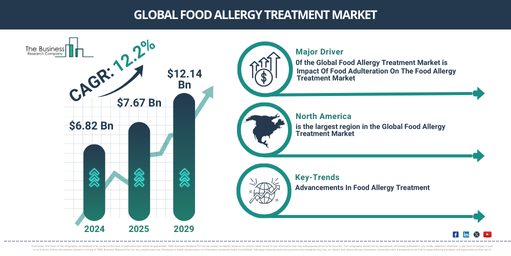
    In recent times, the food allergy treatment market has seen a notable increase in size. The market, which was worth $6.82 billion in 2024, is expected to further develop to $7.67 billion in 2025 with a compound annual growth rate (CAGR) of 12.5%. Factors such as the growing frequency of food allergies, a surge in regulatory approvals, advancement in emergency care, and increased funding in cutting-edge technologies have all contributed to the significant growth rate witnessed in the historic period.

    In the upcoming years, it’s anticipated that there will be a remarkable surge in the food allergy treatment market, which is projected to reach $12.14 billion by 2029 with a Compound Annual Growth Rate (CAGR) of 12.2%. This escalation during the forecast period is accountable to several factors like the expanding elderly populace, surge in recognition of food allergies, climbing healthcare expenses, rising asthma cases, and increasing incidents of food allergies. Some significant trends projected in the time frame are an escalation in innovation and technological advancements, enhancements in medical technology and diagnostic methods, a rise in the use of mobile apps and telemedicine services, more research and development initiatives, and a significant increase in drug approvals and launches.

    You can Directly Purchase the Report Here:

    https://www.thebusinessresearchcompany.com/purchaseoptions.aspx?id=16684

    What New Market Trends Are Reshaping theFood Allergy Treatment Market and Its Opportunities?

    Leading firms in the food allergy treatment market are pioneering new therapies, such as monoclonal antibodies, to tackle the root causes of food allergies and offer more effective patient solutions. Monoclonal antibodies are an emerging strategy for treating food allergies, achieving this by specifically addressing key aspects of the immune system involved in allergies, thereby delivering more precise and fruitful treatments for patients. For example, Novartis AG, a pharmaceutical company based in Switzerland, got approval from the FDA in February 2024 for their product Xolair (omalizumab) to diminish IgE-mediated food allergies. This humanized monoclonal antibody, given subcutaneously, operates by preventing the bonding of IgE antibodies, in turn, reducing the release of chemicals that cause allergy symptoms. The FDA approval has its foundation on encouraging data received from the Phase III OUtMATCH study, indicating that a notably larger percentage of food allergy patients as young as one year who were treated with Xolair were able to consume small quantities of peanut, milk, egg, and cashews without experiencing allergic reactions compared to those taking placebo.

    Who Are the Leading Market Players Fueling Growth in the Food Allergy Treatment Market Trend?

    Major companies operating in the food allergy treatment market are Pfizer Inc., F. Hoffmann-La Roche Ltd., Merck & Co. Inc., Bayer AG, Sanofi S.A., AstraZeneca PLC, Novartis AG, Amgen Inc., Regeneron Pharmaceuticals Inc., Parexel International (MA) Corporation, Nestle Health Science, ALK-Abelló A/S, Stallergenes Greer, Kaleo Inc., HAL Allergy B.V., Vedanta Biosciences Inc., Aimmune Therapeutics, AnaptysBio Inc., Immunomic Therapeutics Inc., Alladapt Immunotherapeutics Inc., Aravax, Prota Therapeutics Pty Ltd., DBV Technologies, Adamis Pharmaceuticals Corporation

    Order Your Report Now For A Swift Delivery:

    https://www.thebusinessresearchcompany.com/report/food-allergy-treatment-global-market-report

    How is the Global Food Allergy Treatment Market Segemented?

    The food allergy treatment market covered in this report is segmented –

    1) By Drug Type: Antihistamines, Decongestants, Corticosteroids, Mast Cell Stabilizers, Leukotriene Inhibitors, Nasal Anti-Cholinergic, Immuno-Modulators, Epinephrine, Immunotherapy

    2) By Route Of Administration: Parenteral, Oral

    3) By Allergen Type: Dairy Products, Poultry Product, Tree Nuts, Peanuts, Shellfish, Wheat, Soys, Other Allergens

    4) By End-Use: Hospital Pharmacies, Retail Pharmacies, Other End-Uses

    Subsegments:

    1) By Antihistamines: Oral Antihistamines, Topical Antihistamines, Intranasal Antihistamines

    2) By Decongestants: Oral Decongestants, Nasal Decongestants

    3) By Corticosteroids: Oral Corticosteroids, Topical Corticosteroids, Intranasal Corticosteroids

    4) By Mast Cell Stabilizers: Cromolyn Sodium, Nedocromil

    5) By Leukotriene Inhibitors: Montelukast, Zafirlukast

    6) By Nasal Anti-Cholinergic: Ipratropium Bromide

    7) By Immuno-Modulators: Omalizumab, Dupilumab

    8) By Epinephrine: Injectable Epinephrine, Auto-Injectors

    9) By Immunotherapy: Oral Immunotherapy (OIT), Sublingual Immunotherapy (SLIT), Epicutaneous Immunotherapy (EPIT)

    Gain Exclusive Market Insights—Customize Your Research Report Today for Fast Delivery!

    https://www.thebusinessresearchcompany.com/customise?id=16684&type=smp

    Which Geographics are Influencing the Growth of the Food Allergy Treatment Market?

    North America was the largest region in the food allergy treatment market in 2024. Asia-Pacific is expected to be the fastest-growing region in the forecast period. The regions covered in the food allergy treatment market report are Asia-Pacific, Western Europe, Eastern Europe, North America, South America, Middle East, Africa.

    Browse Through More Reports Similar to the Global Food Allergy Treatment Market 2025, By The Business Research Company:

    Allergy Immunotherapy Global Market Report 2024

    https://www.thebusinessresearchcompany.com/report/allergy-immunotherapy-global-market-report

    Allergy Diagnostics Global Market Report 2024

    https://www.thebusinessresearchcompany.com/report/allergy-diagnostics-global-market-report

    House Dust Mite Allergy Global Market Report 2024

    https://www.thebusinessresearchcompany.com/report/house-dust-mite-allergy-global-market-report

    About The Business Research Company:

    With over 15000+ reports from 27 industries covering 60+ geographies, The Business Research Company has built a reputation for offering comprehensive, data-rich research and insights. Armed with 1,500,000 datasets, the optimistic contribution of in-depth secondary research, and unique insights from industry leaders, you can get the information you need to stay ahead in the game.

    Contact us at:

    The Business Research Company: https://www.thebusinessresearchcompany.com/

    Americas +1 3156230293

    Asia +44 2071930708

    Europe +44 2071930708

    Email us at info@tbrc.info

    Follow us on:

    LinkedIn: https://in.linkedin.com/company/the-business-research-company

    YouTube: https://www.youtube.com/channel/UC24_fI0rV8cR5DxlCpgmyFQ

    Global Market Model: https://www.thebusinessresearchcompany.com/global-market-model

    Found this article helpful? Share it on:
  • In-Depth Insights into the Food Allergy Treatment Market: Growth, Trends, and Opportunities for 2025-2034

    In-Depth Insights into the Food Allergy Treatment Market: Growth, Trends, and Opportunities for 2025-2034

    Updated 2025 Market Reports Released: Trends, Forecasts to 2034 – Early Purchase Your Competitive Edge Today!

    What Are the Projected Expansion Rates of the Food Allergy Treatment Market for the Next Decade?

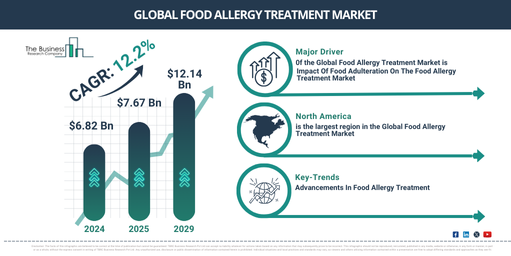
    Over the past few years, the food allergy treatment market size has expanded swiftly. Its growth is projected to rise from $6.82 billion in 2024 to $7.67 billion in 2025, experiencing a compound annual growth rate (CAGR) of 12.5%. Factors such as the growing instances of food allergies, an increase in regulatory approvals, advancements in emergency treatments, and more investments in cutting-edge technologies have contributed to its expansion during the historical period.

    In the coming years, the food allergy treatment market is slated for significant expansion, with an anticipated valuation of $12.14 billion by 2029 at a compound annual growth rate (CAGR) of 12.2%. Several factors contribute to this projected growth, including an ageing population, an increase in food allergy diagnoses, higher healthcare expenditure, a rise in asthma cases, and a surge in food allergy prevalence. The forecast period is expected to see several noteworthy trends such as groundbreaking innovation and technological upgrades, enhancements in medical technology and diagnostic methods, increased use of mobile applications and telemedicine services, a rise in research and development initiatives, and a surge in drug approvals and release.

    Which Drivers Are Expected to Have the Greatest Impact on the Food Allergy Treatment Market’s Growth?

    The surge in food adulteration is anticipated to stimulate the expansion of the food allergy treatment market. Food adulteration involves the deliberate modification of food items by adding substandard, harmful, or unauthorized substances, or by removing important ingredients, to increase quantity or improve look, often compromising quality and safety. The rise in food adulteration is attributed to reasons such as financial gain, intricacy in supply chain, insufficient regulation, advancements in technology, demand for convenience, globalization, environmental factors, consumer cognizance, profitability, and feeble enforcement of rules. The primary driving force for the growth of food adulteration is the escalating demand for more affordable products, which encourages manufacturers to reduce expenses and amplify profits through unscrupulous methods. Food adulteration can heighten the chances of allergic triggers by introducing allergenic substances into foodstuffs or by jeopardizing the safety and reliability of the food chain. For example, in November 2022, Europol, a Netherlands-based government organization, declared that during Operation OPSON XI, led by Europol, authorities from 26 nations confiscated approximately 27,000 tons of fake foods and 15 million liters of alcoholic drinks from December 2021 to May 2022. Hence, the surge in food adulteration is propelling the expansion of the food allergy treatment market.

    Request Your Free Food Allergy Treatment Market Report Sample Now!

    https://www.thebusinessresearchcompany.com/sample.aspx?id=16684&type=smp

    Which Companies Are Redefining the Future of the Food Allergy Treatment Market?

    Major companies operating in the food allergy treatment market are:

    • McDonald’s Corporation_x000D_

    • Darden Restaurants Inc._x000D_

    • Chipotle Mexican Grill Inc._x000D_

    • Yum! Brands Inc._x000D_

    • Restaurant Brands International Inc._x000D_

    What Trends Are Poised to Drive the Future Success of the Food Allergy Treatment Market?

    Leading corporations in the food allergy treatment sector are exploring innovative therapeutic methods like monoclonal antibodies to understand and treat the core causes of food allergies more effectively. These antibodies are seen as a front-running solution to treat food allergies with their unique ability to target certain parts of the immune system responsible for allergic reactions, thus leading to more efficient and specific treatments for patients. For example, in February 2024, a Swiss pharmaceutical company Novartis AG, secured FDA approval for their product Xolair (omalizumab) which is designed to curb IgE-mediated food allergies. Xolair, a humanized monoclonal antibody that is administered under the skin, prevents the binding of IgE antibodies, in turn decreasing the release of allergy-causing chemicals. This FDA approval was influenced by positive results from the Phase III OUtMATCH study, which revealed a significantly larger percentage of food allergy patients, as young as one year old, could tolerate minor amounts of peanut, milk, egg, and cashews without an allergic response when treated with Xolair, compared to a placebo.

    Pre-order Your Report for Quick and Easy Delivery!

    https://www.thebusinessresearchcompany.com/report/food-allergy-treatment-global-market-report

    What Are the Major Categories and Their Growth Dynamics in the Food Allergy Treatment Market?

    The food allergy treatment market covered in this report is segmented –

    1) By Drug Type: Antihistamines, Decongestants, Corticosteroids, Mast Cell Stabilizers, Leukotriene Inhibitors, Nasal Anti-Cholinergic, Immuno-Modulators, Epinephrine, Immunotherapy

    2) By Route Of Administration: Parenteral, Oral

    3) By Allergen Type: Dairy Products, Poultry Product, Tree Nuts, Peanuts, Shellfish, Wheat, Soys, Other Allergens

    4) By End-Use: Hospital Pharmacies, Retail Pharmacies, Other End-Uses

    Subsegments:

    1) By Antihistamines: Oral Antihistamines, Topical Antihistamines, Intranasal Antihistamines

    2) By Decongestants: Oral Decongestants, Nasal Decongestants

    3) By Corticosteroids: Oral Corticosteroids, Topical Corticosteroids, Intranasal Corticosteroids

    4) By Mast Cell Stabilizers: Cromolyn Sodium, Nedocromil

    5) By Leukotriene Inhibitors: Montelukast, Zafirlukast

    6) By Nasal Anti-Cholinergic: Ipratropium Bromide

    7) By Immuno-Modulators: Omalizumab, Dupilumab

    8) By Epinephrine: Injectable Epinephrine, Auto-Injectors

    9) By Immunotherapy: Oral Immunotherapy (OIT), Sublingual Immunotherapy (SLIT), Epicutaneous Immunotherapy (EPIT)

    What Are the Leading Regions in the Food Allergy Treatment Market Expansion?

    North America was the largest region in the food allergy treatment market in 2024. Asia-Pacific is expected to be the fastest-growing region in the forecast period. The regions covered in the food allergy treatment market report are Asia-Pacific, Western Europe, Eastern Europe, North America, South America, Middle East, Africa.

    What Are the Core Features That Define the Food Allergy Treatment Market?

    Food allergy treatment refers to the medical interventions and strategies employed to prevent, manage, and treat allergic reactions triggered by specific foods. The goal of food allergy treatment is to reduce the frequency and severity of allergic reactions, improve the quality of life for affected individuals, and enhance overall patient safety.

    Browse Through More Similar Reports By The Business Research Company:

    Allergy Immunotherapy Global Market Report 2024

    https://www.thebusinessresearchcompany.com/report/allergy-immunotherapy-global-market-report

    Allergy Diagnostics Global Market Report 2024

    https://www.thebusinessresearchcompany.com/report/allergy-diagnostics-global-market-report

    House Dust Mite Allergy Global Market Report 2024

    https://www.thebusinessresearchcompany.com/report/house-dust-mite-allergy-global-market-report

    About The Business Research Company:

    With over 15000+ reports from 27 industries covering 60+ geographies, The Business Research Company has built a reputation for offering comprehensive, data-rich research and insights. Armed with 1,500,000 datasets, the optimistic contribution of in-depth secondary research, and unique insights from industry leaders, you can get the information you need to stay ahead in the game.

    Contact us at:

    The Business Research Company: https://www.thebusinessresearchcompany.com/

    Americas +1 3156230293

    Asia +44 2071930708

    Europe +44 2071930708

    Email us at info@tbrc.info

    Follow us on:

    LinkedIn: https://in.linkedin.com/company/the-business-research-company

    YouTube: https://www.youtube.com/channel/UC24_fI0rV8cR5DxlCpgmyFQ

    Global Market Model: https://www.thebusinessresearchcompany.com/global-market-model

    Found this article helpful? Share it on:
  • Top 5 Insights From The Food Allergy Treatment Market Report 2024

    Top 5 Insights From The Food Allergy Treatment Market Report 2024

    The Business Research Company’s global market reports are now updated with the latest market sizing information for the year 2024 and forecasted to 2033

    According to The Business Research Company’s Food Allergy Treatment Global Market Report 2023, the food allergy treatment market is expected to show promising growth in the forecast period.

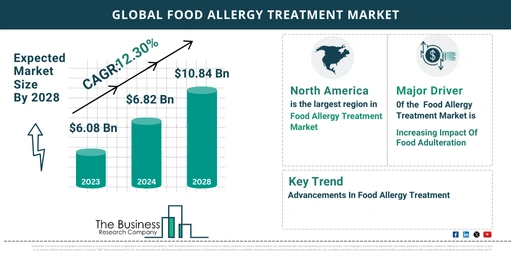
    • Current Market Size: The food allergy treatment market has experienced significant growth, expanding from $6.08 billion in 2023 to an expected $6.82 billion in 2024.
    • CAGR: This represents a compound annual growth rate (CAGR) of 12.2%, driven by factors like the increasing prevalence of food allergies and rising regulatory approvals.
    • Historic Drivers: The market’s expansion can be attributed to the development of emergency treatments and greater investment in modern technologies.

    Future Outlook: Sustained Expansion

    • Projected Growth: The market is expected to continue its upward trajectory, reaching $10.84 billion by 2028.
    • CAGR: This translates to a CAGR of 12.3% over the forecast period.
    • Key Drivers: Growth will be propelled by the increasing diagnosis of food allergies, rising healthcare spending, and the growing geriatric population.

    Major Trends:

      • High degree of innovation and technological advancements.
      • Improvement in medical technology and diagnostic techniques.
      • Increasing use of mobile apps and telemedicine services.
      • A surge in research and development activities.
      • Rising number of drug approvals and launches.

    View More On The Food Allergy Treatment Market Report 2024 –
    https://www.thebusinessresearchcompany.com/report/food-allergy-treatment-global-market-report

    Impact of Food Adulteration on the Market

    • Definition: Food adulteration involves the intentional alteration of food products, often for economic gain, leading to compromised quality and safety.
    • Rising Concern: The increasing incidence of food adulteration is expected to drive market growth by raising the risk of allergic reactions.
    • Recent Example: In November 2022, Europol reported the seizure of nearly 27,000 tons of counterfeit food, highlighting the growing concern over food adulteration.

    Leading Players in the Market

    • Major Companies: The market is dominated by companies like Pfizer Inc., F. Hoffmann-La Roche Ltd., Merck & Co. Inc., Bayer AG, and Sanofi S.A.
    • Key Developments: These companies are focused on innovative therapies, such as monoclonal antibodies, to provide more effective treatments for food allergies.

    Advancements in Food Allergy Treatment

    • Monoclonal Antibodies: These represent a promising approach for treating food allergies by targeting specific components of the immune system.
    • Recent Approval: In February 2024, Novartis AG received FDA approval for Xolair (omalizumab), a monoclonal antibody designed to reduce IgE-mediated food allergies.
    • Study Results: The Phase III OUtMATCH study showed that Xolair allowed food allergy patients to tolerate small amounts of allergens like peanuts and milk without allergic reactions.

    Strategic Acquisitions: Expanding Treatment Portfolios

    • Stallergenes Greer’s Acquisition: In September 2023, Stallergenes Greer acquired Nestlé’s peanut allergy treatment business, allowing Nestlé to focus on its core strengths.
    • Market Impact: This acquisition enables Stallergenes Greer to expand its allergy treatment portfolio, strengthening its position in the market.

    Market Segmentation and Regional Insights

    • Drug Type: The market is segmented into antihistamines, decongestants, corticosteroids, mast cell stabilizers, and more.
    • Route of Administration: Treatment options are available in parenteral and oral forms.
    • Allergen Type: Common allergens include dairy products, poultry, tree nuts, peanuts, shellfish, wheat, and soys.
    • End-Use: Major end-users include hospital pharmacies and retail pharmacies.
    • Regional Insights: North America was the largest market in 2023, while Asia-Pacific is expected to be the fastest-growing region during the forecast period.

    Request A Sample Of The Global Food Allergy Treatment Market Report 2024:
    https://www.thebusinessresearchcompany.com/sample_request?id=16684&type=smp