The Business Research Company’s 2026 market reports feature enhanced tools like market attractiveness analysis, TAM assessment, and company scoring matrices, along with interactive dashboards, deeper supply chain insights, and startup coverage strengthening the depth, usability, and strategic value of insights.
What Is The Estimated Market Size Of The Genetic Engineering Plant Genomics Market In 2026, And How Will Its Value Evolve By 2030?
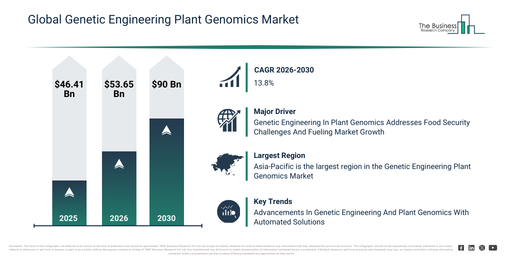
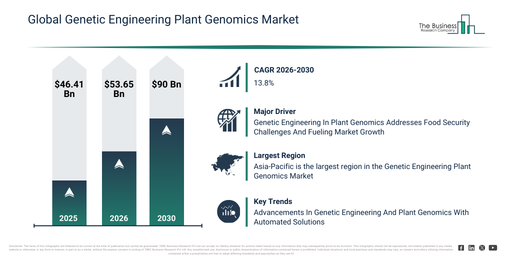
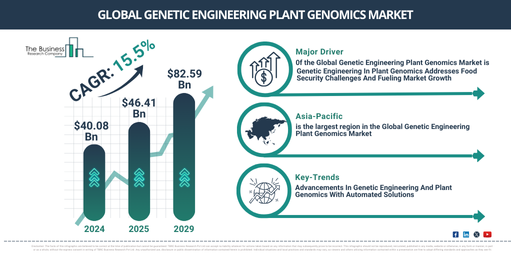
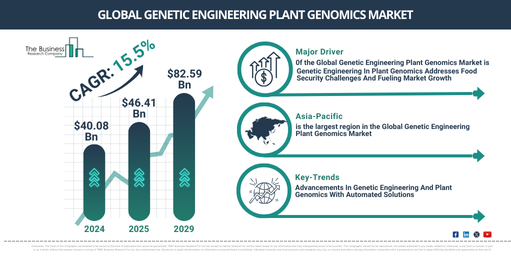
The genetic engineering plant genomics market has seen rapid expansion in recent years. Its valuation is expected to rise from $46.41 billion in 2025 to $53.65 billion in 2026, showing a compound annual growth rate (CAGR) of 15.6%. The historical expansion of this market is attributable to developments in plant biotechnology research, a rising need for higher crop yields, increased cultivation of genetically modified crops, enhancements in sequencing technologies, and a boost in public and private research funding.
The genetic engineering plant genomics market is poised for substantial expansion in the coming years, forecast to reach $90 billion by 2030, exhibiting a compound annual growth rate (CAGR) of 13.8%. This projected growth stems from several factors, including the increasing adoption of precision breeding techniques, a heightened focus on developing climate-resilient crops, the broadening scope of genome editing regulatory approvals, rising investments in sustainable agriculture technologies, and an escalating demand for resource-efficient crop traits. Dominant trends during this forecast period are expected to encompass the wider implementation of CRISPR-based genome editing in crops, an intensified focus on plant varieties capable of tolerating abiotic stress, the growing integration of genomic data analytics, the expansion of trait-specific crop development, and an enhanced emphasis on sustainable crop improvement practices.
Access Your Free Sample Report For In-Depth Market Analysis:
What Key Factors Are Shaping The Genetic Engineering Plant Genomics Market Landscape?
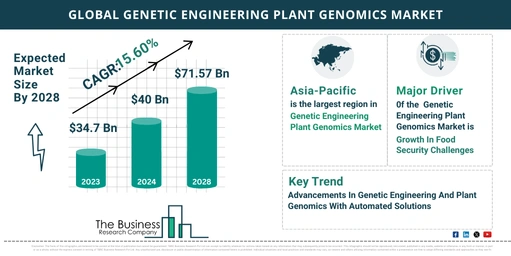
Future expansion of the genetic engineering plant genomics market is anticipated due to increasing worries about food security. Food security refers to a state where everyone consistently has enough safe and nourishing food for a healthy and active lifestyle. Mounting apprehension regarding food security originates from issues like climate change, economic unpredictability, and a growing worldwide populace, all of which jeopardize food availability and access. Through the creation of crops that are more resistant to pests, ailments, and environmental challenges, genetic engineering in plant genomics improves food security, thus boosting agricultural output and the steadiness of food supplies. As an illustration, in January 2025 the US Department of Agriculture, a governmental body in the US tracking food security data, reported that 13.5 percent of US households, or 18.0 million households, experienced food insecurity at some point in 2023, an increase from 12.8 percent, or 17.0 million households, in 2022. Consequently, the escalating worries about food security are projected to stimulate the expansion of the genetic engineering plant genomics market.
How Is The Genetic Engineering Plant Genomics Market Organized By Segment Classification?
The genetic engineering plant genomics market covered in this report is segmented –
1) By Type: Molecular Engineering, Genetic Engineering And Genome Editing, Other Types
2) By Trait: Yield Improvement, Disease Resistance, Herbicide Tolerance And Insect Resistance, Abiotic Stress Tolerance
3) By Application: Cereals And Grains, Oilseeds And Pulses, Fruits And Vegetables, Sugar Crops, Ornamentals, Alfalfa
Subsegments:
1) By Molecular Engineering: Gene Synthesis And Cloning, Protein Engineering, Enzyme Engineering, Marker-Assisted Selection
2) By Genetic Engineering And Genome Editing: CRISPR/Cas9 Technology, TALENs (Transcription Activator-Like Effector Nucleases), ZFNs (Zinc Finger Nucleases), RNA Interference (RNAi), Agrobacterium-mediated Transformation
3) By Other Types: Synthetic Biology In Plant Genomics, Epigenetic Engineering, Horizontal Gene Transfer
What Market Trends Are Affecting The Genetic Engineering Plant Genomics Market?
Leading companies within the genetic engineering plant genomics market are prioritizing technological innovations, particularly automated molecular breeding genotyping solutions, to significantly improve the accuracy and speed of crop breeding procedures. Such an automated solution constitutes a system designed to process vast quantities of plant samples with high efficiency and precision, utilizing computerized technologies and specialized software to simplify genetic analysis within breeding initiatives. As an illustration, in June 2024, MGI Tech, a biotechnology firm based in China, unveiled a comprehensive workflow solution aimed at large-scale low-pass whole genome sequencing in agriculture. This novel solution comprises an automated, end-to-end product suite specifically engineered for extensive molecular breeding and genotyping of agricultural diploid species. MGI’s automation platforms empower this low-pass WGS solution to surpass the constraints of traditional library preparation, delivering ultra-high throughput using fewer instruments. It facilitates swift, economical large-scale library preparation and supports substantial throughput via the DNBSEQ-T7 sequencer, alongside medium throughput with the DNBSEQ-G400 benchtop sequencer, making it exceptionally well-suited for agricultural genomics studies.
Who Are The Industry Participants Involved In The Genetic Engineering Plant Genomics Market?
Major companies operating in the genetic engineering plant genomics market are BASF SE, Bayer AG, Thermo Fisher Scientific Inc., Suntory Holdings Limited, Corteva Inc., DuPont de Nemours Inc, Eurofins Scientific SE, Agilent Technologies Inc, ADAMA Ltd, Illumina Inc, PerkinElmer Inc., Beckman Coulter Inc., Bio-Rad Laboratories, Zhejiang Xinan Chemical Industrial Group Co Ltd, UPL Limited, Qiagen N.V., Novogene Co Ltd, KWS SAAT SE & Co KGaA, Vilmorin & Cie, Neogen Corporation, Rubicon Genomics Inc, Verdesian Life Sciences LLC, GeneWiz Inc, Genotypic Technology Pvt Ltd, Syngenta AG, Keygene NV
Get The Full Genetic Engineering Plant Genomics Market Report:
Which Region Is The Leading Market For The Genetic Engineering Plant Genomics Market?
Asia-Pacific was the largest region in the genetic engineering plant genomics market in 2025. The regions covered in the genetic engineering plant genomics market report are Asia-Pacific, South East Asia, Western Europe, Eastern Europe, North America, South America, Middle East, Africa.
Request A Customized Genetic Engineering Plant Genomics Market Report For Competitive Insights:
Browse Through More Reports Similar to the Global Genetic Engineering Plant Genomics Market 2026, By The Business Research Company
Optogenetics Market Report 2026
https://www.thebusinessresearchcompany.com/report/optogenetics-global-market-report
Epigenetics Market Report 2026
https://www.thebusinessresearchcompany.com/report/epigenetics-global-market-report
Genetically Modified Fruits Market Report 2026
https://www.thebusinessresearchcompany.com/report/genetically-modified-fruits-global-market-report
Get in touch with us:
The Business Research Company: https://www.thebusinessresearchcompany.com/
Americas +1 310-496-7795
Asia +44 7882 955267 & +91 8897263534
Europe +44 7882 955267
Email us at info@tbrc.info
Follow us on:
LinkedIn: https://in.linkedin.com/company/the-business-research-company
YouTube: https://www.youtube.com/channel/UC24_fI0rV8cR5DxlCpgmyFQ
Global Market Model: https://www.thebusinessresearchcompany.com/global-market-model