Built to provide research that’s more actionable and strategically valuable, The Business Research Company’s 2026 market reports include market attractiveness analysis, total addressable market sizing, company benchmarking matrices, interactive Excel dashboards, broader supply chain intelligence, emerging startup tracking, and in-depth product insights.
Healthcare Claims Management Solutions Market Size Forecast: How Big Could The Market Get By 2030?
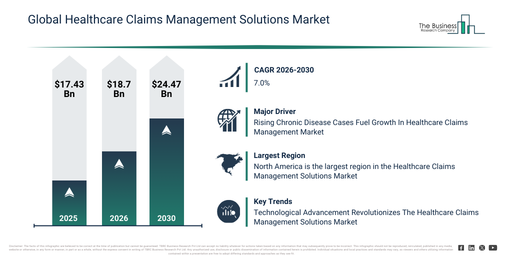
The healthcare claims management solutions market has experienced robust growth in recent years. It is projected to expand from $17.43 billion in 2025 to $18.7 billion in 2026, demonstrating a compound annual growth rate (CAGR) of 7.3%. Historically, this growth has been driven by increasing healthcare insurance coverage, rising claim volumes across providers, the adoption of digital billing systems, the growing complexity of reimbursement processes, and the demand for faster claim settlement.
The market for healthcare claims management solutions is projected to experience robust expansion in the coming years. This market is predicted to reach $24.47 billion by 2030, driven by a compound annual growth rate (CAGR) of 7.0%. Several factors contribute to this growth over the forecast period, including the increased adoption of AI-driven claims platforms, a heightened focus on value-based care reimbursement, the broadening of cloud-based claims solutions, a greater emphasis on automating regulatory compliance, and the demand for real-time claims transparency. Key trends anticipated during the forecast period involve a rise in the uptake of automated claims processing systems, increased application of predictive analytics to improve claims accuracy, a growing integration of real-time patient data access, the proliferation of fraud detection and prevention instruments, and an amplified emphasis on data security and compliance.
Get A Free Sample Report With In-Depth Market Insights:
Healthcare Claims Management Solutions Market Demand Drivers: What’s Powering Industry Growth?
The expanding occurrence of chronic diseases is anticipated to fuel the expansion of the healthcare claims management solutions market in the future. Chronic diseases are characterized as long-term health conditions that persist over an extended period, typically requiring ongoing medical oversight. Healthcare claims management solutions offer crucial support for the efficient and accurate processing of claims, ensuring that healthcare providers receive timely reimbursement for services related to chronic disease management. For instance, in January 2023, according to the National Center for Biotechnology Information (NCBI), a US-based National Library of Medicine, it is projected that by the year 2050, the number of individuals aged 50 years and older who have at least one chronic illness will surge by 99.5%, rising to 142.66 million. Therefore, the increasing incidence of chronic diseases will propel the healthcare claims management solutions market.
Healthcare Claims Management Solutions Market Segment Analysis And Revenue Potential
The healthcare claims management solutions market covered in this report is segmented –
1) By Type: Software, Services
2) By Deployment Mode: Web-Based, Cloud-Based, On-Premise
3) By End-User: Healthcare Payers, Healthcare Providers, Other End-Users
Subsegments:
1) By Software: Claims Processing Software, Revenue Cycle Management Software, Medical Billing Software, Analytics And Reporting Tools
2) By Services: Consulting Services, Implementation Services, Training And Support Services, Claims Auditing Services
Healthcare Claims Management Solutions Market Innovation Trends Shaping Future Development
Major companies within the healthcare claims management solutions market are prioritizing product innovation, exemplified by developments like the AI-enabled claims data activator Suite, to maintain their competitive standing. The Claims Data Activator facilitates data interoperability, intelligent analytics, and smart reporting by employing Document AI, the Healthcare Natural Language API, and the Healthcare API to transform unstructured data into structured information. For instance, in April 2023, Google LLC, a US-based technology corporation, launched a new Google Cloud AI-enabled claims data activator. This system is designed to assist health plans and providers in decreasing administrative costs and responsibilities by converting unstructured data into structured data, thereby empowering specialists to make swifter, more insightful decisions that enhance patient care.
Healthcare Claims Management Solutions Market Key Players Shaping Industry Direction
Major companies operating in the healthcare claims management solutions market are Allscripts Healthcare Solutions Inc, Athenahealth, McKesson Corporation, Oracle Corporation, Availity LLC, Cerner Corporation, Change Healthcare, Conifer Health Solutions LLC, eClinicalWorks, Emdeon Inc, Epic Systems Corporation, Inovalon Co, InstaMed LLC, Kareo Co, NaviNet Inc, NTT Data Services, Optum Inc, SSI Group LLC, Cognizant Technology Ltd, TruBridge Co, Waystar Co, ZirMed Inc
View The Full Healthcare Claims Management Solutions Market Report:
Healthcare Claims Management Solutions Market Regional Analysis: Which Geography Leads On Revenue?
North America was the largest region in the healthcare claim management solution market in 2025. Asia-Pacific is expected to be the fastest-growing region in the forecast period. The regions covered in the healthcare claims management solutions market report are Asia-Pacific, South East Asia, Western Europe, Eastern Europe, North America, South America, Middle East, Africa.
Reach Out To Our Team:
The Business Research Company: https://www.thebusinessresearchcompany.com/
Americas: +1 310-496-7795
Asia: +44 7882 955267 & +91 8897263534
Europe: +44 7882 955267
Email us at: marketing@tbrc.info
Follow us on:
LinkedIn: https://in.linkedin.com/company/the-business-research-company
YouTube: https://www.youtube.com/channel/UC24_fI0rV8cR5DxlCpgmyFQ
Global Market Model: https://www.thebusinessresearchcompany.com/global-market-model


