Tag: human fibroblast growth factor market share

  • Human Fibroblast Growth Factor Market Growth Forecast: Market Size, Key Trends And Emerging Opportunities Through 2030

    Human Fibroblast Growth Factor Market Growth Forecast: Market Size, Key Trends And Emerging Opportunities Through 2030

    Built to provide research that’s more actionable and strategically valuable, The Business Research Company’s 2026 market reports include market attractiveness analysis, total addressable market sizing, company benchmarking matrices, interactive Excel dashboards, broader supply chain intelligence, emerging startup tracking, and in-depth product insights.

    Human Fibroblast Growth Factor Market Growth Analysis: How Will Revenue Trend Over The Forecast Period?

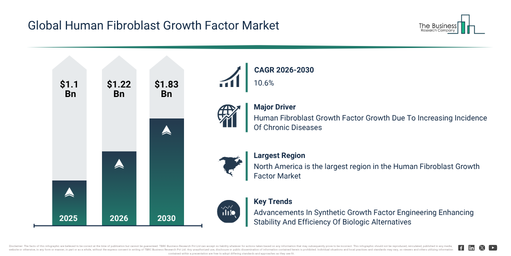
    The human fibroblast growth factor market has experienced rapid expansion in recent years. It is anticipated to grow from $1.1 billion in 2025 to $1.22 billion in 2026, registering a compound annual growth rate (CAGR) of 10.4%. The significant increase observed in prior periods can be attributed to developments in regenerative medicine research, a growing demand for human tissue derived proteins, increased investment in biotech R&D, the broadening of hospital and research institute networks, and the incorporation of hfgf into diagnostic applications.

    The human fibroblast growth factor market is projected for substantial expansion over the coming years. Its value is anticipated to reach $1.83 billion by 2030, exhibiting a compound annual growth rate (CAGR) of 10.6%. This projected increase is driven by factors such as the rising acceptance of recombinant hfgf products, the expansion of tissue engineering and cell therapy sectors, growing utilization in high-throughput drug screening, innovations in protein stabilization technologies, and the broadening reach of direct sales and e-commerce platforms. Key developments expected during this period involve a greater focus on developing recombinant hfgf variants, increased application of hfgf in tissue engineering, the wider availability of high-purity and lyophilized formulations, expanded adoption of hfgf in drug screening systems, and the incorporation of hfgf solutions into cell proliferation research.

    Get A Free Sample Report With In-Depth Market Insights:

    https://thebusinessresearchcompany.com/sample_request?id=81358654&type=smp&name=Human%20Fibroblast%20Growth%20Factor%20Market%20Report%202026&utm_source=Blogs&utm_medium=Paid&utm_campaign=Oct_PR

    Human Fibroblast Growth Factor Market Demand Drivers: What’s Powering Industry Growth?

    A rising prevalence of chronic diseases is anticipated to drive expansion in the human fibroblast growth factor market moving ahead. These are defined as enduring health conditions, typically lasting at least three months, which frequently advance gradually and are not generally curable, though their symptoms can be controlled, and they often necessitate continuous medical care or prolonged medication. The surge in chronic diseases stems from lifestyle modifications and environmental elements linked to contemporary living, which gradually accumulate to precipitate extended health issues. Human fibroblast growth factor assists in preventing chronic illnesses by enabling tissue repair, new blood vessel formation, and the reduction of persistent inflammation within the body, thereby diminishing the risk and advancement of prolonged health conditions. For example, reports from The Northern Arizona Medical Group, a US-based healthcare provider, indicated that by 2025, nearly three-quarters of the global population is expected to be living with at least one chronic illness, with the prevalence consistently rising. Specifically, in the United States, about 76.4% of adults in 2023 stated they had at least one chronic condition, and 51.4% reported having two or more. Consequently, the escalating occurrence of chronic diseases is propelling the expansion of the human fibroblast growth factor market.

    Human Fibroblast Growth Factor Market Segment Breakdown: Which Categories Lead On Revenue?

    The human fibroblast growth factor market covered in this report is segmented –

    1) By Product Type: Animal Derived, Natural, Recombinant

    2) By Form: Liquid, Lyophilized, Powder

    3) By Sales Channel: Direct Sales, Distributor, E Commerce

    4) By Application: Cell Proliferation, Diagnostics, Drug Screening, Tissue Engineering

    5) By End User: Biotech Companies, Hospitals, Pharmaceutical Companies, Research Institutes

    Subsegments:

    1) By Animal Derived: Bovine Derived Fibroblast Growth Factor, Porcine Derived Fibroblast Growth Factor, Other Animal Sources

    2) By Natural: Tissue Extracted Fibroblast Growth Factor, Plant Derived Fibroblast Growth Factor, Human Tissue Derived Fibroblast Growth Factor

    3) By Recombinant: Recombinant Human Fibroblast Growth Factor 1, Recombinant Human Fibroblast Growth Factor 2, Recombinant Human Fibroblast Growth Factor 7, Recombinant Human Fibroblast Growth Factor 10

    Human Fibroblast Growth Factor Market Innovation Trends: What Developments Are Reshaping The Industry?

    Companies operating in the human fibroblast growth factor market are increasingly concentrating on technological advancements, such as synthetic growth factor engineering. This allows for the development of engineered peptide or protein mimetics that replicate the biological activity of native FGFs, while providing enhanced stability, reduced degradation, improved receptor specificity, and lower production costs. Synthetic growth factor engineering involves the design and development of artificially created or modified molecules that mimic or enhance the biological activity of natural growth factors, concurrently improving properties like stability, specificity, and manufacturability. For instance, in October 2024, PeptiGrowth Inc, a Japan-based biotechnology company, launched a novel synthetic peptide growth factor. This factor offers enhanced biological performance by mimicking natural growth factor activity while also improving stability and efficiency. It delivers prolonged activity in cell culture systems, reducing the need for frequent media replacement. Additionally, these peptides exhibit greater resistance to degradation, ensuring consistent results across experiments.

    Human Fibroblast Growth Factor Market Competitive Landscape: Who Leads The Industry?

    Major companies operating in the human fibroblast growth factor market are Thermo Fisher Scientific Inc., Merck KGaA, Lonza Group AG, Bio-Techne Corporation, STEMCELL Technologies Inc., GenScript Biotech Corporation, Promega Corporation, Sino Biological Inc., Cell Signaling Technology Inc, ACROBiosystems Co. Ltd., RayBiotech Inc., Proteintech Group Inc., PromoCell GmbH, Creative Biolabs Co. Ltd., BPS Bioscience Inc., MedChemExpress LLC, ProSpec-Tany Technogene Ltd., Novoprotein Scientific Inc., Elabscience Biotechnology Inc., Enzo Life Sciences Inc.

    View The Full Human Fibroblast Growth Factor Market Report:

    https://thebusinessresearchcompany.com/report/human-fibroblast-growth-factor-market-report?utm_source=Blogs&utm_medium=Paid&utm_campaign=Oct_PR

    Human Fibroblast Growth Factor Market Geographic Landscape: Which Region Dominates Industry Growth?

    North America was the largest region in the human fibroblast growth factor market in 2025. Asia-Pacific is expected to be the fastest-growing region in the forecast period. The regions covered in the human fibroblast growth factor market report are Asia-Pacific, South East Asia, Western Europe, Eastern Europe, North America, South America, Middle East, Africa.

    Reach Out To Our Team:

    The Business Research Company: https://www.thebusinessresearchcompany.com/

    Americas: +1 310-496-7795

    Asia: +44 7882 955267 & +91 8897263534

    Europe: +44 7882 955267

    Email us at: marketing@tbrc.info

    Follow us on:

    LinkedIn: https://in.linkedin.com/company/the-business-research-company

    YouTube: https://www.youtube.com/channel/UC24_fI0rV8cR5DxlCpgmyFQ

    Global Market Model: https://www.thebusinessresearchcompany.com/global-market-model
  • Human Fibroblast Growth Factor Growth Due To Increasing Incidence Of Chronic Diseases Continues To Impact The Growth Of The Human Fibroblast Growth Factor Market

    Human Fibroblast Growth Factor Growth Due To Increasing Incidence Of Chronic Diseases Continues To Impact The Growth Of The Human Fibroblast Growth Factor Market

    The Business Research Company’s 2026 market reports feature advanced enhancements such as market attractiveness analysis, total addressable market evaluation, company benchmarking matrices, interactive Excel dashboards, expanded supply chain intelligence, emerging startup coverage, and detailed product insights, delivering more actionable and strategically valuable research.

    How Much Larger Will The Human Fibroblast Growth Factor Market Become By 2030 Compared To 2026?

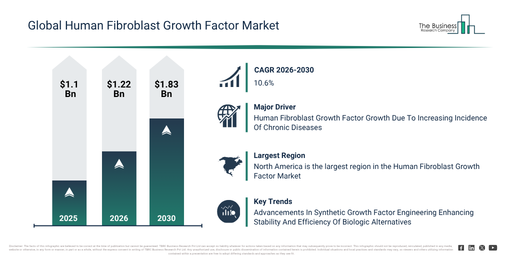
    The human fibroblast growth factor market size has seen significant growth in recent years. It is anticipated to expand from $1.1 billion in 2025 to $1.22 billion in 2026, at a compound annual growth rate (CAGR) of 10.4%. The historical expansion of this market can be attributed to factors such as the rise in regenerative medicine research, a surging demand for human tissue derived proteins, escalating investment in biotech research and development, the broadening of hospital and research institute networks, and the adoption of hfgf in diagnostic uses.

    The human fibroblast growth factor market size is anticipated to experience substantial expansion in the coming years, projected to reach $1.83 billion by 2030, exhibiting a compound annual growth rate (CAGR) of 10.6%. This growth over the forecast period is propelled by factors such as the increasing embrace of recombinant hfgf products, the flourishing tissue engineering and cell therapy markets, expanding applications in high-throughput drug screening, breakthroughs in protein stabilization technologies, and the widening reach of direct sales and e-commerce channels. Prominent trends for the forecast period include the rising development of recombinant hfgf variants, the escalating use of hfgf in tissue engineering, the broader availability of high-purity and lyophilized formulations, the growing integration of hfgf into drug screening platforms, and the incorporation of hfgf solutions into cell proliferation research.

    Download A Free Sample Report For Comprehensive Market Insights:

    https://www.thebusinessresearchcompany.com/sample_request?id=81928061&type=smp&name=Human%20Fibroblast%20Growth%20Factor%20Market%20Report%202026

    Which Strategic Drivers Are Supporting The Human Fibroblast Growth Factor Market Development?

    The escalating occurrence of chronic diseases is anticipated to drive the expansion of the human fibroblast growth factor market moving forward. Chronic diseases are defined as long-term health conditions that typically persist for three months or longer, often progressing slowly and generally not curable completely, though their symptoms can be managed. These conditions frequently necessitate ongoing medical attention or prolonged medication. The increase in chronic diseases results from lifestyle changes and environmental factors associated with modern living, which cumulatively contribute to long-term health problems. Human fibroblast growth factor aids in preventing chronic diseases by enabling the body to mend damaged tissues, create new blood vessels, and reduce chronic inflammation, thereby lowering the risk and progression of long-term health conditions. For instance, in 2025, according to The Northern Arizona Medical Group, a US-based healthcare provider, nearly three-quarters of the world’s population is projected to live with at least one chronic illness, and the prevalence of chronic illnesses continued to increase notably. In the United States, in 2023, about 76.4% of adults reported having at least one chronic condition, and 51.4% had two or more. Therefore, the rising incidence of chronic diseases is propelling the growth of the human fibroblast growth factor market.

    Which Segment Divisions Form The Structure Of The Human Fibroblast Growth Factor Market?

    The human fibroblast growth factor market covered in this report is segmented –

    1) By Product Type: Animal Derived, Natural, Recombinant

    2) By Form: Liquid, Lyophilized, Powder

    3) By Sales Channel: Direct Sales, Distributor, E Commerce

    4) By Application: Cell Proliferation, Diagnostics, Drug Screening, Tissue Engineering

    5) By End User: Biotech Companies, Hospitals, Pharmaceutical Companies, Research Institutes

    Subsegments:

    1) By Animal Derived: Bovine Derived Fibroblast Growth Factor, Porcine Derived Fibroblast Growth Factor, Other Animal Sources

    2) By Natural: Tissue Extracted Fibroblast Growth Factor, Plant Derived Fibroblast Growth Factor, Human Tissue Derived Fibroblast Growth Factor

    3) By Recombinant: Recombinant Human Fibroblast Growth Factor 1, Recombinant Human Fibroblast Growth Factor 2, Recombinant Human Fibroblast Growth Factor 7, Recombinant Human Fibroblast Growth Factor 10

    What Trends Are Driving Changes In The Human Fibroblast Growth Factor Market?

    Leading companies within the human fibroblast growth factor market are concentrating on technological advancements, such as synthetic growth factor engineering. This innovation enables the creation of engineered peptide or protein mimetics that emulate the biological activity of native FGFs, simultaneously providing improved stability, decreased degradation, enhanced receptor specificity, and reduced production costs. Synthetic growth factor engineering specifically involves the design and development of artificially crafted or modified molecules that replicate or boost the biological function of natural growth factors, while also improving attributes like stability, specificity, and manufacturability. For example, in October 2024, PeptiGrowth Inc, a Japan-based biotechnology company, introduced a new synthetic peptide growth factor that delivers superior biological performance by mirroring natural growth factor activity and enhancing both stability and efficiency. It ensures prolonged activity in cell culture systems, thereby reducing the need for frequent media replacement. These peptides exhibit greater resistance to degradation, thus ensuring consistent results across various experiments.

    Which Companies Are Engaged In The Human Fibroblast Growth Factor Market Environment?

    Major companies operating in the human fibroblast growth factor market are Thermo Fisher Scientific Inc., Merck KGaA, Lonza Group AG, Bio-Techne Corporation, STEMCELL Technologies Inc., GenScript Biotech Corporation, Promega Corporation, Sino Biological Inc., Cell Signaling Technology Inc, ACROBiosystems Co. Ltd., RayBiotech Inc., Proteintech Group Inc., PromoCell GmbH, Creative Biolabs Co. Ltd., BPS Bioscience Inc., MedChemExpress LLC, ProSpec-Tany Technogene Ltd., Novoprotein Scientific Inc., Elabscience Biotechnology Inc., Enzo Life Sciences Inc.

    Access The Complete Human Fibroblast Growth Factor Market Report:

    https://www.thebusinessresearchcompany.com/report/human-fibroblast-growth-factor-market-report

    Which Region Stands As The Largest Contributor To The Human Fibroblast Growth Factor Market?

    North America was the largest region in the human fibroblast growth factor market in 2025. Asia-Pacific is expected to be the fastest-growing region in the forecast period. The regions covered in the human fibroblast growth factor market report are Asia-Pacific, South East Asia, Western Europe, Eastern Europe, North America, South America, Middle East, Africa.

    Get in touch with us:

    The Business Research Company: https://www.thebusinessresearchcompany.com/

    Americas: +1 310-496-7795

    Asia: +44 7882 955267 & +91 8897263534

    Europe: +44 7882 955267

    Email us at: marketing@tbrc.info

    Follow us on:

    LinkedIn: https://in.linkedin.com/company/the-business-research-company

    YouTube: https://www.youtube.com/channel/UC24_fI0rV8cR5DxlCpgmyFQ

    Global Market Model: https://www.thebusinessresearchcompany.com/global-market-model