Backed by market attractiveness analysis, total addressable market sizing, company benchmarking matrices, interactive Excel dashboards, wider supply chain intelligence, emerging startup coverage, and detailed product-level insights, The Business Research Company’s 2026 market reports are designed to offer research that is more actionable and strategically valuable than ever.
Injectable Drug Delivery Devices Market Growth Potential: How Will Market Size Shift Through 2030?
The market size for injectable drug delivery devices has seen substantial expansion in recent years. It is projected to increase from $54.3 billion in 2025 to $58.69 billion in 2026, achieving a compound annual growth rate (CAGR) of 8.1%. The growth observed in the past can be attributed to the rising prevalence of chronic diseases, the expanding market for biologics and biosimilars, an increase in hospital-based injectable treatments, improvements in sterile manufacturing practices, and the wider availability of various injection devices.
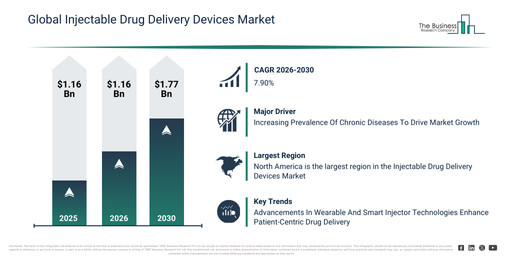
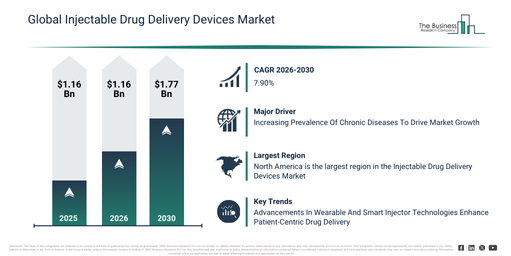
The injectable drug delivery devices market is poised for significant expansion over the coming years. This market is projected to reach $79.51 billion by 2030, exhibiting a compound annual growth rate (CAGR) of 7.9%. The anticipated growth during this forecast period can be attributed to an increasing shift toward self-administration devices, rising demand for personalized drug delivery, the expansion of biologic drug pipelines, growing investments in smart injection technologies, and the increasing adoption of home healthcare solutions. Major trends expected in this period include the increased adoption of prefilled and safety syringes, a rising demand for autoinjectors and pen injectors, the growing use of home-based injectable therapies, the expansion of wearable and implantable infusion pumps, and an enhanced focus on dose accuracy and patient safety.
Get A Free Sample Report With In-Depth Market Insights:
Injectable Drug Delivery Devices Market Growth Drivers: What’s Behind The Acceleration?
The increasing incidence of long-term health conditions is projected to significantly drive the expansion of the injectable drug delivery devices market. A chronic disease is generally defined as an illness lasting for at least three months, with the potential to worsen over time. Injectable drug delivery devices offer a reliable and user-friendly approach for administering medications across prolonged periods. These devices can enhance patient adherence to their prescribed treatment regimens, thereby ensuring effective management of chronic conditions and ultimately leading to improved health outcomes. For instance, in June 2024, according to the National Health Service, a UK-based government department, 3,615,330 individuals registered with a general practitioner (GP) were diagnosed with non-diabetic hyperglycemia or pre-diabetes (a condition with elevated blood sugar levels, not high enough to be classified as diabetes) in 2023, representing an 18% increase from 3,065,825 cases in 2022. Consequently, the rising prevalence of chronic diseases is propelling the growth of the injectable drug delivery devices market going forward.
Injectable Drug Delivery Devices Market Segment Analysis: What Are The Core Market Categories?
The injectable drug delivery devices market covered in this report is segmented –
1) By Type: Syringes, Injectors, Pump
2) By Application: Autoimmune Diseases, Hormonal Disorders, Oncology, Orphan Diseases, Pain Management, Respiratory Therapy, Other Applications
3) By End-user: Hospitals And Clinics, Home Healthcare Settings, Pharmaceutical And Biotechnological Companies, Research Laboratories, Other End Users
Subsegments:
1) By Syringes: Conventional Syringes, Prefilled Syringes, Safety Syringes
2) By Injectors: Autoinjectors, Pen Injectors, Needle-Free Injectors
3) By Pumps: Insulin Pumps, Ambulatory Infusion Pumps, Implantable Pumps
Injectable Drug Delivery Devices Market Trends: What’s Defining The Industry’s Next Phase?
Leading companies in the injectable drug delivery devices market are concentrating on developing advanced solutions, such as wearable and smart injectors, to enhance patient convenience, boost adherence, and facilitate the self-administration of complex therapies. These innovative wearable and smart injector systems are engineered to deliver accurate doses of medications, including biologics and large-volume formulations, while simultaneously reducing discomfort, minimizing user error, and improving the overall treatment experience. For instance, in January 2025, Becton, Dickinson and Company, a US-based medical technology company, introduced several next-generation devices such as the BD Accuspray Nasal Spray System, BD Hylok Glass Prefillable Syringe, BD Effivax Glass Prefillable Syringe, BD Libertas Wearable Injector, BD Evolve On-body Injector, BD Physioject Disposable Autoinjector, and BD Vystra Disposable Pen. These solutions provide user-friendly designs for self-administration, precise and consistent dosing for biologics and vaccines, compatibility with diverse drug formulations, and wearable formats that support large-volume delivery, all while ensuring sterility and safety via disposable components. This product launch underscores the industry’s progression toward advanced, patient-centric injectable drug delivery systems designed to improve adherence, comfort, and therapeutic outcomes.
Injectable Drug Delivery Devices Market Key Participants And Competitive Landscape
Major companies operating in the injectable drug delivery devices market are Becton Dickinson and Company, Baxter International, Gerresheimer AG, Catalent Inc., Antares Pharma, Owen Mumford, West Pharmaceutical Services Inc., B. Braun Melsungen AG, Ypsomed AG, AptarGroup Inc., Nemera, Teleflex Medical, Medtronic, Caplin Steriles Limited, Hovione Technology, Jiangsu Delfu Medical Device Co. Ltd., Terumo Corporation, Roche, Sorrel Medical, Novo Nordisk
View The Full Injectable Drug Delivery Devices Market Report:
Injectable Drug Delivery Devices Market Geographic Analysis: Where Is Demand Rising Fastest?
North America was the largest region in the injectable drug delivery devices market in 2025. Asia-Pacific is expected to be the fastest-growing region in the forecast period. The regions covered in the injectable drug delivery devices market report are Asia-Pacific, South East Asia, Western Europe, Eastern Europe, North America, South America, Middle East, Africa.
Reach Out To Our Team:
The Business Research Company: https://www.thebusinessresearchcompany.com/
Americas: +1 310-496-7795
Asia: +44 7882 955267 & +91 8897263534
Europe: +44 7882 955267
Email us at: marketing@tbrc.info
Follow us on:
LinkedIn: https://in.linkedin.com/company/the-business-research-company
YouTube: https://www.youtube.com/channel/UC24_fI0rV8cR5DxlCpgmyFQ
Global Market Model: https://www.thebusinessresearchcompany.com/global-market-model