Tag: low-dose ct lung screening programs market demand

  • Low-Dose Computed Tomography (CT) Lung Screening Programs Market Size Forecast: How The Industry Is Expected To Grow From 2026 To 2030

    Low-Dose Computed Tomography (CT) Lung Screening Programs Market Size Forecast: How The Industry Is Expected To Grow From 2026 To 2030

    Backed by market attractiveness analysis, total addressable market sizing, company benchmarking matrices, interactive Excel dashboards, wider supply chain intelligence, emerging startup coverage, and detailed product-level insights, The Business Research Company’s 2026 market reports are designed to offer research that is more actionable and strategically valuable than ever.

    Low-Dose Computed Tomography (CT) Lung Screening Programs Market Growth Potential: How Will Market Size Shift Through 2030?

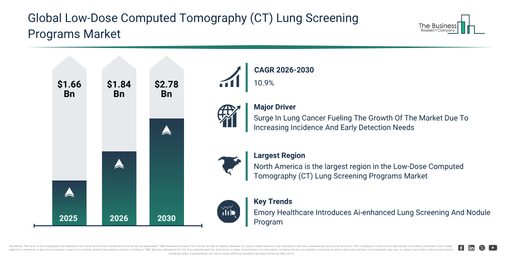
    The low-dose computed tomography (CT) lung screening programs market has witnessed rapid growth in recent years. Its size is expected to increase from $1.66 billion in 2025 to $1.84 billion in 2026, achieving a compound annual growth rate (CAGR) of 10.7%. This historical expansion can be attributed to the rising prevalence of lung cancer cases, increasing awareness about early cancer detection, growing recommendations from clinical guidelines, the expansion of hospital-based screening infrastructure, and increasing healthcare reimbursement support.

    The low-dose computed tomography (CT) lung screening programs market is poised for significant expansion in the coming years. This market is projected to reach $2.78 billion by 2030, exhibiting a compound annual growth rate (CAGR) of 10.9%. Factors contributing to this growth over the forecast period include the increasing integration of AI in CT screening, the broadening of precision oncology efforts, a surge in investments in mobile healthcare models, the greater incorporation of telehealth for consultations, and the development of more public-private collaborations in preventive health. Key developments anticipated during this timeframe involve an increase in government-backed lung cancer screening programs, a higher uptake of mobile screening facilities in remote regions, the enhanced bundling of smoking cessation support with screening, a greater focus on identifying patients based on risk, and the broadening of services for radiology interpretation and subsequent monitoring.

    Get A Free Sample Report With In-Depth Market Insights:

    https://thebusinessresearchcompany.com/sample_request?id=64834292&type=smp&name=Low-Dose%20Computed%20Tomography%20%28CT%29%20Lung%20Screening%20Programs%20Market%20Report%202026&utm_source=Blogs&utm_medium=Paid&utm_campaign=Oct_PR

    Low-Dose Computed Tomography (CT) Lung Screening Programs Market Growth Drivers: What’s Behind The Acceleration?

    The increasing prevalence of lung cancer is a significant factor propelling the expansion of the low-dose computed tomography (CT) lung screening programs market. This disease, a malignancy developing in lung tissue, involves the uncontrolled proliferation of abnormal cells, frequently showing no symptoms until its later stages. Its rising occurrence is largely attributable to ongoing tobacco consumption, supplemented by other risk factors such as exposure to environmental pollutants and workplace carcinogens. Low-dose CT lung screening programs are vital for managing lung cancer, facilitating the early identification of tumors, especially in high-risk individuals like long-term smokers. As an illustration, the Australian Government reported in February 2026 that approximately 15,108 new instances of lung cancer were identified in 2025, constituting 9.0% of all new cancer diagnoses. Consequently, the growing impact of lung cancer is fostering the development of the low-dose computed tomography (CT) lung screening programs market.

    Low-Dose Computed Tomography (CT) Lung Screening Programs Market Segment Breakdown: Which Categories Lead On Revenue?

    The low-dose computed tomography (CT) lung screening programs market covered in this report is segmented –

    1) By Type: Hospital-Based, Independent Imaging Centers, Mobile Screening Units

    2) By Service: Screening Services, Diagnostic Follow-Up Services, Radiology Interpretation Services, Patient Identification And Risk Assessment Services, Program Management Services, Telehealth And Remote Consultation Services

    3) By Technology: Standard Low-Dose CT Screening, AI-Assisted/Computer-Aided Detection (CAD) Screening, Integrated Smoking Cessation And Screening Programs

    4) By Application: Early Detection, Risk Assessment, Follow-Up Monitoring

    5) By End User: Hospitals And Multi-Specialty Clinics, Standalone Diagnostic Imaging Centers, Mobile Screening Service Providers, Government And Public Health Agencies, Private Healthcare Networks And Insurance Providers, Employer And Corporate Wellness Programs, Academic And Research Institutions, Community Health Centers

    Subsegments:

    1) By Hospital-Based: Outpatient Department, Inpatient Department, Radiology Department

    2) By Independent Imaging Centers: Standalone Imaging Clinics, Diagnostic Centers, Specialized Lung Screening Centers

    3) By Mobile Screening Units: Bus-Based Screening Units, Van-Based Screening Units, Temporary Pop-Up Screening Units

    Low-Dose Computed Tomography (CT) Lung Screening Programs Market Trends: What’s Defining The Industry’s Next Phase?

    Leading companies in the low-dose computed tomography (CT) lung screening programs market are concentrating on developing advanced solutions, notably artificial intelligence (AI)–assisted nodule detection, to improve early cancer discovery, enhance diagnostic precision, and streamline patient management. AI-assisted nodule detection specifically utilizes machine-learning algorithms within lung screening programs to automatically identify, characterize, and prioritize pulmonary nodules found on low-dose CT scans, enabling prompt follow-up and intervention. As an illustration, in December 2025, Emory Healthcare, a US-based health system, unveiled the Emory Healthcare Lung Screening and Nodule Program, which incorporates low-dose CT screening with AI-enhanced imaging technology. This program supports multidisciplinary care by integrating advanced diagnostic and treatment options, including robot-assisted bronchoscopy, minimally invasive lung cancer surgery, and coordinated care navigation, thereby facilitating early diagnosis, personalized treatment planning, and improved patient outcomes across several metro Atlanta locations.

    Low-Dose Computed Tomography (CT) Lung Screening Programs Market Key Players Shaping Industry Direction

    Major companies operating in the low-dose computed tomography (CT) lung screening programs market are Hitachi Medical Systems America Inc., Medtronic plc, Siemens Healthineers AG, Koninklijke Philips N.V., GE HealthCare Inc., Mayo Clinic, Columbia University Herbert Irving Comprehensive Cancer Center, Duke University Health System, Emory Healthcare, Canon Medical Systems Corporation, RadNet Inc., University of Tennessee Medical Center, McLeod Health, Holy Cross Health, Lima Memorial Health System, Memorial Sloan Kettering Cancer Center, Independence Health System, Weill Cornell Medicine & NewYork-Presbyterian Mobile Unit, Optellum Ltd., 4DMedical Pty Ltd.

    View The Full Low-Dose Computed Tomography (CT) Lung Screening Programs Market Report:

    https://thebusinessresearchcompany.com/report/low-dose-computed-tomography-ct-lung-screening-programs-market-report?utm_source=Blogs&utm_medium=Paid&utm_campaign=Oct_PR

    Low-Dose Computed Tomography (CT) Lung Screening Programs Market Regional Analysis: Which Geography Leads On Revenue?

    North America was the largest region in the low-dose computed tomography (CT) lung screening programs market in 2025. Asia-Pacific is expected to be the fastest-growing region in the forecast period. The regions covered in the low-dose computed tomography (CT) lung screening programs market report are Asia-Pacific, South East Asia, Western Europe, Eastern Europe, North America, South America, Middle East, Africa.

    Reach Out To Our Team:

    The Business Research Company: https://www.thebusinessresearchcompany.com/

    Americas: +1 310-496-7795

    Asia: +44 7882 955267 & +91 8897263534

    Europe: +44 7882 955267

    Email us at: marketing@tbrc.info

    Follow us on:

    LinkedIn: https://in.linkedin.com/company/the-business-research-company

    YouTube: https://www.youtube.com/channel/UC24_fI0rV8cR5DxlCpgmyFQ

    Global Market Model: https://www.thebusinessresearchcompany.com/global-market-model
  • Low-Dose Computed Tomography (CT) Lung Screening Programs Market Forecast Indicating Stable Growth Toward $2.77 Billion By 2030

    Low-Dose Computed Tomography (CT) Lung Screening Programs Market Forecast Indicating Stable Growth Toward $2.77 Billion By 2030

    The Business Research Company’s 2026 market reports feature enhanced tools like market attractiveness analysis, TAM assessment, and company scoring matrices, along with interactive dashboards, deeper supply chain insights, and startup coverage strengthening the depth, usability, and strategic value of insights.

    How Much Will The Market Value Of The Low-Dose Computed Tomography (CT) Lung Screening Programs Market Grow Between 2026 And 2030?

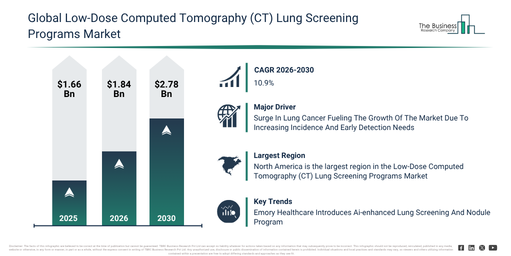
    The market size for low-dose computed tomography (CT) lung screening programs has witnessed substantial growth in recent years. This market is anticipated to expand from $1.66 billion in 2025 to $1.84 billion in 2026, demonstrating a compound annual growth rate (CAGR) of 10.7%. The increase observed historically can be ascribed to the increasing occurrence of lung cancer cases, greater understanding of the importance of early cancer detection, stronger endorsements from clinical guidelines, the development of hospital-based screening infrastructure, and enhanced healthcare reimbursement assistance.

    The market for low-dose computed tomography (CT) lung screening programs is projected to experience substantial expansion over the coming years. This market is anticipated to reach a valuation of $2.78 billion by 2030, driven by a compound annual growth rate (CAGR) of 10.9%. Factors contributing to this growth during the forecast period include the increasing uptake of AI-assisted CT screening, the broadening of precision oncology initiatives, heightened investment in mobile healthcare delivery systems, greater incorporation of telehealth consultation services, and an increase in public-private collaborations in preventive healthcare. Key trends expected over this period involve the enlargement of government-funded lung cancer screening programs, more widespread use of mobile screening units in remote regions, enhanced integration of smoking cessation support alongside screening, a stronger focus on risk-stratified patient identification, and the expansion of radiology interpretation and subsequent monitoring services.

    Access Your Free Sample Report For In-Depth Market Analysis:

    https://www.thebusinessresearchcompany.com/sample_request?id=64006196&type=smp&name=Low-Dose%20Computed%20Tomography%20%28CT%29%20Lung%20Screening%20Programs%20Market%20Report%202026

    What Primary Drivers Are Shaping The Low-Dose Computed Tomography (CT) Lung Screening Programs Market?

    The increasing prevalence of lung cancer is projected to propel the expansion of the low-dose computed tomography (CT) lung screening programs market in the coming years. Lung cancer, a severe disease originating in lung tissue, involves the uncontrolled proliferation of abnormal cells and frequently shows no symptoms until it has advanced significantly. Its growing occurrence is predominantly linked to prolonged tobacco consumption, along with contributing factors like environmental air pollution and workplace carcinogens. These low-dose CT lung screening initiatives are vital for managing lung cancer, facilitating the early discovery of tumors in vulnerable groups, especially those who smoke long-term. A notable example is the data from February 2026, where the Australian Government reported approximately 15,108 new lung cancer diagnoses in 2025, representing 9.0% of all new cancer cases. Consequently, the escalating impact of lung cancer is a key factor driving the growth of the low-dose computed tomography (CT) lung screening programs market.

    Which Segment Categories Are Included In The Low-Dose Computed Tomography (CT) Lung Screening Programs Market Segment Analysis?

    The low-dose computed tomography (CT) lung screening programs market covered in this report is segmented –

    1) By Type: Hospital-Based, Independent Imaging Centers, Mobile Screening Units

    2) By Service: Screening Services, Diagnostic Follow-Up Services, Radiology Interpretation Services, Patient Identification And Risk Assessment Services, Program Management Services, Telehealth And Remote Consultation Services

    3) By Technology: Standard Low-Dose CT Screening, AI-Assisted/Computer-Aided Detection (CAD) Screening, Integrated Smoking Cessation And Screening Programs

    4) By Application: Early Detection, Risk Assessment, Follow-Up Monitoring

    5) By End User: Hospitals And Multi-Specialty Clinics, Standalone Diagnostic Imaging Centers, Mobile Screening Service Providers, Government And Public Health Agencies, Private Healthcare Networks And Insurance Providers, Employer And Corporate Wellness Programs, Academic And Research Institutions, Community Health Centers

    Subsegments:

    1) By Hospital-Based: Outpatient Department, Inpatient Department, Radiology Department

    2) By Independent Imaging Centers: Standalone Imaging Clinics, Diagnostic Centers, Specialized Lung Screening Centers

    3) By Mobile Screening Units: Bus-Based Screening Units, Van-Based Screening Units, Temporary Pop-Up Screening Units

    Which Trends Are Impacting The Progress Of The Low-Dose Computed Tomography (CT) Lung Screening Programs Market?

    Leading companies within the low-dose computed tomography (CT) lung screening programs market are prioritizing the development of sophisticated solutions, particularly artificial intelligence (AI)–assisted nodule detection, to improve early cancer detection, elevate diagnostic precision, and optimize patient management. AI-assisted nodule detection involves the application of machine-learning algorithms in lung screening initiatives to automatically identify, characterize, and prioritize pulmonary nodules on low-dose CT scans, thereby facilitating prompt follow-up and intervention. For instance, in December 2025, Emory Healthcare, a US-based health system, inaugurated the Emory Healthcare Lung Screening and Nodule Program, which merges low-dose CT screening with AI-enhanced imaging technology. This program supports multidisciplinary care through the incorporation of advanced diagnostic and treatment capabilities, including robot-assisted bronchoscopy, minimally invasive lung cancer surgery, and coordinated care navigation, leading to early diagnosis, tailored treatment planning, and enhanced patient outcomes across multiple metro Atlanta locations.

    Who Are The Active Companies Shaping The Low-Dose Computed Tomography (CT) Lung Screening Programs Market?

    Major companies operating in the low-dose computed tomography (CT) lung screening programs market are Hitachi Medical Systems America Inc., Medtronic plc, Siemens Healthineers AG, Koninklijke Philips N.V., GE HealthCare Inc., Mayo Clinic, Columbia University Herbert Irving Comprehensive Cancer Center, Duke University Health System, Emory Healthcare, Canon Medical Systems Corporation, RadNet Inc., University of Tennessee Medical Center, McLeod Health, Holy Cross Health, Lima Memorial Health System, Memorial Sloan Kettering Cancer Center, Independence Health System, Weill Cornell Medicine & NewYork-Presbyterian Mobile Unit, Optellum Ltd., 4DMedical Pty Ltd.

    Get The Full Low-Dose Computed Tomography (CT) Lung Screening Programs Market Report:

    https://www.thebusinessresearchcompany.com/report/low-dose-computed-tomography-ct-lung-screening-programs-market-report

    Which Region Holds The Highest Market Share In The Low-Dose Computed Tomography (CT) Lung Screening Programs Market?

    North America was the largest region in the low-dose computed tomography (CT) lung screening programs market in 2025. Asia-Pacific is expected to be the fastest-growing region in the forecast period. The regions covered in the low-dose computed tomography (CT) lung screening programs market report are Asia-Pacific, South East Asia, Western Europe, Eastern Europe, North America, South America, Middle East, Africa.

    Request A Customized Low-Dose Computed Tomography (CT) Lung Screening Programs Market Report For Competitive Insights:

    https://www.thebusinessresearchcompany.com/Customise?id=64006196&name=Low-Dose%20Computed%20Tomography%20%28CT%29%20Lung%20Screening%20Programs%20Market%20Report%202026&type=smp

    Browse Through More Reports Similar to the Global Low-Dose Computed Tomography (CT) Lung Screening Programs Market 2026, By The Business Research Company

    pruritus therapeutic market report 2026

    https://www.thebusinessresearchcompany.com/report/pruritus-therapeutic-global-market-report

    genomic urine testing market report 2026

    https://www.thebusinessresearchcompany.com/report/genomic-urine-testing-global-market-report

    ocular genetic diagnostic market report 2026

    https://www.thebusinessresearchcompany.com/report/ocular-genetic-diagnostic-global-market-report

    Get in touch with us:

    The Business Research Company: https://www.thebusinessresearchcompany.com/

    Americas +1 310-496-7795

    Asia +44 7882 955267 & +91 8897263534

    Europe +44 7882 955267

    Email us at marketing@tbrc.info

    Follow us on:

    LinkedIn: https://in.linkedin.com/company/the-business-research-company

    YouTube: https://www.youtube.com/channel/UC24_fI0rV8cR5DxlCpgmyFQ

    Global Market Model: https://www.thebusinessresearchcompany.com/global-market-model