Backed by market attractiveness analysis, total addressable market sizing, company benchmarking matrices, interactive Excel dashboards, wider supply chain intelligence, emerging startup coverage, and detailed product-level insights, The Business Research Company’s 2026 market reports are designed to offer research that is more actionable and strategically valuable than ever.
Lysosomal Disease Treatment Market Value Analysis: What Growth Lies Ahead Over The Forecast Period?
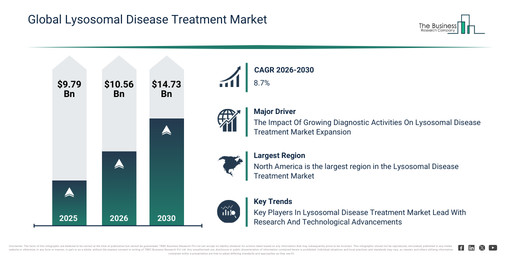
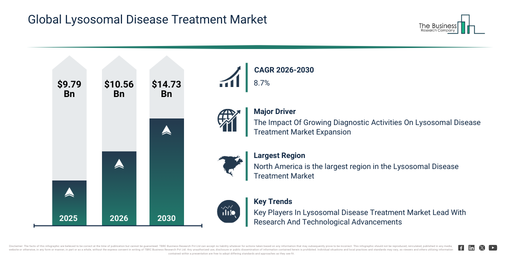
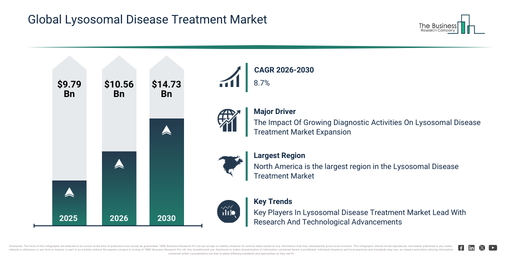
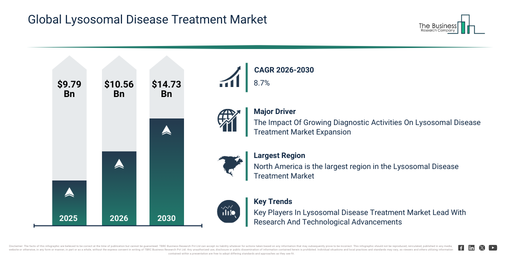
The lysosomal disease treatment market size has demonstrated robust expansion in recent years. Projections indicate it will increase from $9.79 billion in 2025 to $10.56 billion in 2026, at a compound annual growth rate (CAGR) of 7.9%. This historical growth can be ascribed to advancements in enzyme replacement therapies, heightened awareness of lysosomal storage disorders, the expansion of pediatric care infrastructure, government funding for rare disease research, and the emergence of diagnostic technologies.
The lysosomal disease treatment market is projected to experience substantial expansion in the coming years. It is set to reach $14.73 billion by 2030, exhibiting a compound annual growth rate (CAGR) of 8.7%. This anticipated growth is primarily driven by factors such as the increasing reach of personalized medicine, the growing embrace of gene therapy, heightened investments within the biotechnology sector, improvements in healthcare infrastructure across emerging markets, and collaborative efforts for developing drugs for rare diseases. Key trends anticipated during this period involve the creation of focused enzyme replacement therapies, enhanced diagnostic abilities for rare diseases, the expansion of treatment initiatives for both pediatric and adult patients, an increase in customized and precision medicine strategies, and a surge in partnerships between pharmaceutical companies and research institutions.
Get A Free Sample Report With In-Depth Market Insights:
Lysosomal Disease Treatment Market Growth Drivers: What’s Behind The Acceleration?
The expansion of diagnostic procedures is anticipated to fuel the rise of the lysosomal disease treatment market. These activities involve structured processes and examinations designed to pinpoint and evaluate issues, states, or illnesses in people or systems, frequently requiring data gathering and analysis to guide decisions and therapeutic approaches. The increasing scope of diagnostics is driven by progress in medical technology, the escalating occurrence of chronic illnesses, a greater need for preventive medicine, enhanced public understanding and knowledge of health matters, and favorable government support and financial backing for healthcare programs. With enhanced sophistication, diagnostic methods allow healthcare professionals to detect lysosomal diseases with greater precision, leading to increased capital allocation for specific therapies and interventions. For example, in May 2023, data from the National Health Service (NHS), a UK-based publicly funded healthcare system, showed that 2,302,400 diagnostic tests were carried out in March 2023, marking a rise of 223,100 tests from March 2022. By the end of March 2023, the count of individuals awaiting a critical diagnostic test stood at 1,628,300, which was an increase of 59,400 over March 2022. Consequently, the expansion in diagnostic activities is a key impetus for the growth of the lysosomal disease treatment market.
Lysosomal Disease Treatment Market Segment Trends And Revenue Contributors
The lysosomal disease treatment market covered in this report is segmented –
1) By Disease Type: Mucopolysaccharidosis, Pompe Syndrome, Fabry Diseases, Gaucher’s Disease, Other Disease Types
2) By Therapy: Substrate Reduction Therapy, Stem Cell Therapy, Enzyme Replacement Therapy, Other Therapies
3) By Route Of Administration: Oral, Parenteral, Other Routes Of Administration
4) By End User: Hospitals, Specialty Clinics, Homecare, Other End Users
Subsegments:
1) By Mucopolysaccharidosis: MPS I (Hurler Syndrome), MPS II (Hunter Syndrome), MPS III (Sanfilippo Syndrome), MPS IV (Morquio Syndrome), MPS VI (Maroteaux-Lamy Syndrome), MPS VII (Sly Syndrome)
2) By Pompe Syndrome: Late-Onset Pompe Disease, Infantile-Onset Pompe Disease
3) By Fabry Disease: Classic Fabry Disease, Late-Onset Fabry Disease
4) By Gaucher’s Disease: Type 1 Gaucher Disease, Type 2 Gaucher Disease, Type 3 Gaucher Disease
5) By Other Disease Types: Niemann-Pick Disease, Krabbe Disease, Tay-Sachs Disease
Lysosomal Disease Treatment Market Trends: What’s Defining The Industry’s Next Phase?
Key companies within the lysosomal diseases treatment market are concentrating on progress in research and technology to reinforce their market position. Such advancements denote ongoing development and enhancements across scientific exploration and technological capacities. Illustratively, in September 2023, Amicus Therapeutics, an American biopharmaceutical firm, declared that the U.S. Food and Drug Administration (FDA) granted approval for Pombiliti (cipaglucosidase alfa-atga) combined with Opfolda (miglustat) 65mg capsules to manage late-onset Pompe disease (LOPD) in adult patients. This Pombiliti + Opfolda regimen constitutes a two-component therapeutic approach, comprising cipaglucosidase alfa-atga, which is a bis-M6P-enriched rhGAA promoting strong uptake via the M6P receptor, alongside miglustat, an oral enzyme stabilizer developed to mitigate the reduction of enzyme activity within the bloodstream.
Lysosomal Disease Treatment Market Competitive Landscape: Which Companies Lead The Industry?
Major companies operating in the lysosomal disease treatment market are Eli Lilly and Company, Takeda Pharmaceutical Company Limited, Sanofi SA, Pfizer Inc., Novartis International AG, Johnson & Johnson Services Inc., Alexion Pharmaceuticals Inc., Amicus Therapeutics Inc., Actelion Pharmaceuticals Ltd., Sigilon Therapeutics Inc., BioMarin Pharmaceutical Inc., Merck & Co Inc., AstraZeneca PLC, Astellas Pharma Inc., Horizon Therapeutics plc, Leadient Biosciences Inc., Orphazyme A/S, Recordati Industria Chimica e Farmaceutica S.p.A., Valerion Therapeutics Llc, Viatris Inc., Chiese Farmaceutici SpA, Genzyme Corporation, Ultragenyx Pharmaceutical Inc., Sangamo Therapeutics Inc., Avrobio Inc., Axovant Gene Therapies Ltd., Regenxbio Inc., Krystal Biotech Inc., Homology Medicines Inc., Orchard Therapeutics plc, Sarepta Therapeutics Inc., Solid Biosciences Inc.
View The Full Lysosomal Disease Treatment Market Report:
Lysosomal Disease Treatment Market Regional Analysis And Leading Geography
North America was the largest region in the lysosomal disease treatment market in 2025. Europe is expected to be the fastest-growing region in the global lysosomal disease treatment market report during the forecast period. The regions covered in the lysosomal disease treatment market report are Asia-Pacific, South East Asia, Western Europe, Eastern Europe, North America, South America, Middle East, Africa.
Reach Out To Our Team:
The Business Research Company: https://www.thebusinessresearchcompany.com/
Americas: +1 310-496-7795
Asia: +44 7882 955267 & +91 8897263534
Europe: +44 7882 955267
Email us at: marketing@tbrc.info
Follow us on:
LinkedIn: https://in.linkedin.com/company/the-business-research-company
YouTube: https://www.youtube.com/channel/UC24_fI0rV8cR5DxlCpgmyFQ
Global Market Model: https://www.thebusinessresearchcompany.com/global-market-model